
Japan’s offshore wind law decides which sea areas can host projects, which developer gets each site, for how long, and at what power price. Known in English as the Renewable Sea Area Act or the Marine Renewable Energy Act, it took a new Japanese title on 1 April 2026, and its reach extended from territorial waters into Japan’s exclusive economic zone (EEZ). Of the 12 promotion zones designated since the law took effect in 2019, one hosts an operating project as of November 2026: the 16.8 MW floating array off Goto, Nagasaki. This guide sets out what the amendment changed and how developers will be chosen in the EEZ.
The amending act was promulgated on 11 June 2025 and took effect on 1 April 2026. It renamed the law and extended it beyond the 12-nautical-mile territorial sea into the EEZ, which reaches 200 nautical miles from shore.
In territorial waters, the state designates a zone, runs a tender and scores bids to pick one developer. In the EEZ, the state opens a “recruitment area” and reviews applications. Plans are compared only when applicants ask for overlapping sites.
Of 12 promotion zones, one hosts an operating project. Three Round 1 zones are waiting for a re-tender after the winning consortium withdrew in 2025. Rounds 2 and 3 total about 2.9 GW and are scheduled to start operating by 2030.
👉 Background: Japan’s offshore wind policy framework
What Changed on 1 April 2026: A New Title and the EEZ
The law (Act No. 89 of 2018) was promulgated on 7 December 2018 and took effect on 1 April 2019. It gave Japan its first national rulebook for occupying general sea areas with power plants for up to three decades. Before it, developers negotiated site by site with port authorities and fishing cooperatives, with no clear path to a long-term permit.
The 2025 amendment (Act No. 59 of 2025) changed three things.
| Item | April 2019 to March 2026 | From April 2026 |
|---|---|---|
| Japanese title | Act on promoting the use of sea areas for marine renewable energy facilities | Act on the development of marine renewable energy facilities |
| Geographic scope | Territorial sea and internal waters | Territorial sea, internal waters and the EEZ |
| Environmental survey | Each developer runs the full impact assessment | The Environment Minister surveys the area before designation |
Japan’s territorial sea extends 12 nautical miles (about 22 km) from the coast. The EEZ runs to 200 nautical miles (about 370 km), and gives Japan sovereign rights over resources such as fish and energy. Japan has little shallow water near its coast. Much of its remaining wind resource sits in deep water far from shore, which is why the EEZ matters.
The survey change shifts early environmental work to the state. After the ministers survey a candidate area, the Environment Minister conducts a marine environment survey and publishes the results. A developer selected by tender then skips the scoping stages of Japan’s Environmental Impact Assessment Act, the steps that decide what to study and how. Zones designated before April 2026, and areas where the state survey had already started, stay under the old rules.
How large the EEZ opening is, and how much of it is practical for floating wind, is covered in a separate analysis.
👉 Japan Expands Offshore Wind to the EEZ: What the 2026 Law Change Means
Route 1, Territorial Waters: Zone Designation, Then a Scored Tender
Inside the territorial sea, the Minister of Economy, Trade and Industry (METI) and the Minister of Land, Infrastructure, Transport and Tourism (MLIT) designate promotion zones: sea areas the state has decided to tender. Article 10 sets seven tests. Wind and sea conditions must suit generation. Shipping lanes and ports must not be disrupted, and a nearby port must be usable for construction and maintenance. A grid connection must be in prospect. Fisheries must not be harmed. Since April 2026, the marine environment must not be put at risk. The zone must not overlap fishing-port, port or coastal-protection areas.
Once a zone is designated, the ministers publish public tender guidelines with a ceiling on the power price and the scoring rules. Bidders submit an occupancy plan covering price, construction timing, ports, decommissioning and financing. The winner can occupy the site for up to 30 years, and that window includes construction and removal. The scoring was revised in June 2026. Price and project feasibility keep the 120 points each they carried in Rounds 2 and 3. Within feasibility, points for speed fall and execution and supply-chain plans gain. Bids below a set threshold all receive full price points, so cutting further earns nothing.
👉 Japan’s Offshore Wind Auction Reform: How Price, Deliverability and Schedule Scoring Change
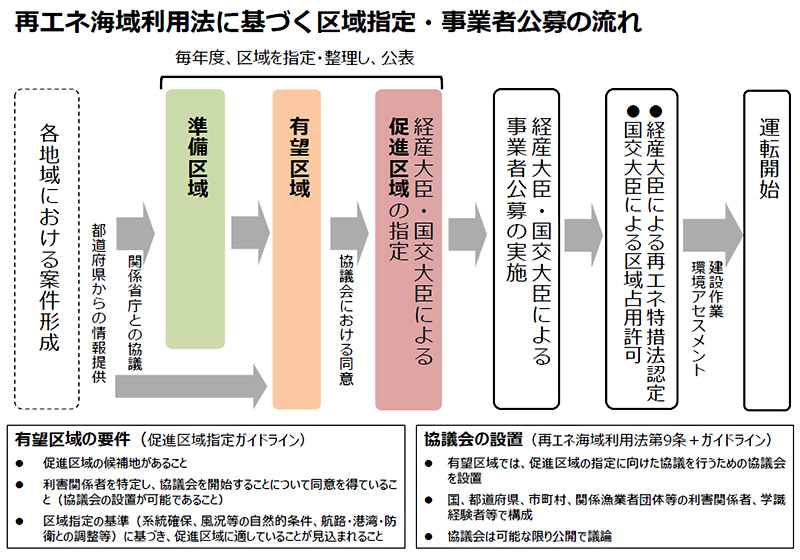
Figure 1: From candidate area to selected developer (territorial waters)
A local council of government, municipalities and fishers meets in a promising area before the zone is designated and tendered.
Source: METI Agency for Natural Resources and Energy
Two earlier stages feed the pipeline. A promising area is a candidate where a council of national and local government, fishers and other users works toward designation. A preparation area is one where information is still being gathered.
Route 2, the EEZ: Four Steps From Recruitment Area to Permit
Chapter 4 of the amended law creates a separate procedure for the EEZ.
- Recruitment area. METI designates an EEZ area open to applicants and sets the power price ceiling, minimum capacity and application window.
- Provisional permit. Developers apply with a draft installation plan. If the plan meets the criteria, METI and MLIT grant a provisional status valid for up to five years.
- Council. For each area with a provisional permit holder, the ministers convene a council with the developer, fishing organisations and other stakeholders. The developer must align its plan with what the council agrees.
- Permit. The developer applies for the installation permit. It is granted if six tests are met: port access, grid connection, consistency with the council’s agreement, navigation, fisheries and project certainty.
The selection logic is the largest difference. If an application does not overlap with any other, METI and MLIT check it against the criteria. Only when sites overlap do they compare plans and pick the “most appropriate”. In the territorial sea, by contrast, several bidders compete for one zone and the highest score wins. In the EEZ, whether competition happens at all depends on where applicants draw their boundaries.
The order of checks also changes. For a promotion zone, the state confirms port access, grid prospects and fisheries before designation. A recruitment area needs only three tests at designation: natural conditions, no clear harm to fisheries, and low risk to the marine environment. Ports, grid and navigation are tested at the final permit stage. In practice, the developer carries those risks during the provisional period of up to five years.
| Item | Territorial waters (promotion zone) | EEZ (recruitment area) |
|---|---|---|
| Who designates | METI and MLIT | METI |
| How the developer is chosen | Scored tender, one winner | Application review; comparison only if sites overlap |
| Port and grid checks | Before designation, by the state | At the permit stage, on the developer’s plan |
| Term | Occupancy up to 30 years | Provisional permit up to 5 years; permit term set by the ministers |
As of November 2026, DeepWind has found no public announcement of a designated EEZ recruitment area. The price ceiling attached to the first one will be the first real test of how this route works. The deep-water floating demonstration that the government is preparing is analysed separately.
👉 Deepwater Offshore Wind in Japan: The 500-Metre Demonstration and Its 240 MW Condition
12 Promotion Zones, One Operating Project: Why the Count Diverges
An MLIT map dated April 2026 counts 12 promotion zones, 9 promising areas and 17 preparation areas. It also lists 6 projects inside port areas and 7 designated base ports, the harbours where turbine components are stored and pre-assembled.
Only one project selected under this law is generating: the 16.8 MW floating array off Goto, Nagasaki, which began operating in January 2026. The other three Round 1 zones, off Akita and Chiba, lost their developer in August 2025, when a Mitsubishi Corporation-led consortium withdrew from about 1,742 MW. Those zones are waiting for a re-tender.
👉 Why Japan’s Offshore Wind Round 1 Ended in Withdrawal
Rounds 2 and 3 add about 2.9 GW, scheduled to start operating by 2030, according to Ministry of the Environment material. Pressure is visible there too. In July 2026, Japanese media reported that bp was considering leaving the Round 3 Yuza project in Yamagata. The law moves zones from designation to a named developer. What happens next depends on whether the price fixed at the tender still covers construction cost.
Some of that gap is being addressed outside the law. Round 2 and 3 projects that give up any premium above market prices, known as zero-premium projects, are set to be allowed into the Long-Term Decarbonization Auction (LTDA). The LTDA is a capacity auction that funds the fixed costs of new low-carbon plants over long periods. The rule is in the draft FY2026 auction guidelines.
The 30-year occupancy cap includes construction and decommissioning. Yuza (450 MW) plans to occupy its site from April 2028 to December 2055, with commercial operation from June 2030. That leaves at most about 25.5 years of revenue before removal must begin. Debt tenor and revenue assumptions have to fit inside that window. In February 2026, the government said it would in principle allow Round 2 and 3 permits to be renewed. The initial term, however, remains capped at 30 years.
The bigger change in 2026 is not the new title but the new way of choosing developers in the EEZ.
In the territorial sea, the scored tender rewarded low prices, and the Round 1 winner later said its prices no longer covered rising costs. The June 2026 revision responded by capping the points a lower price can earn. The EEZ route avoids a price contest unless applicants overlap. That should ease the race to the bottom. It also moves the hard questions of port access and grid connection to the developer, during a provisional period of up to five years.
Two numbers will show whether the route works: the price ceiling on the first recruitment area, and how many applications overlap. Consider the route promising if the ceiling reflects deep-water floating costs. Exercise caution if it does not, because an area can be open in law and still attract no applicants. Readers should also track whether floating supply chains and base ports are ready in the same years.
Frequently Asked Questions
Related DeepWind Articles
- Japan’s Offshore Wind Policy & Regulatory Framework Explained
- Japan Expands Offshore Wind to the EEZ: What the 2026 Law Change Means
- Japan’s Offshore Wind Promotion Zone Guideline Revision (March 2026)
- Japan’s Offshore Wind Promotion Zones: A Complete Project List and Structural Market Analysis
- Japan’s Floating Wind Base Ports Cannot Work Alone: MLIT Sets a 2-Year Build Target
- France’s 10 GW AO10 auction and the grid, curtailment and wake risks Japan’s bidders carry
DeepWind Weekly tracks Japan’s offshore wind market beyond headline announcements, focusing on execution risk, cost structure, project viability, supply-chain constraints, and policy implications.
Subscribe to receive weekly intelligence on Japan’s offshore wind market.
Free reportWhich of April’s planning assumptions no longer hold? Our 17-page review of Japan’s offshore wind market, April to September 2026. Free when you subscribe to the Weekly. See what’s inside →