
Japan Offshore Wind Auction Outside the Sea Area Act: A Secret Ceiling After Three Rounds With No Winner
Japan opens its fourth FIT/FIP auction for fixed-bottom offshore wind outside the Renewabl…
Understand what offshore wind costs in Japan, how economics vary by site, and which revenue and financing terms make a project viable.
Connect CAPEX, OPEX, LCOE and revenue schemes before examining individual projects.
Understand construction costs, operating costs and LCOE.
Compare LCOE and returns across Japan’s offshore wind zones.
Examine revenue conditions and project-specific cost assumptions.
Examine the gap between bidding terms and project economics.
Explore how cost, WACC and revenue assumptions affect the results.
Explore the Viability Simulator →Japan opens its fourth FIT/FIP auction for fixed-bottom offshore wind outside the Renewabl…
BP is reportedly exiting Japan’s 450 MW Yuza offshore wind project. The deeper issue is structural: why a zero-premium Round 3 award is hard to finance — and how the LTDA could change it.
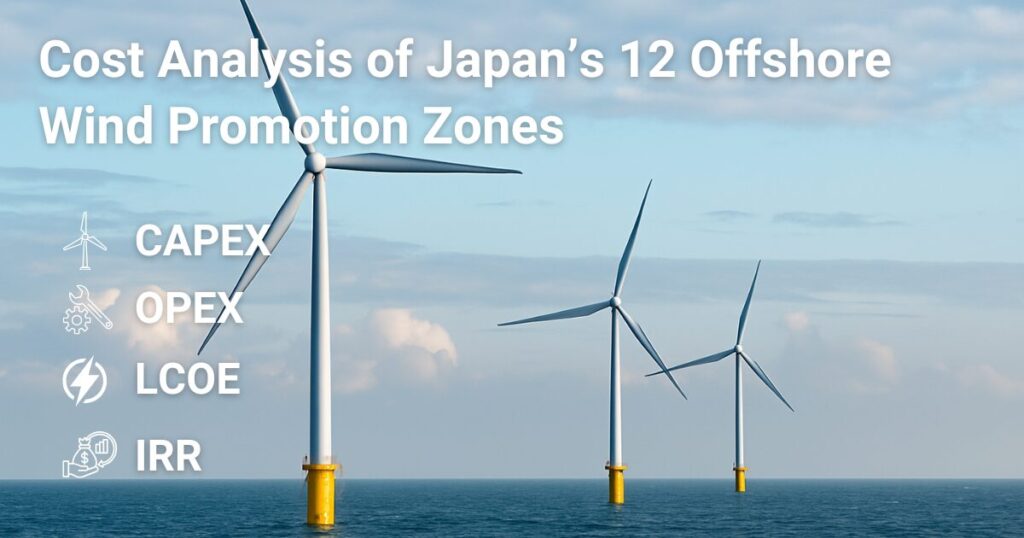
Japan’s 12 offshore wind promotion zones compared on LCOE and IRR using DeepWind’s cost model. Akita and Yamagata lead; Hokkaido faces structural constraints driven by wind, water depth, and grid distance. All zones on common assumptions.
Japan’s fixed-bottom offshore wind costs about ¥908,000/kW in a developer survey, with installation near a third. How to read CAPEX, OPEX and LCOE.
At ¥908,000/kW, Japan’s fixed-bottom offshore wind costs about ¥20 to ¥41/kWh depending on assumptions. How CAPEX, yield, capital and price interact.
Goto’s construction cost is undisclosed. Working back from its JPY 36/kWh tariff, 20 years of revenue can repay about JPY 530,000 to 1.18 million per kW.
Japan’s nine offshore wind promising zones compared on LCOE and IRR under the same assumptions as the promotion zones. Sakata undercuts every promotion zone; Gan-wu-Minami-goshi fails despite the shortest grid run.