
Published: September 2, 2025
Last updated: February 12, 2026
Introduction
Evaluating the profitability of offshore wind projects requires close attention to cost-related indicators such as CAPEX, OPEX, LCOE, and IRR.
However, in Japan’s designated Promotion Zones, publicly available cost data remain scarce, leaving investors and developers with limited information for decision-making.
In this article, we assess the Goto City Offshore Floating Wind, estimating CAPEX, OPEX, LCOE, and IRR using on DeepWind’s proprietary cost model which references the NEDO cost model and international benchmarks, based on representative site conditions including distance to shore, water depth, and distance to port.
While these figures are independent estimates, they provide useful insights into the characteristics of this zone and a basis for relative comparison with other areas.
This article focuses not on project progress or policy background, but on the cost analysis. If you would like to learn more about the project overview of the Goto City Offshore Floating Wind Project, please see the article below.
👉 Goto City Offshore Floating Wind Project
Note: This article presents an indicative analysis based on the cost model and assumptions available at the time of writing.
For the latest cost assumptions and updated relative positioning of projects, please refer to the following Pillar article.
👉 Cost Realities of Japan’s Offshore Wind: Analyzing LCOE and IRR Across 12 Promotion Zones
1. Area Overview
- Area Name: Nagasaki Goto City Offshore
- Location: Southeast Offshore, Nagasaki
- Estimated Capacity: 16.8 MW
- Status: Promotion Zone
- Developer: Toda Corporation, ENEOS, Osaka Gas, INPEX, Kansai Electric Power, Chubu Electric Power
2. Assumptions (Representative Values)
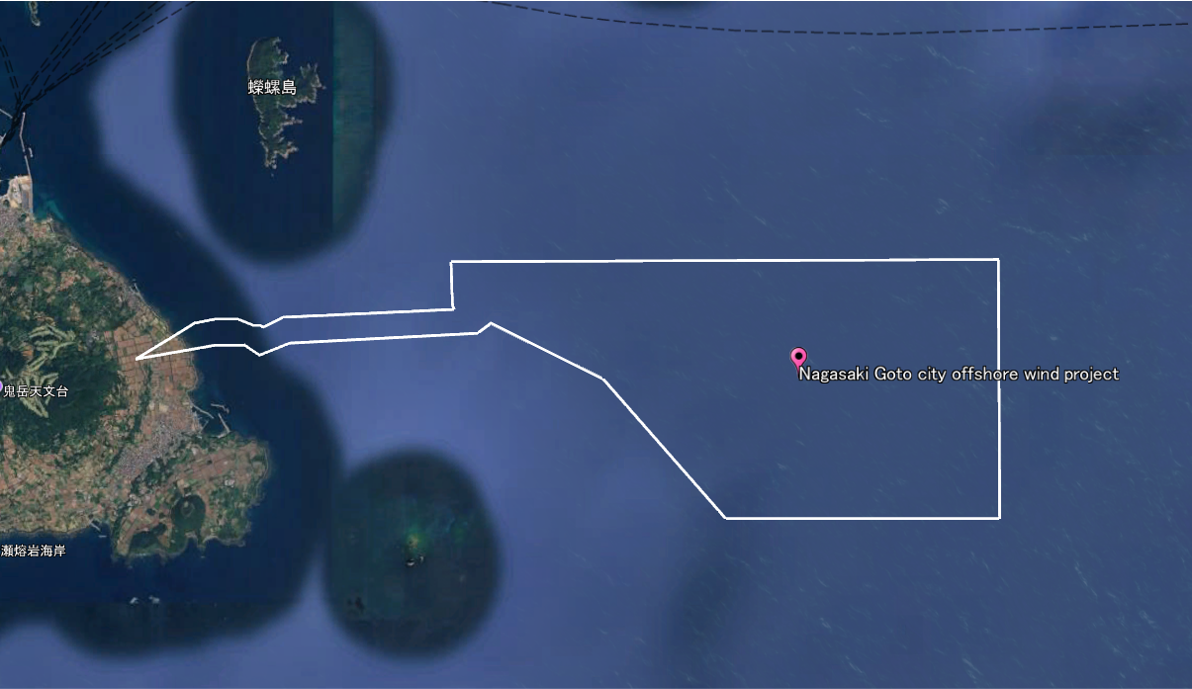
In this article, the representative point was set at the center of the designated promotion area polygon based on its coordinates. Water depth and distance conditions were estimated using data from NeoWins.
| Item | Estimated Value | Notes |
|---|---|---|
| Water Depth (m) | 131 m | Depth at representative point |
| Distance to Shore (km) | 7.0 km | Shortest distance to landfall point |
| Distance to Port (km) | 10.8 km | Straight-line distance to assumed O&M port |
3. CAPEX / OPEX Estimates
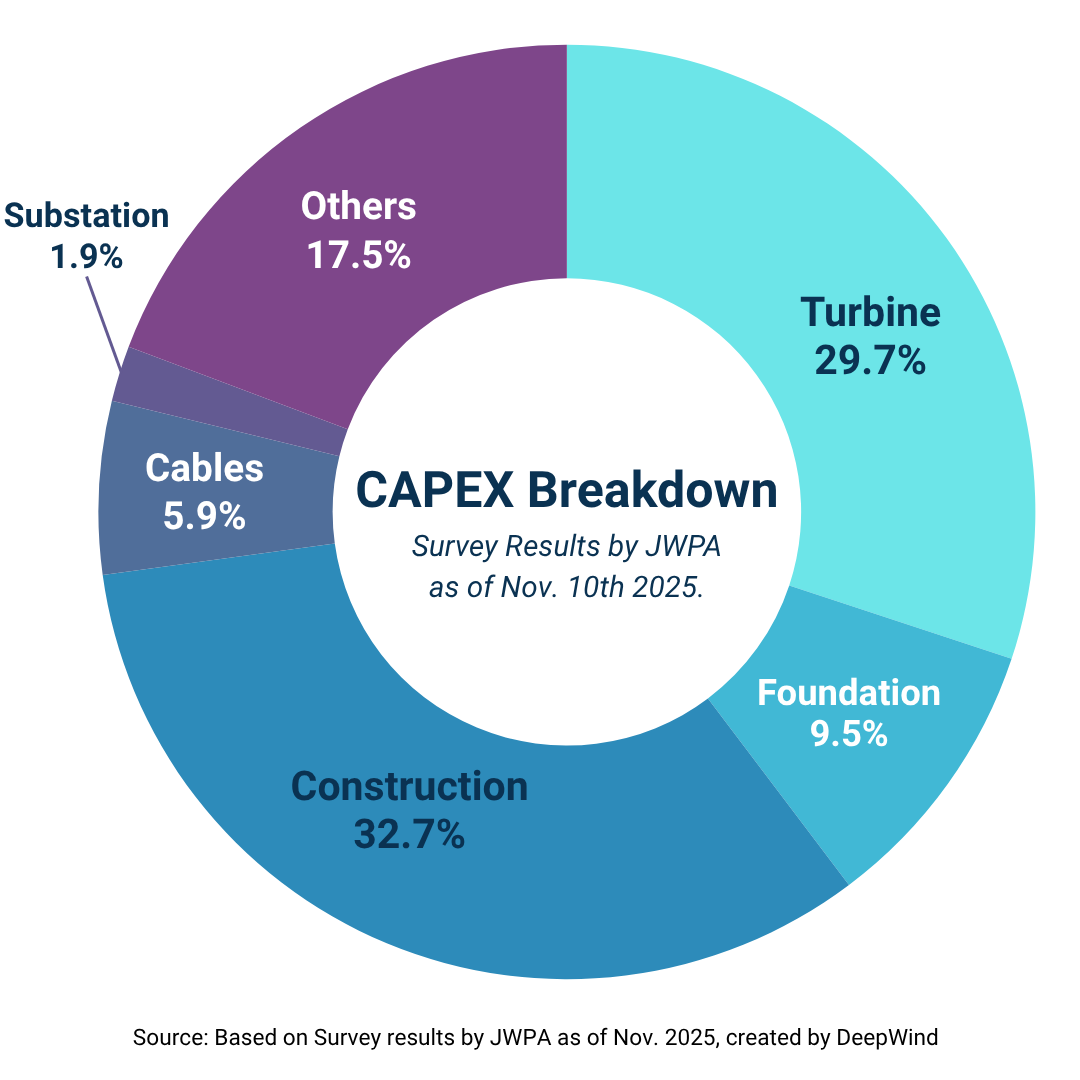
CAPEX and OPEX were independently estimated by DeepWind with reference to JWPA’s developer survey results and international benchmarks.
| Floating type | Estimated CAPEX | Estimated OPEX |
|---|---|---|
| Spar | Approx. JPY 22.5 B | Approx. JPY 200 M per year |
4. LCOE Estimate
The LCOE was independently estimated by DeepWind cost model and NeoWins data.
| Floating type | Gross CF | WACC | Estimated LCOE |
|---|---|---|---|
| Spar | 31% | 3% | 41.4 JPY/kWh |
5. IRR Estimate
| Price conditions | Estimated IRR | Power Selling Price | Assumed Operating Period |
|---|---|---|---|
| Bid Price | 1.6 % | 36 JPY/kWh | 25 years |
| Breakeven Price | 3.0% | 41.4 JPY/kWh | 25 years |
6. Profitability Rating (DeepWind Independent Evaluation)
| Evaluation Metric | Score (★1–5) | Result |
|---|---|---|
| Profitability (Bid Price) | ★-★★ | Unviable – Challenging |
| Overall Rating | D – C Rank | Unprofitable under current conditions; major cost reductions or technological innovation needed. |
Conclusion
In this analysis, we reviewed the cost structure of the floating offshore wind project off Goto City, Nagasaki, and evaluated its profitability from the perspectives of CAPEX, OPEX, LCOE, and IRR. The results show that, due to the use of floating foundations, CAPEX remains high, and the relatively small turbine size leads to a low gross capacity factor of 31%. As a result, the LCOE reaches 41.4 JPY/kWh, which is considerably high. At the auction price of 36 JPY/kWh, the project would be unprofitable, indicating that substantial cost reductions or additional policy support will be necessary.
However, cost structures and site conditions differ significantly across Japan’s Promotion Zones. This assessment is therefore just one example, and relative comparisons with other zones are essential for understanding the broader investment landscape.
If you would like to compare the CAPEX, OPEX, LCOE, and IRR of other Promotion Zones, please also check out this summary article.
🌊 Cost Analysis of Japan’s 12 Offshore Wind Promotion Zones
Explore more categories at DeepWind:
- 🔍Market Insights – Understand the latest trends and key topics in Japan’s offshore wind market
- 🏛️Policy & Regulations – Explore Japan’s legal frameworks, auction systems, and designated promotion zones.
- 🌊Projects – Get an overview of offshore wind projects across Japan’s coastal regions.
- 🛠️Technology & Innovation – Discover the latest technologies and innovations shaping Japan’s offshore wind sector.
- 💡Cost Analysis – Dive into Japan-specific LCOE insights and offshore wind cost structures.