Premium Reports

DeepWind’s premium reports provide structural, execution-focused analysis beyond headline policy commentary.

Paid research on Japan's offshore wind market. Not policy commentary: each report tests whether projects clear, working from cost structure, supply constraints and financing conditions. Every assumption is stated in the text, so you can swap in your own and see what moves.

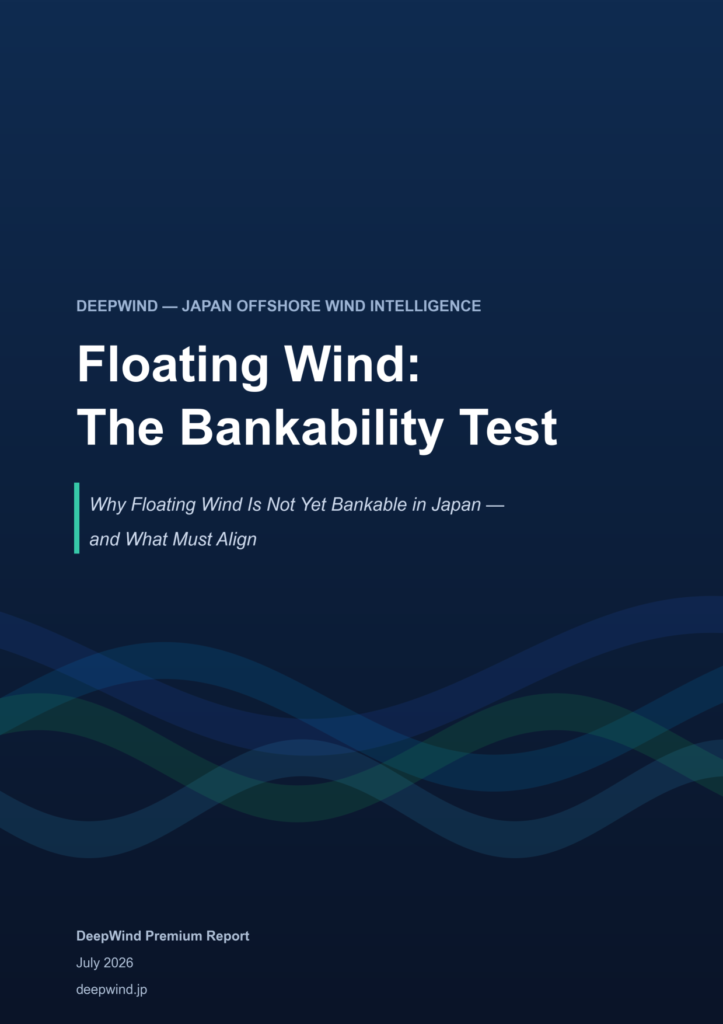
Cover of Floating Wind: The Bankability Test, DeepWind Premium Report, July 2026

Latest / Floating wind bankability

Floating Wind: The Bankability Test

Why floating wind is not yet bankable in Japan, and what has to align before it scales.

July 2026 Analysis 28 pp. / Brief 12 pp.

The constraint is not the platform. Installation vessels, marshalling ports, mooring and anchor supply, and dynamic cables have to unlock in step, and a project stalls if any one of them lags. The report quantifies that bottleneck node by node, ranks the variables that actually move bankability, and sets out a ladder of the conditions under which floating scales.

Minimum DSCR (how comfortably a project covers debt service in its tightest year), equity IRR thresholds, the CAPEX breakdown and zone-level capacity factors are all stated explicitly.

Includes DeepWind Viability Simulator, Professional (β) access. Every figure in the report can be recomputed on your own CAPEX, WACC and power-price assumptions, so the analysis can be tested against your case rather than taken on trust.
See the contents (10 sections)
  • 1Executive Summary
  • 2Why Floating Is the Decisive Test
  • 3The Bankability Entry: How Far From Financeable?
  • 4Not a Platform-Engineering Problem
  • 5The Synchronized Bottleneck (vessels, ports, mooring, dynamic cables)
  • 6From Bottleneck to Bankability
  • 7Sensitivity: What Moves Floating Bankability
  • 8What Could Break, or Unlock, These Projects
  • 9Under What Conditions Does Floating Scale?
  • 10Implications by Stakeholder
EditionWhat it coversPagesPrice
Analysis (full)All 10 sections, plus Simulator Professional (β) access28$298
BriefThe core of sections 1 to 512$98
Buy the Analysis Buy the Brief

Prices in USD. Customers in Japan are charged 10% Japanese consumption tax at checkout.

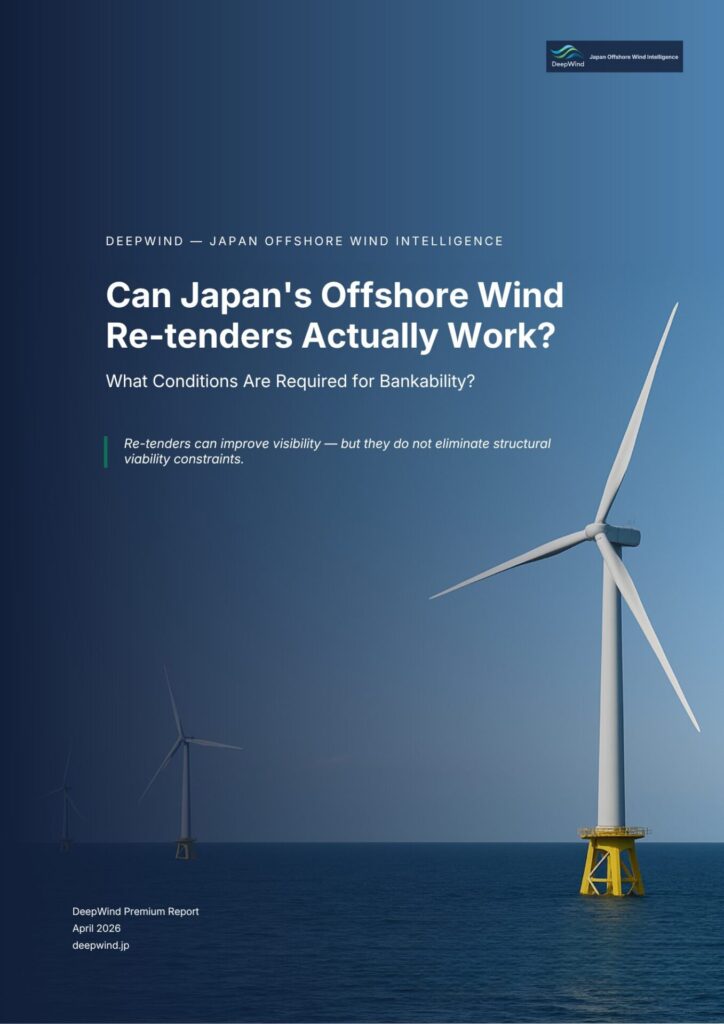
Cover of Can Japan's Offshore Wind Re-tenders Actually Work, DeepWind Premium Report, April 2026

Re-tender viability assessment

Can Japan's Offshore Wind Re-tenders Actually Work?

What conditions the three re-tendered zones need before they are bankable.

April 2026 18 pp. English

Site-condition scoring, LCOE and project IRR modelling, sensitivity across six parameters, and an execution-risk overlay for Noshiro-Mitane-Oga (495 MW), Yurihonjo (840 MW) and Choshi (390 MW). Choshi carries the strongest baseline economics at LCOE 27.5 JPY/kWh and IRR 5.0%, where 13 m water depth offsets weaker seabed conditions.

The finding: re-tenders can proceed, but they do not close the viability gap. WACC and power price dominate, and the report marks the levels at which each project stops working.

See the contents (11 sections)
  • 1Executive Summary
  • 2Background: Why Re-tenders Matter Now
  • 3What Policy Can, and Cannot, Fix
  • 4Analytical Framework: From Cost to Viability
  • 5Cost Model Assumptions
  • 6Site Assessments (Noshiro-Mitane-Oga, Yurihonjo, Choshi)
  • 7Comparative Site Analysis
  • 8LCOE and IRR Sensitivity Analysis
  • 9What Could Break These Projects?
  • 10Are Re-tenders Viable, and Under What Conditions?
  • 11What This Means for Developers and Investors
EditionLanguagePagesPrice
Analysis (full)English18$148
Buy the report
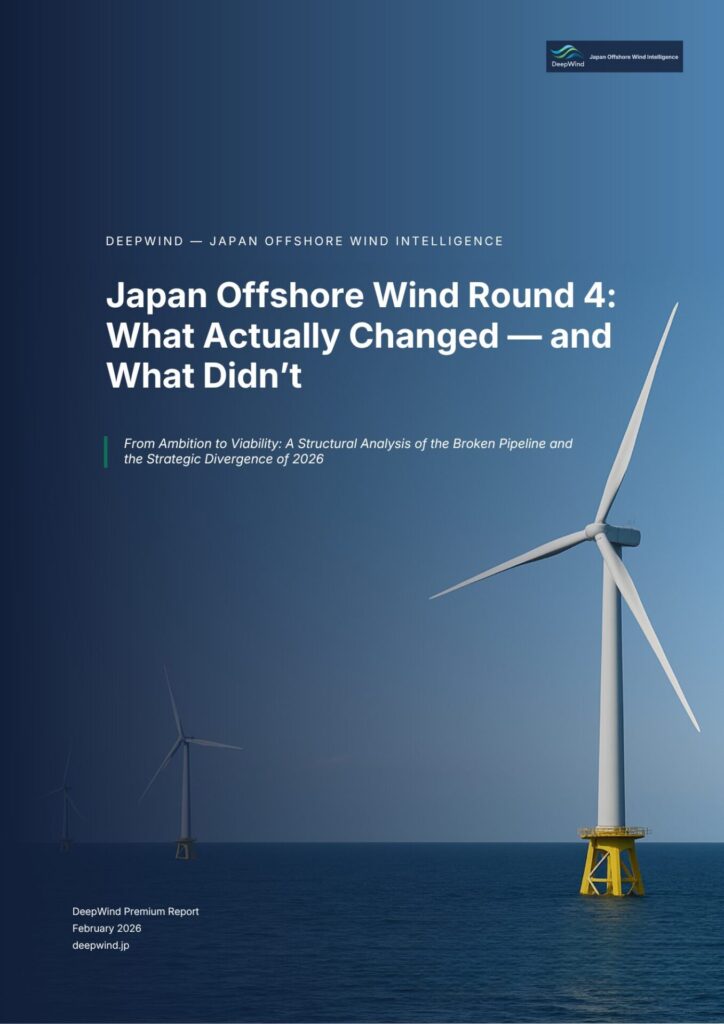
Cover of Japan Offshore Wind Round 4, DeepWind Premium Report, February 2026

Round-specific policy analysis

Japan Offshore Wind Round 4: What Actually Changed and What Didn't

Sorting the rule changes that reach execution from the ones that stop at paper.

February 2026 15 pp. English

Round 4 read as the point where the market leaves the ambition-driven phase for the viability-driven one. The report separates what the government changed, what developers expected to change and did not, and where the execution gap stayed open, then sets out who gains and who is still exposed through 2026 to 2028.

See the contents (12 sections)
  • 1Why Round 4 Matters Now
  • 2What the Government Changed
  • 3What Developers Expected to Change
  • 4What Actually Changed (Execution View)
  • 5What Did Not Change
  • 6Round 4 and Re-auctions
  • 7Supply-Chain Reality Check
  • 8Who Benefits from Round 4
  • 9Who Is Still at Risk
  • 10Implications for Bidders
  • 11Implications for Investors
  • 12What This Means for 2026 to 2028
EditionLanguagePagesPrice
Analysis (full)English15$148
Buy the report
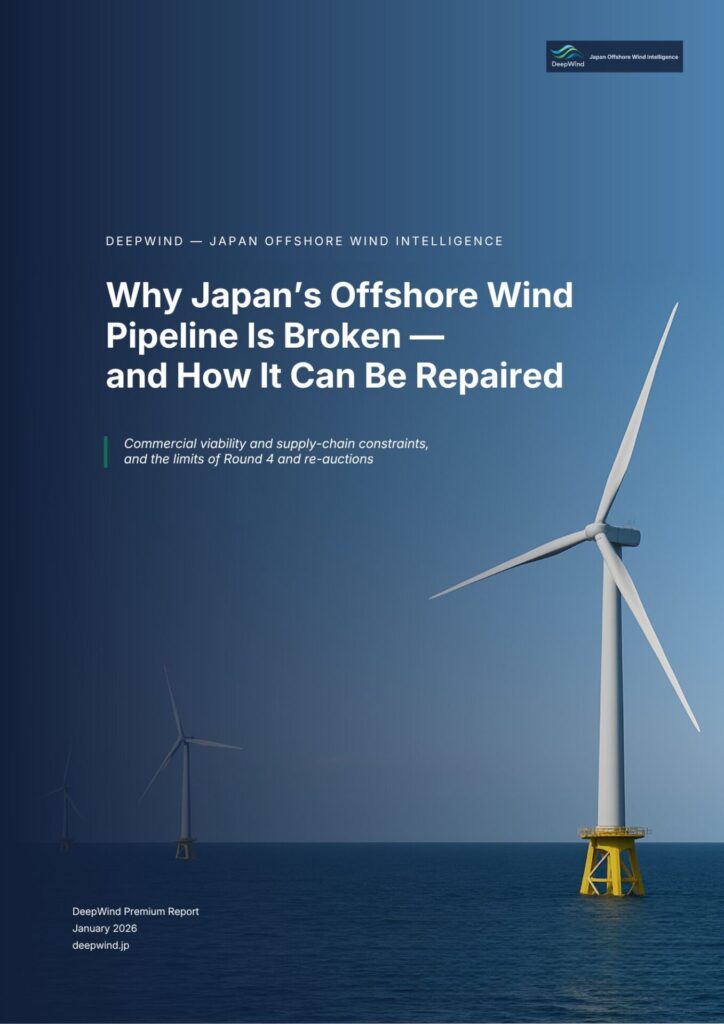
Cover of Why Japan's Offshore Wind Pipeline Is Broken, DeepWind Premium Report, January 2026

Flagship structural report

Why Japan's Offshore Wind Pipeline Is Broken and How It Can Be Repaired

Withdrawals and delays treated as symptoms of one system, not as separate events.

January 2026 35 pp. English

The question is not whether an individual project can be optimised, but whether tender design, cost assumptions, supply-chain build-out and financing structure can be made to fit together. Built on direct input from EPCs, suppliers, consultants and researchers working in the market, the report shows where viability breaks down at each stage of the pipeline.

The longest of the four, and the analytical base the later reports build on.

See the contents (9 sections and appendix)
  • 1Executive Summary
  • 2Market Reality Check: Constrained by Viability, Not Ambition
  • 3Cost and Commercial Viability
  • 4Why Project-Level Fixes Fail
  • 5Supply-Chain Realities
  • 6Round 4 and Re-auctions: The Limits of Policy
  • 7What Must Change
  • 8Strategic Implications, 2026 to 2028
  • 9Appendix: Data and References
EditionLanguagePagesPrice
Analysis (full)English35$298
Buy the report

Delivery and payment. Checkout runs through Gumroad (Gumroad, Inc.), and the PDF downloads immediately after payment. Prices are in USD, so your card issuer's exchange rate and any foreign transaction fee may apply. Customers in Japan are charged 10% Japanese consumption tax at checkout.
For invoicing, or for access across a team, write to info@deepwind.jp.

Scroll to Top