
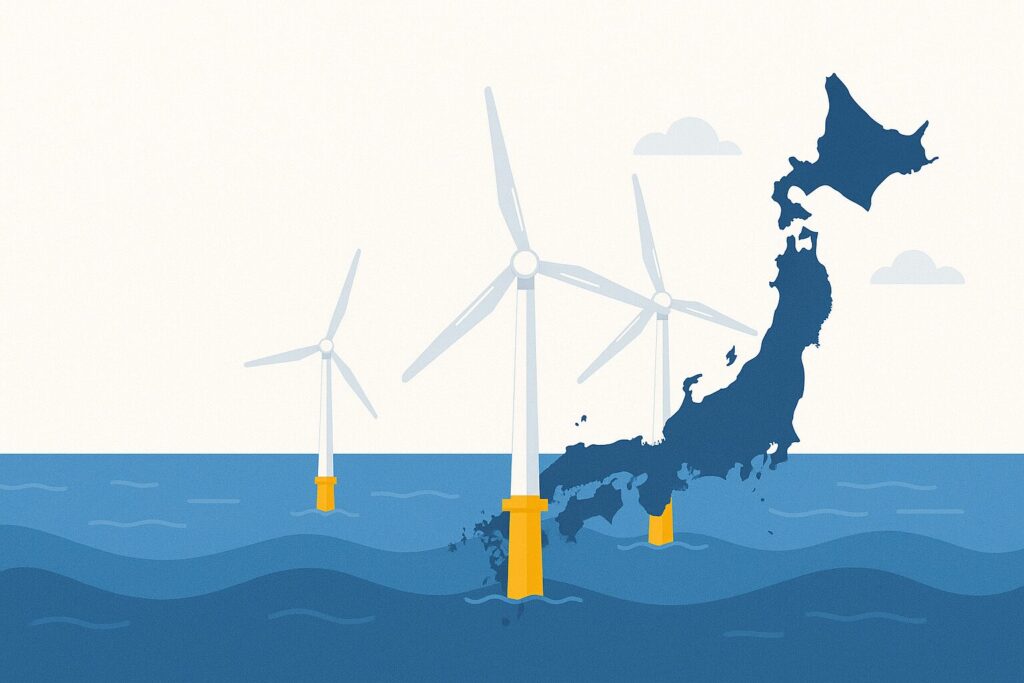
In Japan’s offshore wind market, “Promotion Zones” are positioned as the most important institutional step toward commercialization. Under the Act on Promoting Utilization of Sea Areas for the Development of Marine Renewable Energy Power Generation Facilities (the “Renewable Energy Sea Area Utilization Act”), the national government takes the lead in coordinating sea-area use and conducts tenders premised on long-term occupation rights—an institutional mechanism designed to provide offshore wind projects with regulatory stability.
Today, multiple Promotion Zones have been designated across Japan, and a wide range of offshore wind projects—both fixed-bottom and floating—are being planned and considered. At first glance, Promotion Zones are often interpreted as “designation means the project will move forward,” or that “designated projects can be compared under the same conditions.” In reality, however, it is not that simple.
Even when projects are designated as Promotion Zones, the underlying conditions differ significantly by project, including water depth, metocean conditions, port constraints, construction distance, grid constraints, project scale, and technology selection. As a result, there are clear differences in commercial viability, schedule/execution risk, and the difficulty of investment decision-making.
Rather than presenting Japan’s Promotion Zone offshore wind projects as a simple list, this Pillar article organizes them through a structural lens: “Why does difficulty differ by project?” and “Which conditions determine whether a project can be realized?” While detailed project-specific information is left to individual project articles, the purpose here is to provide cross-cutting comparison axes and an overall market picture.
The scope of this article covers the following 12 Promotion Zone projects:
▶ Promotion Zones List (with individual article links)
| Sea Area | Capacity | Turbines | Technology | Details |
|---|---|---|---|---|
| Goto, Nagasaki | 16.8MW | 8 | Floating | Read more |
| Noshiro/Mitane/Oga, Akita | 494MW | 38 | Fixed-bottom | Read more |
| Yurihonjo, Akita | 845MW | 65 | Fixed-bottom | Read more |
| Choshi, Chiba | 403MW | 31 | Fixed-bottom | Read more |
| Happo/Noshiro, Akita | 375MW | 25 | Fixed-bottom | Read more |
| Oga/Katagami/Akita, Akita | 315MW | 21 | Fixed-bottom | Read more |
| Murakami/Tainai, Niigata | 684MW | 38 | Fixed‑bottom | Read more |
| Saikai/Enoshima, Nagasaki | 420MW | 28 | Fixed-bottom | Read more |
| Yusa, Yamagata | 450MW | 30 | Fixed-bottom | Read more |
| Tsugaru, Aomori | 615MW | 41 | Fixed-bottom | Read more |
| Hokkaido Hiyama | 910–1,140MW | 76 | Fixed-bottom | Read more |
| Hokkaido Matsumae | 315–320MW | 21 | Fixed-bottom | Read more |
All of these projects belong to the same institutional framework called “Promotion Zones,” but their project difficulty and future outlook are by no means uniform. This article re-frames Promotion Zones not as a “goal,” but as an entry point toward project realization, and provides a foundational framework for understanding Japan’s offshore wind market realistically.
In the next section, we first summarize what the Promotion Zone framework actually means: what it guarantees, what it does not, and from where developer risk begins.
What Are Promotion Zones? (Key Premises)
To understand Japan’s offshore wind market, it is essential to correctly grasp the position and meaning of the Promotion Zone framework. Promotion Zones are a framework under the Renewable Energy Sea Area Utilization Act, through which the national government coordinates sea-area use and creates an environment in which offshore wind projects can be implemented over the long term.
The framework’s most important feature is that it enables sea-area occupation for a certain period (in principle, 30 years). For offshore wind—where upfront investment is enormous and payback periods are long—this can be considered a minimum prerequisite for securing institutional stability.
However, designation as a Promotion Zone does not guarantee that the project will be commercially viable or executable. This is where a major misunderstanding arises when evaluating Japan’s offshore wind market.
What Promotion Zones “Guarantee” vs. What They Do Not
What the Promotion Zone framework guarantees is the institutional framework itself. Specifically, this includes:
- Legal coordination and arrangement of sea-area use
- A developer selection process through competitive tendering
- Institutional stability premised on long-term occupation
These are critical “entry conditions” for starting a project, but they do not guarantee project realization itself.
On the other hand, many elements are not directly guaranteed by the framework, such as:
- Levels of construction cost and O&M cost
- Securing port and installation capacity
- Grid connection conditions and output constraints (curtailment)
- Risks arising from natural conditions (wind, waves, seabed/geotechnical)
- Financing conditions and cost of capital (WACC)
All of these must be borne as risks by developers and addressed on a project-by-project basis. Therefore, even within the same Promotion Zone framework, project viability can change significantly depending on developer experience, strategy, and the external environment.
The Misconception: “Promotion Zone = Low Risk”
In the market, Promotion Zones are sometimes described as “projects with lower risk because they are designated.” In practice, that understanding is not accurate. It is more appropriate to view Promotion Zones as a framework that does not remove risks, but clarifies where risks reside.
Early-stage uncertainties—such as sea-area use and stakeholder coordination—are organized to some extent. At the same time, challenges in the execution phase—cost, installation, and financing—become more visible. As a result, Promotion Zone projects can easily become cases where “technically possible, but commercially difficult.”
This is not so much a framework defect as a structural issue inherent in offshore wind as a business. Promotion Zones do not conceal this reality; rather, they play a role in making it explicit.
Promotion Zones Are Only the “Starting Line”
From the above, Promotion Zones should be positioned not as the goal of a project, but as the starting point toward project realization. Only after institutional clarification is completed does meaningful project risk assessment truly begin.
Without this perspective, comparing Promotion Zone projects side-by-side leads to unresolved questions such as “Why do some projects progress while others stall?” and “Why do economics differ under the same framework?”
In the next section, based on these premises, we clarify common axes for comparing Promotion Zone projects and examine where project-to-project differences come from.
Common Axes for Comparing Promotion Zone Projects
Promotion Zone offshore wind projects fall under the same framework. However, their practical difficulty and commercial feasibility vary widely, and the “Promotion Zone” label alone cannot determine superiority, viability, or the likelihood of progress.
What matters, therefore, is identifying which viewpoints should be used to compare projects. This section clarify key comparison axes as a preface before diving into individual project articles.
1) Water Depth and Metocean Conditions (Premises That Determine Technology Choice)
The most fundamental and important axis is water depth and metocean conditions. Water depth effectively determines whether fixed-bottom or floating is selected, and directly links to foundation structure, installation method, and cost structure.
In addition, metocean conditions—waves, currents, and wind—affect design margins and installation windows, influencing both CAPEX and OPEX. Even in shallow waters, harsh metocean can increase difficulty; conversely, even in deeper waters, relatively mild conditions can improve the relative feasibility of floating.
Therefore, rather than relying only on the simple classification of “fixed-bottom vs. floating,” projects should be evaluated as execution difficulty by sea area.
2) Port Conditions and Construction Distance (Determinants of Executability)
In offshore wind, port conditions and construction distance significantly affect executability. Whether a nearby port can support assembly, storage, load-out, towing, and installation is not merely a cost factor; it relates to whether the project can be built at all.
Especially for Promotion Zone projects, port development can become a schedule bottleneck. Longer distances amplify weather risk, fuel costs, and efficiency loss, increasing difficulty beyond initial expectations.
For project comparison, it is necessary to evaluate “distance from port,” “available port functions,” and “status of port development” as a set.
3) Grid Connection and Output Constraints (Impact on Revenue)
Even among Promotion Zone projects, grid connection conditions are not uniform. Available connection capacity, grid reinforcement plans, and curtailment risk directly affect energy yield and revenue.
In particular, in regional areas, grid constraints can become a bottleneck—creating risks such as “power can be generated but not sold” or “curtailment becomes routine.” This is often underestimated at the planning stage, but the impact on IRR can be material.
4) Project Scale and Maturity (Differences in the Nature of Risk)
Even within Promotion Zones, assumed capacity and project maturity vary significantly. Larger projects may benefit from scale, but initial investment and risk exposure increase proportionally.
Risk characteristics also differ depending on the progress of environmental assessment and geotechnical surveys. Early-stage projects carry higher uncertainty; as projects move forward, risks become more concrete and bounded. Which phase of risk to take depends on developer and investor strategy.
5) Technology Choice and Supply Chain Fit
Finally, technology choice and supply chain fit are critical. Whether the assumed turbine size, foundation type, and floating platform type can be realistically procured and installed through domestic and international supply chains strongly affects realizability.
Even if a technology is theoretically viable, projects do not progress without manufacturing bases and installation capacity capable of execution. In Promotion Zone projects, this “executability” often becomes a problem later in the process.
By applying these common axes, Promotion Zone projects can be compared not as “institutional categories,” but through the lens of practical difficulty and conditions for realization.
In the next section, based on these axes, we clarify the Promotion Zone projects by region and outline the position and characteristics of each project.
Overall Landscape of Promotion Zone Projects (Regional Structure)
Japan’s Promotion Zone offshore wind projects show a clear geographical bias. Many of the designated/advanced projects are concentrated along the Sea of Japan coast and Hokkaido, while projects on the Pacific side are limited.
This distribution is not accidental. It reflects the combined result of wind conditions, water depth, port readiness, grid configuration, and regional industrial structure. In other words, the market has formed first in areas where the conditions for realization are more likely to align.
In this section, we organize the Promotion Zone projects covered by DeepWind into regional blocks and provide an overview of their shared characteristics and positioning.
1) Akita Coast (Japan Market’s “Benchmark”)
The Akita coastline is positioned as the de facto benchmark area in Japan’s offshore wind market. Multiple Promotion Zone projects are concentrated here, including Noshiro–Mitane–Oga, Yurihonjo, Happo–Noshiro, and Oga–Katagami–Akita.
This area features relatively shallow waters, stable wind conditions for the Sea of Japan side, and the potential to utilize existing ports. Many projects assume fixed-bottom foundations, and from a technical standpoint the area is closest to “standardization” within the Japanese market.
At the same time, it is also the region where challenges associated with scale—competition for ports and installation resources, and the manifestation of grid constraints—surface earliest.
👉 Akita Noshiro–Mitane–Oga Offshore Wind Project
👉 Akita Yurihonjo Offshore Wind Project
👉 Happo–Noshiro Offshore Wind Project
👉 Oga–Katagami–Akita Offshore Wind Project
2) Hokkaido (Large Scale, but High Execution Difficulty)
In Hokkaido, Promotion Zone projects such as Hiyama and Matsumae are being considered. The wind resource potential is very high, making the region attractive from a theoretical energy yield perspective.
However, multiple challenges overlap—construction distance, harsh weather, and constraints in port and grid infrastructure—placing execution difficulty among the highest in Japan. While project scale can be large, initial investment and risk increase proportionally.
Hokkaido projects can be viewed as “future core candidates,” but in the short term they require cautious development approaches.
👉 Hokkaido Hiyama Offshore Wind Project
👉 Hokkaido Matsumae Offshore Wind Project
3) Tohoku (Sea of Japan Side)
Yamagata Yuza and Niigata Murakami–Tainai are adjacent to the Akita coast, yet differ meaningfully in individual conditions. While wind conditions are favorable, constraints related to ports and the grid can affect project feasibility.
This Sea-of-Japan-side Tohoku block includes Aomori Tsugaru in addition to Yamagata Yuza and Niigata Murakami–Tainai. All are fixed-bottom–assumed projects on the Sea of Japan side, but their port conditions, construction distance, and grid premises differ clearly.
In particular, Aomori Tsugaru is attractive in terms of wind resource potential, but its prerequisites in installation/logistics/grid do not fully match Akita coastal projects. Therefore, it should be positioned not as a project where Akita’s success can be directly replicated, but as a Sea-of-Japan-side project that requires project-specific evaluation.
👉 Aomori Tsugaru Offshore Wind Project
👉 Yamagata Yuza Offshore Wind Project
👉 Niigata Murakami–Tainai Offshore Wind Project
4) Honshu Pacific Side
On Honshu’s Pacific side, there are Promotion Zone projects such as Chiba Choshi. While the site benefits from proximity to demand centers, it also features harsh wave conditions, fisheries coordination challenges, and installation constraints.
These projects combine location advantages and high execution difficulty in a way that makes simple success/failure prediction difficult. Technology choice and installation planning can significantly affect viability.
👉 Chiba Choshi Offshore Wind Project
5) Kyushu & Western Japan (Floating Offshore Wind Front-Runner)
Nagasaki’s Goto City offshore and Saikai–Enoshima are Japan’s leading areas for floating offshore wind. Because water depths are deep and fixed-bottom is difficult, these areas have advanced demonstration and implementation experience for floating technology and framework.
The Goto project is limited in scale, but it is important for Japan’s market in terms of real-world floating execution experience. Saikai–Enoshima, meanwhile, is attracting attention as a project with future scalability.
👉 Goto City Offshore Floating Wind Power Project
👉 Nagasaki Saikai–Enoshima Offshore Wind Project
What Japan’s Offshore Wind Market Structure Looks Like from the Promotion Zones List
To understand Japan’s offshore wind market, it is as important as individual project analysis to have a bird’s-eye view of Promotion Zone projects as a list. Each project has different conditions, but only by listing them does the market’s shared structure and constraints become visible.
The table below organizes major publicly known Promotion Zone projects along with capacity, turbine count, and technology type. In this Pillar article, this list is positioned not as a simple link collection, but as a “map” of Japan’s offshore wind market.
By looking at the list, the following points become intuitive:
- Fixed-bottom projects are concentrated on the Sea of Japan side
- Project scale (capacity) and turbine count vary significantly by project
- Floating is still positioned as exceptional and limited at this stage
- Project composition implicitly assumes port and installation capability as prerequisites
In this sense, the list functions not as a “summary of results,” but as an entry point to interpret market structure.
Of particular importance is geographic distribution. Japan’s Promotion Zone projects can be grouped into blocks with significantly different metocean and port conditions, such as:
- Hokkaido
- Tohoku/Hokuriku on the Sea of Japan side
- Honshu Pacific side (e.g., Choshi)
- Western Japan/Kyushu (e.g., Goto, Saikai–Enoshima)
These differences directly affect technology approach, construction cost, installation risk, and overall feasibility.
For example, Niigata Murakami–Tainai is located on Honshu, but it is not a Pacific-side project—it is a Sea of Japan–side project. If this geographic premise is misunderstood and compared as if it were similar to Pacific-side projects like Choshi, there is a risk of major errors in technology and cost assessment.
The list below links to DeepWind’s individual project articles. For project details (developer consortium, assumed technology, cost implications, key risks, etc.), please refer to each linked article.
▶ Promotion Zones List (with individual article links)
| Sea Area | Capacity | Turbines | Technology | Details |
|---|---|---|---|---|
| Goto, Nagasaki | 16.8MW | 8 | Floating | Read more |
| Noshiro/Mitane/Oga, Akita | 494MW | 38 | Fixed-bottom | Read more |
| Yurihonjo, Akita | 845MW | 65 | Fixed-bottom | Read more |
| Choshi, Chiba | 403MW | 31 | Fixed-bottom | Read more |
| Happo/Noshiro, Akita | 375MW | 25 | Fixed-bottom | Read more |
| Oga/Katagami/Akita, Akita | 315MW | 21 | Fixed-bottom | Read more |
| Murakami/Tainai, Niigata | 684MW | 38 | Fixed‑bottom | Read more |
| Saikai/Enoshima, Nagasaki | 420MW | 28 | Fixed-bottom | Read more |
| Yusa, Yamagata | 450MW | 30 | Fixed-bottom | Read more |
| Tsugaru, Aomori | 615MW | 41 | Fixed-bottom | Read more |
| Hokkaido Hiyama | 910–1,140MW | 76 | Fixed-bottom | Read more |
| Hokkaido Matsumae | 315–320MW | 21 | Fixed-bottom | Read more |
If you wish to check the overview and latest progress of all projects designated as “Promotion Zones,” “Promising Zones,” and “Preparation Zones” under Japan’s Offshore Renewable Energy Act, please refer to the Japan Offshore Wind Project Map.
The most important takeaway from this list is that Japan’s Promotion Zone market is not “expanding evenly in line with policy targets.” Rather, the market is forming step-by-step starting from places where the conditions for realization are easier to align. In particular, the fact that many fixed-bottom projects are concentrated along the Sea of Japan side (Akita–Aomori–Yamagata–Niigata–Hokkaido) suggests that not only wind conditions, but also execution prerequisites—ports, installation capability, and grid—are geographically unevenly distributed.
Next, the variation in capacity (MW) and turbine count is also important. Even within the same “Promotion Zone” designation, scale differs widely—from ~315MW-class projects to ~1000MW-class projects—and turbine counts range roughly from 21 to 76. This is not merely a planning difference; it indicates that the realistically achievable scale changes depending on the combination of sea-area conditions, installation planning, port function, and grid conditions. If Promotion Zones are treated as “uniform conditions,” this scale-driven difficulty difference is easily overlooked.
The positioning of floating in the list also highlights the current market phase. While Offshore Goto City (floating) appears as an exception, most projects assume fixed-bottom. This does not mean floating is unimportant; rather, it reflects that today’s Promotion Zone market is in a phase of building market foundations by accumulating fixed-bottom execution experience.
Above all, what the list suggests is that offshore wind market growth is determined not by “how many projects exist,” but by execution capability—especially ports and installation capacity. Promotion Zones organize the institutional entry conditions, but in practice, the bottleneck is often whether “assembly, storage, load-out, and installation can actually be executed.” If this is constrained, projects do not move forward even under an organized framework.
In other words, the Promotion Zones list is not a link collection—it is a “map” that shows where Japan’s market constraints are concentrated. Building on this map, the next section organizes projects not as “individual circumstances,” but as structural factors that differentiate difficulty.
For details on each project (consortium structure, assumed turbines, port distance, grid constraints, installation conditions, key risk discussions, etc.), DeepWind explores them in the individual articles below. Please start with the sea area you are most interested in.
- Noshiro–Mitane–Oga Offshore Wind Project
- Yurihonjo Offshore Wind Project
- Happo–Noshiro Offshore Wind Project
- Oga–Katagami–Akita Offshore Wind Project
- Yamagata Yuza Offshore Wind Project
- Niigata Murakami–Tainai Offshore Wind Project
- Aomori Tsugaru Offshore Wind Project
- Chiba Choshi Offshore Wind Project
- Hiyama Offshore Wind Project
- Matsumae Offshore Wind Project
- Goto City Offshore Floating Wind Power Project
- Nagasaki Saikai–Enoshima Offshore Wind Project
In the next section, rather than classifying projects only by “region,” we classify Promotion Zone projects from the perspective of conditions for realization (difficulty) and clarify where bottlenecks are likely to emerge.
Promotion Zone Projects Can Be Classified by “Difficulty”
To understand Promotion Zone projects in a cross-cutting way, it is useful not only to clarify them by region, but also to classify them by difficulty (the nature of risk) that affects realizability. Here, “difficulty” does not mean technical difficulty alone, but the broader difficulty of execution including ports, installation, grid, and financing conditions.
In this Pillar article, we broadly classify Promotion Zone projects into the following three types:
- Type A: Close to “standard conditions” (but competition is likely) — fixed-bottom is assumed and experience accumulates, but concentration of projects can intensify competition for ports, installation resources, and grid capacity
- Type B: Conditions look good, but “project-specific constraints” dominate — difficulty swings significantly depending on factors such as distance to demand, fisheries coordination, wave conditions, and port development
- Type C: High potential, but high execution difficulty — multiple constraints overlap (distance, harsh weather, grid, ports), leading to large capital exposure and high uncertainty
The goal of this classification is not to declare which projects are “good” or “bad.” The key point is that the type of risk differs by project. Even under the same Promotion Zone framework, Type A may be dominated by “competition risk,” Type B by “project-specific constraints,” and Type C by “execution capability and financing conditions.”
With this lens, the following questions become easier to ask:
- Is the biggest uncertainty in this project “technology,” “installation,” “grid,” or “financing”?
- Is the uncertainty the type that can be reduced over time through experience (learning risk)?
- Or is it a structural type likely to remain (dependent on framework or infrastructure)?
When reading each individual project article, starting by asking “Which type (A/B/C) is this project closest to?” helps organize the key discussion points. In the next subsection, we first clarify why the Akita coast—Japan’s market benchmark and a concentrated project area—can become difficult despite being close to “standard conditions.”
Type A: Akita Coast Is “Standard,” but Competition Becomes the Risk
Multiple projects along the Akita coast are positioned as the area closest to fixed-bottom “standard conditions” in Japan’s market. At the same time, concentration of projects intensifies competition for resources such as port yards, installation vessels, O&M bases, and grid capacity, creating the paradox that “the better the conditions, the fiercer the competition”.
DeepWind organizes details for each Akita project (port assumptions, grid issues, consortium structure, etc.) in the individual articles below:
👉 Akita Noshiro–Mitane–Oga / Akita Yurihonjo / Happo–Noshiro / Oga–Katagami–Akita
Next, we clarify the Pacific-side project (Choshi), where evaluation axes change significantly even within Honshu, and the Sea-of-Japan-side block (Yuza / Murakami–Tainai), which is adjacent but requires independent evaluation.
Type B: Pacific Side (Choshi) Balances “Location Advantage” and “Execution Difficulty”
Chiba Choshi holds an exceptional positioning among Japan’s Promotion Zone projects. Located on Honshu’s Pacific side, it benefits from clear proximity to major demand centers, yet it faces constraints of a different nature from Sea-of-Japan-side projects, such as wave conditions, fisheries coordination, and installation difficulty.
In particular, Pacific swells can narrow installation windows and directly affect the operating efficiency of jack-up/installation vessels and schedule risk. This is not limited to CAPEX increases; it often translates into schedule delay risk, which can in turn be reflected in financing conditions.
At the same time, proximity to demand provides options not available in other regions when considering future power sales and demand-side collaboration (e.g., corporate PPAs). For this reason, Choshi is a typical Type B case where evaluation depends heavily on how constraints are managed rather than a binary “good/bad” judgment.
👉 Chiba Choshi Offshore Wind Project
Type B: Even on the Sea of Japan Side, Some Areas Cannot Be “Replicated” (Yuza / Murakami–Tainai / Aomori Tsugaru)
Yamagata Yuza, Niigata Murakami–Tainai, and Aomori Tsugaru are all located on the Sea of Japan side and are geographically continuous with the Akita coast. In practice, however, it is appropriate to position them as areas where Akita’s success model cannot be directly replicated.
All of these projects have favorable wind conditions and water depths within the range where fixed-bottom can be viable. At first glance they may appear similar to Akita, but port conditions, construction distance, availability of installation resources, grid connection premises, and winter metocean conditions differ by project. As a result, project feasibility depends strongly on project-specific premises.
In particular, Murakami–Tainai is located on Honshu but is a Sea-of-Japan-side project rather than Pacific-side, and its winter wave regime and installation window characteristics are fundamentally different from Choshi. Aomori Tsugaru similarly combines harsh metocean and port/installation constraints, making misreads of premises more likely to directly translate into cost and availability impacts.
What these projects share is the point that:
“They may be technically viable, but standardization and replication do not work.”
Because differences in premises directly affect CAPEX/OPEX and ultimately IRR, they should be positioned as Type B projects that require careful project-by-project premise clarification and cautious design, rather than as simple extensions of the Akita model.
👉 Yamagata Yuza Offshore Wind Project
👉 Niigata Murakami–Tainai Offshore Wind Project
👉 Aomori Tsugaru Offshore Wind Project
Type C: Hokkaido Is “High Potential × High Execution Difficulty”
Hokkaido (Hiyama and Matsumae) is one of the Promotion Zone areas with the highest theoretical potential. Wind conditions are among Japan’s best, and GW-scale development is within scope.
At the same time, multiple constraints overlap—construction distance, harsh weather, and limits in port and grid infrastructure—making execution difficulty among the highest in Japan. The larger the project, the larger the initial investment and uncertainty can become.
Hokkaido projects are often described as a “future pillar” of Japan’s market. In practice, however, they are Type C projects where direct replication of existing success models is difficult in the near term, and careful design of phased development, risk allocation, and financing structure becomes essential.
👉 Hokkaido Hiyama Offshore Wind Project
👉 Hokkaido Matsumae Offshore Wind Project
Type C: Kyushu & Western Japan Is a Floating Front-Runner, but Scaling Remains the Challenge
Nagasaki’s Goto City offshore and Saikai–Enoshima are the front-runners for floating offshore wind in Japan. Under deep-water conditions where fixed-bottom is not feasible, floating demonstration and implementation experience has accumulated.
The Goto project is limited in scale, but it carries significant meaning for Japan’s market as “experience of actually executing floating.” Saikai–Enoshima is positioned as a project looking toward larger-scale expansion, but the hurdles for installation, cost, and financing conditions remain high.
Floating projects in Kyushu can be viewed as being at the stage of confronting the next hurdle required to move from “technically possible” to “commercially realizable.”
👉 Goto City Offshore Floating Wind Power Project
👉 Nagasaki Saikai–Enoshima Offshore Wind Project
Conclusion: Promotion Zones Are Not the “Goal,” but the Entry Point Where Difficulty Diverges
In this Pillar article, Japan’s Promotion Zone offshore wind projects have been organized not merely as an institutional list or a regional grouping, but through a structural lens of difficulty that determines realizability.
The Promotion Zone framework plays a role in aligning the “starting line” for offshore wind by organizing sea-area use and tender processes. However, it does not guarantee profitability or executability. Rather, once the framework is organized, the challenges of the execution phase—cost, installation, ports, grid, and financing—become more visible.
In practice, when Promotion Zone projects are compared side-by-side, it becomes clear that different types of projects coexist, such as:
- Areas close to standard conditions but with intense competition
- Areas where project-specific constraints dominate feasibility
- Areas with high potential but high execution difficulty
The key is not to evaluate projects uniformly to decide “which is best,” but to understand which type of risk you can take—and which constraints are structural versus reducible through experience.
Japan’s market is more likely to form step-by-step starting from projects where conditions align, rather than expanding uniformly nationwide. In that process, reproducibility may matter more than sheer speed, and certainty more than ambitious plans.
DeepWind will continue to organize Promotion Zone projects not through “expectations,” but through “structure,” maintaining an information design where readers can move back and forth between individual project pages and this Pillar page to understand the market three-dimensionally. This article is intended to serve as a shared thinking framework for evaluating Japan’s offshore wind market.
Round 4 Is Not a Reset.📘 DeepWind Premium Report
A concise, decision-oriented structural brief on what actually changed —
and what remains structurally broken.
- 🔍Market Insights – Understand the latest trends and key topics in Japan’s offshore wind market
- 🏛️Policy & Regulations – Explore Japan’s legal frameworks, auction systems, and designated promotion zones.
- 🌊Projects – Get an overview of offshore wind projects across Japan’s coastal regions.
- 🛠️Technology & Innovation – Discover the latest technologies and innovations shaping Japan’s offshore wind sector.
- 💡Cost Analysis – Dive into Japan-specific LCOE insights and offshore wind cost structures.