
The Matsumae Offshore Wind Project in Hokkaido has been designated as a candidate area in Japan’s 4th round of promotion area tenders under the Act on Promoting Utilization of Sea Areas for Renewable Energy (commonly known as “Round 4”). It is positioned as a key project supporting the national target of securing 10 GW of offshore wind capacity by 2030 and 30–45 GW by 2040.
The project’s total generation capacity is estimated at approximately 250 to 320 MW. It is expected to play a significant role in decarbonizing Japan’s energy mix while also contributing to regional industrial development and economic revitalization.
As of July 30, 2025, the area has been officially designated as a promotion zone. While publicly available information remains limited at the time of writing, we will continue to update this article as new details emerge regarding developer selection, project timelines, and more—so stay tuned!
➡ For an overview of all ten Promotion Areas as of 2025, see:
Promotion Areas for Offshore Wind in Japan – 2025 Overview
1. Project Overview
| Project name | TBD (To be determined) |
| Developer | TBD (Kansai Electric Power is considering the project) |
| Consortium Members | TBD |
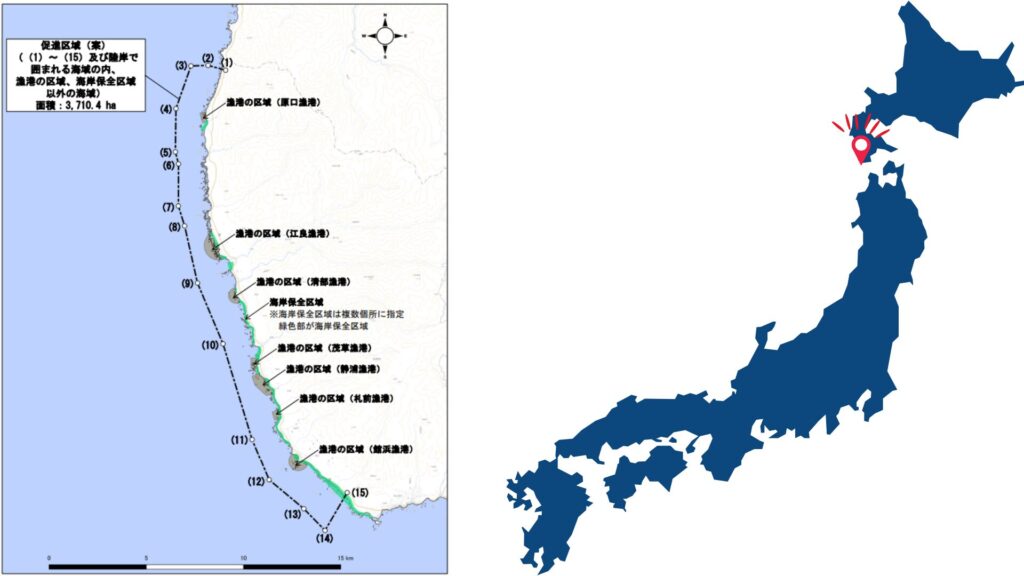
| Location | Hokkaido Matsumae Offshore |
| Type | Fixed-bottom Offshore Wind Power (Estimated) |
| WTG | TBD |
| Price | TBD |
| Capacity | Approximately 250–320 MW (estimated: 21 turbines × 15 MW) |
| Start of Construction | TBD (Estimated: from 2027 to the early 2030s) |
| Operation Period | TBD |
2. Location and Site conditions
2-1. Wind Conditions
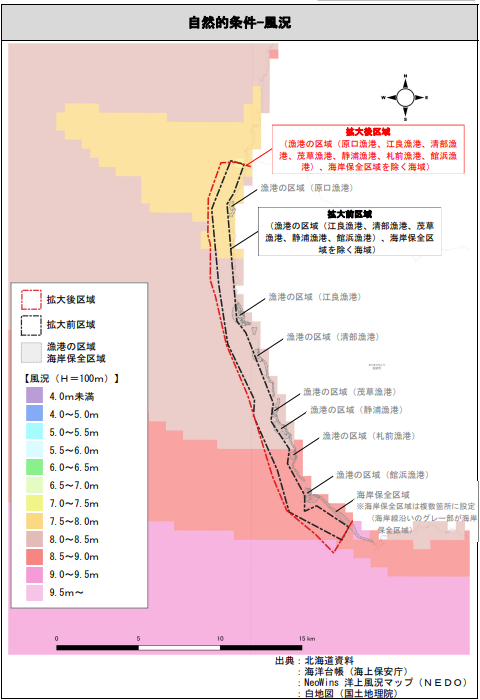
The wind speed within the zone is approximately 7.0–9.0 m/s (at 100 m altitude).
2-2. Water Depth
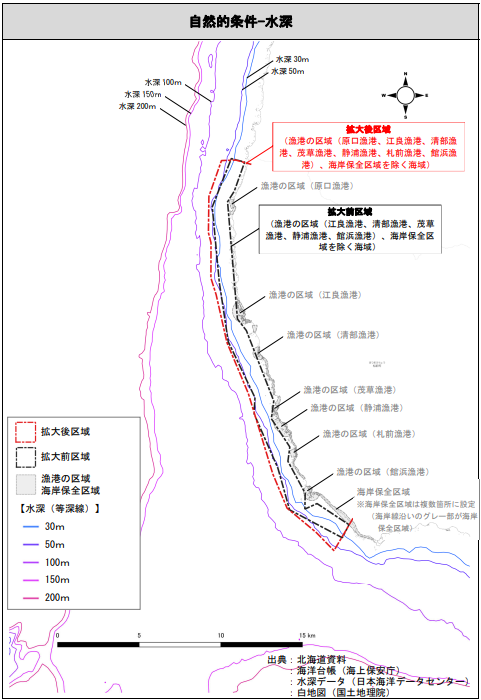
Within the zone, approximately 20% of the area has a water depth of less than 20 m, approximately 50% is less than 30 m, and approximately 75% is less than 40 m.
The deepest point within the zone reaches approximately 67 m.
2-3. Seabed Conditions
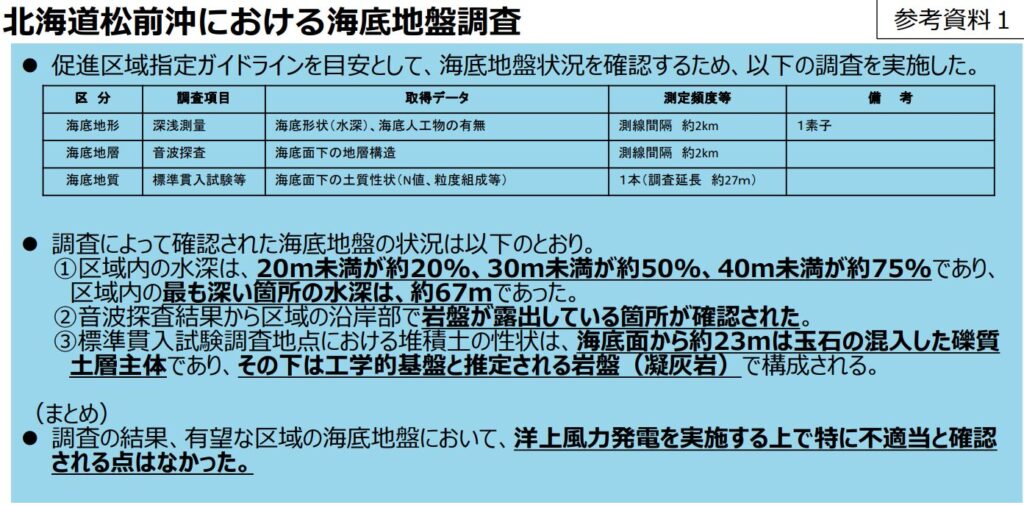
Based on acoustic survey results, exposed bedrock has been confirmed in coastal areas within the zone.
Down to approximately 23 m from the seabed surface, the layer consists primarily of gravelly soil mixed with boulders, below which the formation is composed of bedrock (tuff) estimated to constitute the engineering foundation.
2-4. Port Infrastructure
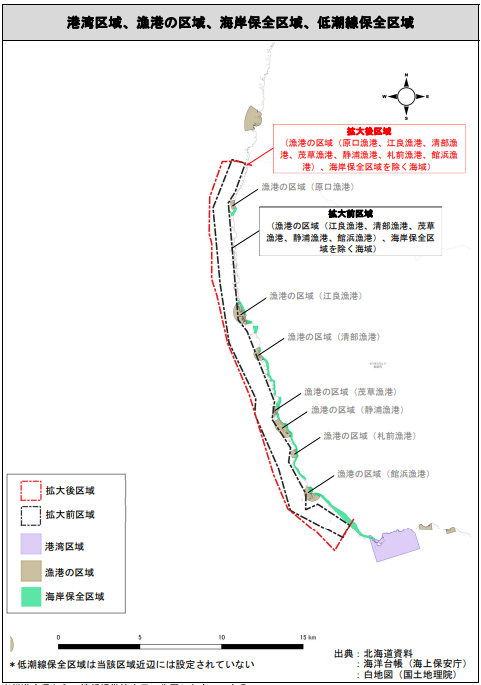
There are multiple fishing ports in the vicinity of the zone, and the nearest port area is Matsumae Port.
3. Consortium Members
TBD
4. Project Implementation Structure
TBD
5. Project Schedule
5-1. Overall schedule
- November 13, 2023: 1st Statutory Council Meeting
- March 26, 2024: 2nd Statutory Council Meeting
- July 31, 2024: 3rd Statutory Council Meeting
5-2. EIA status
| 事業名称 Project name | 事業者名 Developer | 手続段階 EIA Stage | 容量 Capacity | 基数 Turbines | 出力 Rating | 更新日 Last Updated |
|---|---|---|---|---|---|---|
| (仮称)北海道松前沖洋上風力発電事業 Matsumae Offshore Wind Power Project | 関西電力株式会社 Kansai Electric Power | 配慮書 Scoping Document | Max. 360MW | 15 – 25 | 14 – 22.6MW | 2024/11/26 |
Source: Environmental Impact Assessment Case Information (Ministry of the Environment, Japan)
6. LCOE and IRR Estimation
Evaluating the bankability of offshore wind projects requires close attention to key cost indicators such as LCOE (Levelized Cost of Energy) and IRR (Internal Rate of Return). However, in Japan’s Promotion Zones, detailed project-level cost information remains limited in publicly available materials. As a result, investors and developers often lack sufficient data to form a fully informed assessment.
To address this gap, DeepWind applies a proprietary cost model using representative site conditions for each project, including wind resource (capacity factor), water depth, distance to port, and distance to grid connection point. Based on these input parameters, we estimate CAPEX, OPEX, LCOE, and IRR in a consistent framework.
This approach allows us to provide a cross-project comparison of the relative economic positioning of Japan’s Promotion Zone projects.
▶ For the latest model assumptions and updated relative positioning, please refer to the cost analysis Pillar article below.
👉 Cost Realities of Japan’s Offshore Wind: Analyzing LCOE and IRR Across 12 Promotion Zones (Latest Edition)
Summary
The Hokkaido Matsumae Offshore Wind Power Project is one of the candidate sites in Japan’s 4th round of promotion area tenders (“Round 4”) under the Act on Promoting Utilization of Sea Areas for Renewable Energy. Located along the Sea of Japan coast in southwestern Hokkaido, the project is planned to have a maximum capacity of approximately 315 to 320 MW.
As the area requires careful consideration for coexistence with fisheries and environmental impacts, sustainability and regional collaboration will be key challenges moving forward. While the project’s implementation framework, consortium composition, and grid connection plans remain undecided, it has attracted growing attention, and further details are awaited.
As the project advances through developer selection and environmental assessments, we will continue to provide timely updates on its progress.
To explore how this area compares nationally and understand Japan’s offshore wind roadmap, visit:
Promotion Areas for Offshore Wind in Japan – 2025 Overview —
your guide to Japan’s offshore wind Promotion Areas.
Explore more categories at DeepWind:
- 🔍Market Insights – Understand the latest trends and key topics in Japan’s offshore wind market
- 🏛️Policy & Regulations – Explore Japan’s legal frameworks, auction systems, and designated promotion zones.
- 🌊Projects – Get an overview of offshore wind projects across Japan’s coastal regions.
- 🛠️Technology & Innovation – Discover the latest technologies and innovations shaping Japan’s offshore wind sector.
- 💡Cost Analysis – Dive into Japan-specific LCOE insights and offshore wind cost structures.