
Japan is accelerating the deployment of offshore wind power, and one of the most symbolic projects in this effort is the Aomori Tsugaru Offshore Wind Power Project. This initiative is part of the Japanese government’s third round of offshore wind power auctions—commonly known as “Round 3”—and represents a critical step toward achieving the national targets of 10 GW of offshore wind capacity by 2030 and 30–45 GW by 2040.
With a total planned capacity of 615 MW, the project will significantly contribute to the decarbonization of Japan’s energy mix through fixed-bottom offshore wind power. It is also expected to drive regional industrial development and economic revitalization. This article provides a detailed overview of the project, including installation locations, site conditions, and schedules.
➡ For an overview of all ten Promotion Areas as of 2025, see:
Promotion Areas for Offshore Wind in Japan – 2025 Overview
1. Project Overview
| Project name | Tsugaru Offshore Wind Project |
| Developer | Tsugaru Offshore Energy LLC |
| Consortium Members | JERA Green Power Investment Tohoku Electric Power |
| Location | Offshore tsugaru City, aomori Prefecture |
| Type | Fixed-bottom Offshore Wind Power |
| WTG | SG DD236 15MW(SGRE) |
| Price | 3 JPY/kWh |
| Capacity | 615 MW (15 MW × 41 turbines) |
| Start of Construction | april 2026 |
| Operation Period | june 2030 –2055 |
2. Location and Site conditions
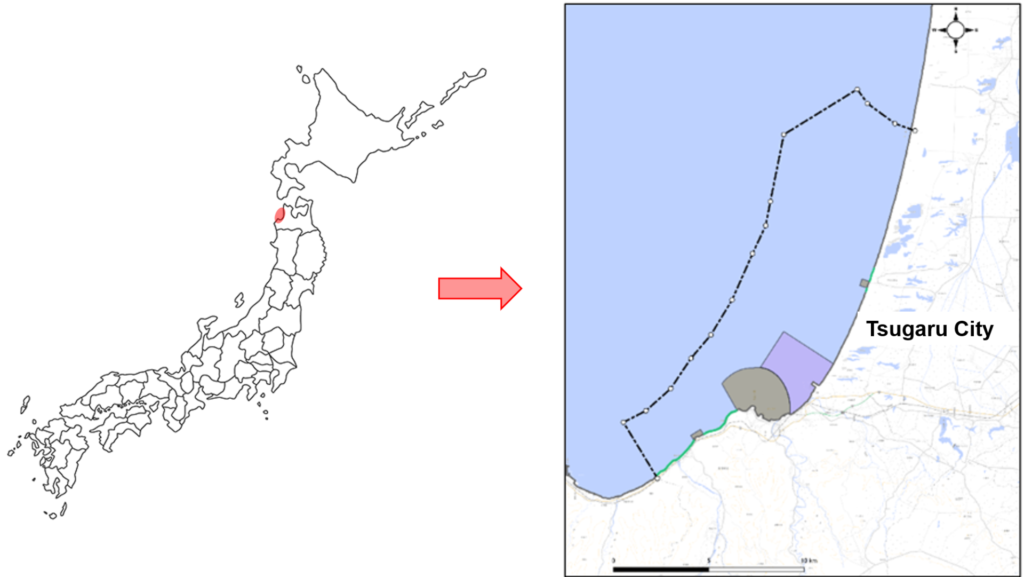
2-1. Wind Conditions
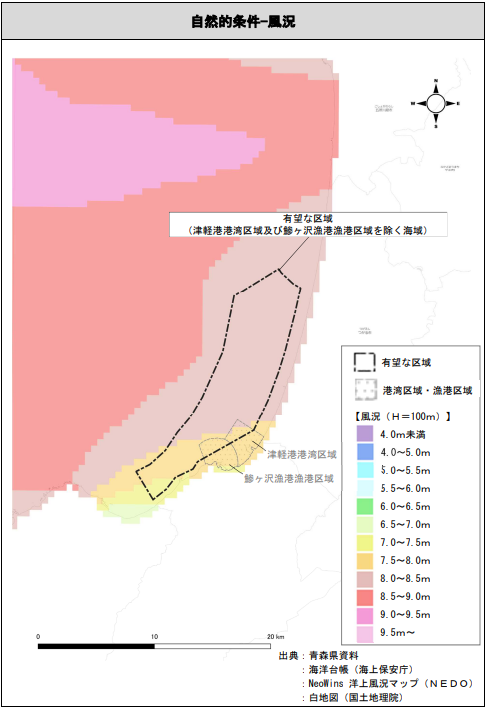
The wind speed within the zone is approximately 7.5–8.5 m/s (at 100 m altitude).
2-2. Water Depth
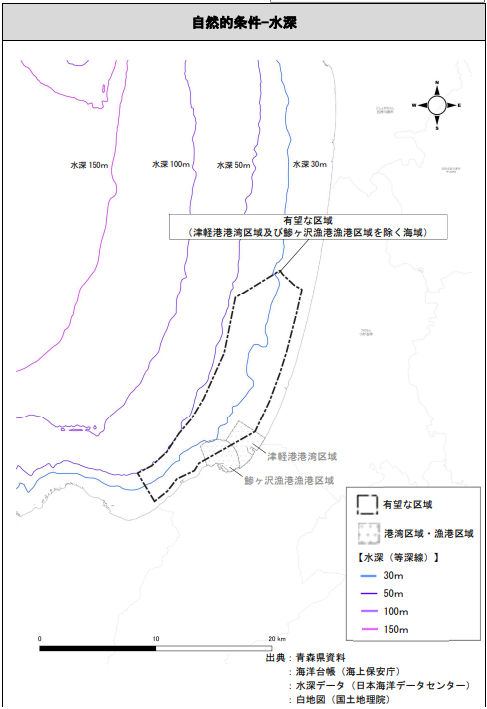
Within the zone, approximately 14% of the area has a water depth of less than 20 m, approximately 39% is less than 30 m, approximately 74% is less than 40 m, and approximately 99% is less than 50 m.
The deepest point within the zone reaches approximately 52 m.
2-3. Seabed Conditions
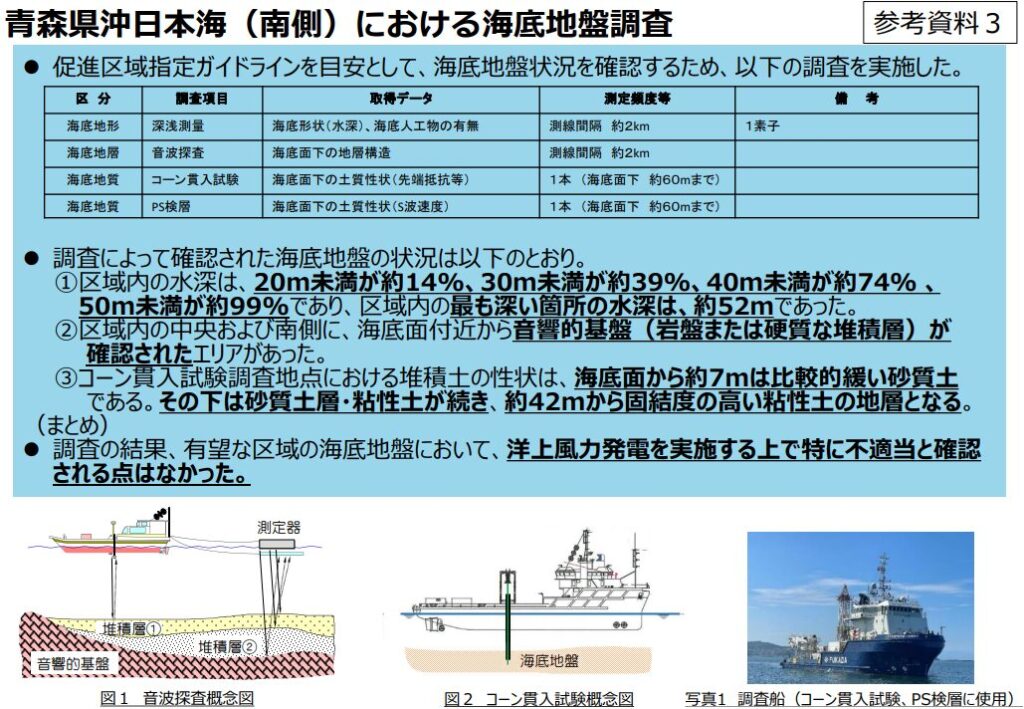
Within the central and southern parts of the zone, areas have been identified where acoustic basement (bedrock or hard sedimentary layers) is confirmed near the seabed surface. Down to approximately 7 m from the seabed surface, the layer consists of relatively loose sandy soil.
Below that, layers of sandy soil and cohesive soil continue, with highly consolidated cohesive soil strata from approximately 42 m depth.
2-4. Port Infrastructure
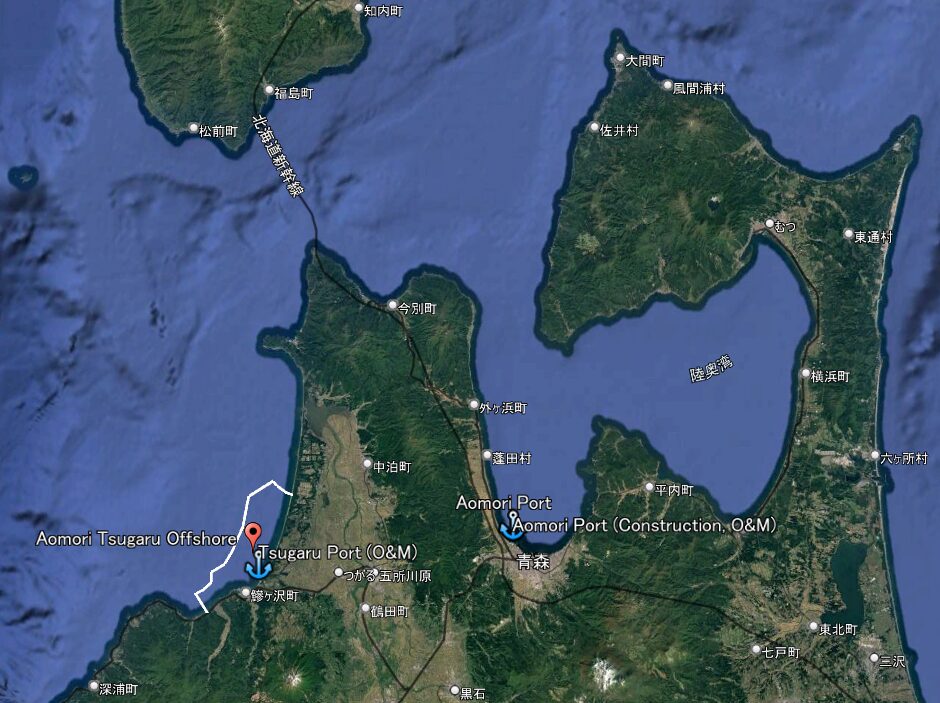
The construction base port is Aomori Port. The O&M ports are designated as Aomori Port and Tsugaru Port.
3. Consortium Members
JERA
- Japan’s largest power generation company.
- Extensive long-term experience in O&M across numerous power plants.
- Rich track record in overseas offshore wind projects in Taiwan and Europe.
- Subsidiary Parkwind has over 13 years of offshore wind O&M experience in Europe.
Green Power Investment
- A renewable energy developer with a strong track record in wind power development, construction, and O&M both in Japan and abroad since the industry’s early days.
- Has worked with the local community in the region since 2009 through the Tsugaru wind farm in Aomori Prefecture.
- Led early-stage development and community engagement in the area, building a foundation of trust with local stakeholders.
- One of the few companies in Japan with hands-on experience in offshore wind through completion of the Ishikari Bay New Port Offshore Wind Farm.
Tohoku Electric Power
- A utility company with over 70 years of experience in power plant construction and O&M in the Tohoku region.
- Extensive expertise in responding to emergencies, including the Great East Japan Earthquake and region-specific natural disasters.
- The leading retail electricity provider in the region, enabling local production and consumption of renewable electricity.
- Trusted by local communities through a long history of ensuring stable power supply in the Tohoku region.
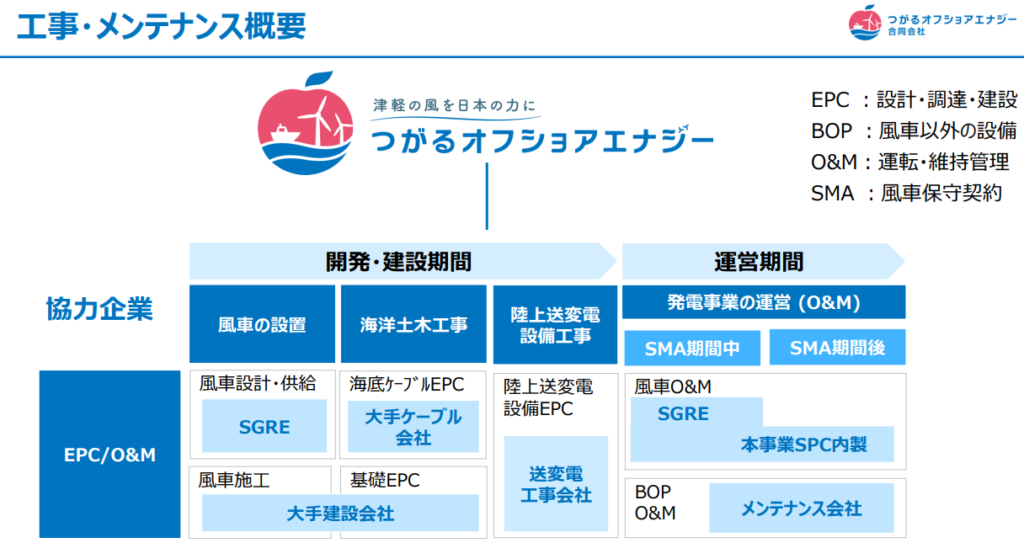
4. Project Implementation Structure
5. Project Schedule
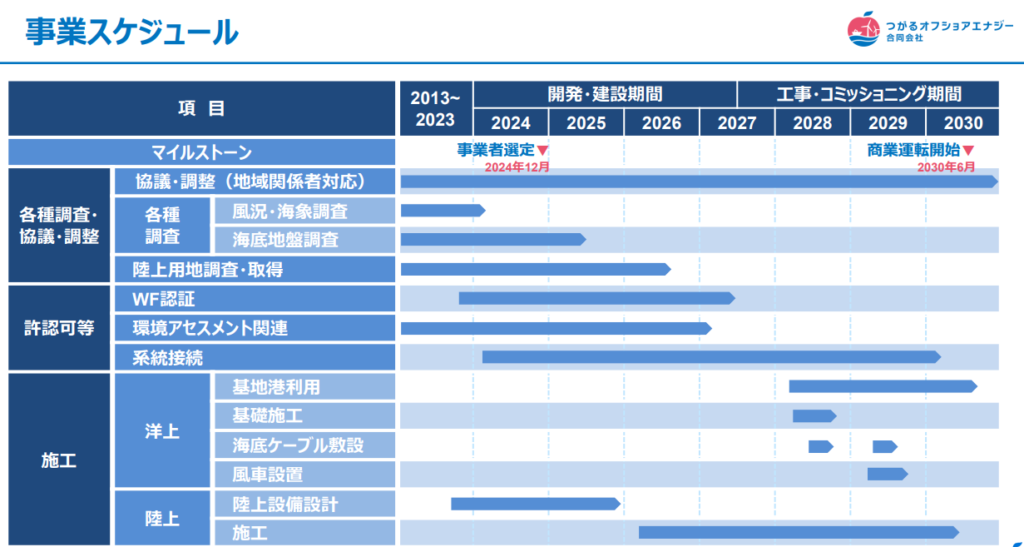
5-1. Overall schedule
- December 25, 2020: 1st Statutory Council Meeting
- December 22, 2021: 2nd Statutory Council Meeting
- May 9, 2023: 3rd Statutory Council Meeting
- July 28, 2023: 4th Statutory Council Meeting
- October 28, 2025: 5th Statutory Council Meeting
Development & Design Phase (2024–2026)
- December 2024: Award of public auction
- Environmental impact assessment, wind and ocean condition surveys, seabed geological surveys
- Local stakeholder consultations and coordination
- Wind farm certification and submission of construction plan
Construction Phase (2026–2030)
- 2026: Construction of onshore substation and transmission infrastructure
- 2028: Installation of offshore foundations and cables
- 2029: Assembly and installation of wind turbines
Operation & Maintenance Phase (2030–2055)
- Turbine maintenance: SGRE and this SPC
- Operation management (BOP): Maintenance company
Decommissioning & Repowering Phase (Post-2055)
5-2. EIA status
| 事業名称 Project name | 事業者名 Developer | 手続段階 EIA Stage | 容量 Capacity | 基数 Turbines | 出力 Rating | 更新日 Last Updated |
|---|---|---|---|---|---|---|
| 津軽洋上風力発電事業 Tsugaru Offshore Wind Project | つがるオフショアエナジー合同会社 Tsugaru Offshore Energy LLC | 準備書 Draft EIA Report | 615MW | 41 | 15MW | 2026/02/17 |
| (仮称)鰺ヶ沢洋上風力発電事業 Ajigasawa Offshore Wind Project | 株式会社鰺ヶ沢洋上風力発電所 Ajigasawa Offshore Wind Power Co., Ltd. | 方法書 EIA Method Statement | Up to 800MW | 51 | 9.5-20MW | 2026/01/13 |
| (仮称)青森県沖日本海(南側)洋上風力発電事業 Aomori Sea of Japan (South Area) Offshore Wind Project | RWE Renewables Japan合同会社、三井物産株式会社、大阪ガス株式会社 RWE Renewables Japan LLC et al. | 配慮書 EIA Scoping Document | 900MW | 38-75 | 12-16MW | 2025/01/21 |
Source: Environmental Impact Assessment Case Information (Ministry of the Environment, Japan)
6. LCOE and IRR Estimation
Evaluating the bankability of offshore wind projects requires close attention to key cost indicators such as LCOE (Levelized Cost of Energy) and IRR (Internal Rate of Return). However, in Japan’s Promotion Zones, detailed project-level cost information remains limited in publicly available materials. As a result, investors and developers often lack sufficient data to form a fully informed assessment.
To address this gap, DeepWind applies a proprietary cost model using representative site conditions for each project, including wind resource (capacity factor), water depth, distance to port, and distance to grid connection point. Based on these input parameters, we estimate CAPEX, OPEX, LCOE, and IRR in a consistent framework.
This approach allows us to provide a cross-project comparison of the relative economic positioning of Japan’s Promotion Zone projects.
▶ For the latest model assumptions and updated relative positioning, please refer to the cost analysis Pillar article below.
👉 Cost Realities of Japan’s Offshore Wind: Analyzing LCOE and IRR Across 12 Promotion Zones (Latest Edition)
Conclusion
Aomori Tsugaru Offshore Wind Power Project represents a significant milestone in Japan’s push for renewable energy. With a strong focus on sustainability, economic development, and technological innovation, it lays the foundation for the expansion of offshore wind power in Japan.
To explore how this area compares nationally and understand Japan’s offshore wind roadmap, visit:
Promotion Areas for Offshore Wind in Japan – 2025 Overview —
your guide to Japan’s offshore wind Promotion Areas.
Explore more categories at DeepWind:
- 🔍Market Insights – Understand the latest trends and key topics in Japan’s offshore wind market
- 🏛️Policy & Regulations – Explore Japan’s legal frameworks, auction systems, and designated promotion zones.
- 🌊Projects – Get an overview of offshore wind projects across Japan’s coastal regions.
- 🛠️Technology & Innovation – Discover the latest technologies and innovations shaping Japan’s offshore wind sector.
- 💡Cost Analysis – Dive into Japan-specific LCOE insights and offshore wind cost structures.