Published: January 9, 2025 | Updated: October 7, 2026
POLICY & REGULATION
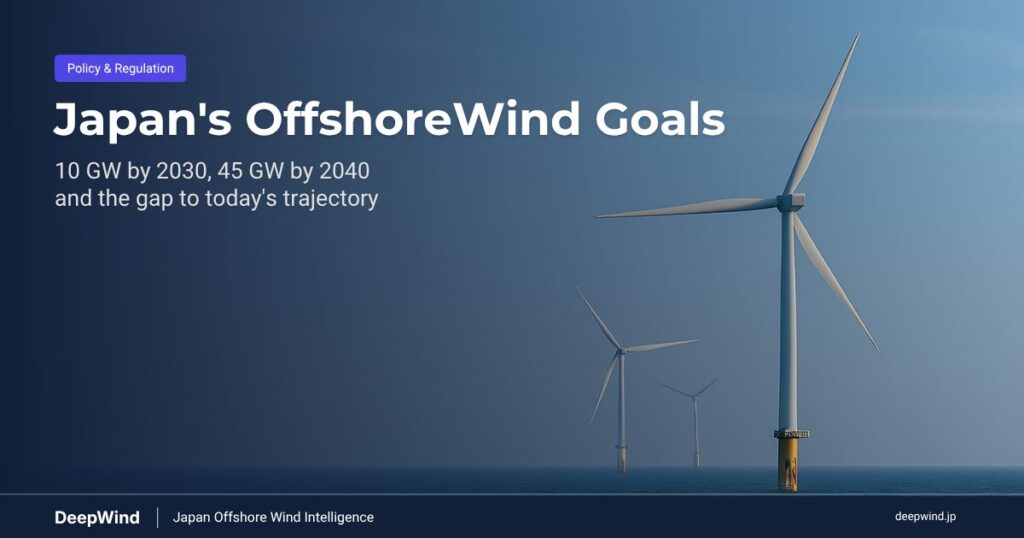
Japan’s headline offshore wind goals are 10 GW by 2030 and 30-45 GW by 2040, with at least 15 GW of that 2040 figure expected to come from floating wind. These numbers are quoted constantly — but two facts about them are usually missed. First, they are project-formation targets: the government’s aim is to bring that much capacity to the point where it can be auctioned, not to guarantee it is built and generating. Second, the current trajectory is well behind them — GWEC forecasts Japan will reach only about 3.5 GW of installed offshore wind by 2030. This article sets out exactly what the targets are, where Japan actually stands today, and what has to change for the gap to close.
👉 Japan’s Offshore Wind Policy & Regulatory Framework Explained
→
Execution Reality
→
Bankability Test
Japan aims to bring 10 GW to auction by 2030 and 30-45 GW by 2040 (≥15 GW floating). As GWEC notes, these “remain project formation targets… rather than to guarantee installed capacity.” Reading them as deployment promises overstates what the policy actually commits to.
Japan’s operational offshore wind only surpassed 500 MW after the 16.8 MW Goto and 220 MW Kitakyushu Hibikinada projects came online in Q1 2026. GWEC forecasts roughly 3.5 GW installed by 2030 and 8.4 GW by 2035 — a fraction of the 10 GW formation target.
The institutions exist; what is scarce is projects commercially viable enough to reach Final Investment Decision. Round 1’s Mitsubishi-led awards are being re-auctioned and Round 4 slipped from 2025 to 2026 — both symptoms of a price/cost gap, not a lack of policy targets.
What the 2030 and 2040 Targets Actually Are
Japan first set its offshore wind targets in late 2020, under the Vision for the Offshore Wind Industry: auction 10 GW of capacity by 2030 and 30-45 GW by 2040. In August 2025, an updated vision added a specific floating component — at least 15 GW of floating wind by 2040 — reflecting that most of Japan’s deep-water resource cannot be reached with fixed-bottom foundations. These figures are now carried into the 7th Strategic Energy Plan as national policy.
The critical detail is the kind of target. As GWEC’s 2026 Global Offshore Wind Report puts it, Japan’s numbers “remain project formation targets, meaning the government’s objective is to bring projects to a stage where they can be tendered rather than to guarantee installed capacity.” A formation target is met when the seabed is designated, surveyed, and put to auction — not when turbines spin. That distinction is why headline capacity figures and actual generation can diverge so widely.
👉 Japan’s Strategic Energy Plan Explained
The pipeline behind the formation target is taking shape. As of 2025, Japan had designated 12 promotion zones, 9 promising zones, and 17 preparation zones under the Renewable Energy Sea Area Utilization Act — a progressively systematized funnel from candidate area to auction.
Where Japan Stands Today
Deployment has lagged the ambition. After the 16.8 MW Goto floating project — Japan’s first commercial-scale floating wind farm — and the 220 MW Kitakyushu Hibikinada project were commissioned in the first quarter of 2026, Japan’s total operational offshore wind capacity only recently passed the 500 MW mark. Floating capacity specifically stood at just 5 MW at the end of 2025.
The awarded pipeline is larger but still maturing. The third auction round produced two major fixed-bottom awards now working toward commercial operation around 2030:
- Aomori Tsugaru (615 MW) — JERA, Green Power Investment, Tohoku Electric Power
- Yamagata Yuza (450 MW) — Marubeni, Kansai Electric Power, BP IOTA, Tokyo Gas
Even counting awarded-but-unbuilt capacity, the distance to a 10 GW formation pipeline that actually converts into operating gigawatts by 2030 is substantial.
The Gap Between Target and Trajectory
GWEC Market Intelligence forecasts that Japan will reach roughly 3.5 GW of installed offshore wind by 2030, expanding to 8.4 GW by 2035 — and projects Japan will account for about 8 GW (4.2%) of the 193 GW of APAC offshore wind additions expected over 2026-2035. In other words, the 2030 deployment trajectory lands at around a third of the 10 GW formation target.
The cause is not a shortage of institutions or permitting pathways. As GWEC frames it, Japan’s market is constrained by “a single correctable problem: the gap between auction price assumptions and market realities.” Projects that can reach Final Investment Decision (FID) generally proceed; the problem is that, under current cost and price conditions, very few can. Global inflation, higher construction costs, and rising financing costs have widened the gap between early-round auction assumptions and today’s economics, prompting several international developers to scale back.
Two visible symptoms: the three sites awarded to a Mitsubishi-led consortium in Round 1 (2021) are being re-auctioned, and the fourth auction round — originally planned for 2025 — was postponed to 2026 to allow auction-design reform.
👉 Japan’s Offshore Wind FID Barrier (GWEC 2026)
The targets do not fail at the ambition stage; they fail at the bankability stage. A formation target moves capacity to auction, but only a Final Investment Decision commits turbine orders, transmission build-out, and port upgrades — and FID requires a revenue case that clears lender hurdle rates under today’s CAPEX and financing costs. When early-round strike prices were set against pre-inflation cost assumptions, the resulting projects could not underwrite a financeable DSCR, which is why awards lapsed rather than converting to construction. Closing the 2030 gap is therefore less about adding zones and more about recalibrating auction price caps and risk-sharing so that awarded projects are financeable in the first place.
What Has to Unlock
Several moving parts determine whether the trajectory bends back toward the targets:
- Auction recalibration. Price caps, evaluation criteria, and risk-sharing are being revised based on the first three rounds — the central lever for restoring FID-grade economics.
- Floating commercialization. The government has committed to forming commercial floating projects in FY2029, the bridge to the ≥15 GW floating-by-2040 goal.
- EEZ expansion. The revised Marine Renewable Energy Sea Area Utilization Act came into force in April 2026, opening deep-water exclusive economic zone areas — substantial additional resource, though a long-term rather than near-term contribution to 2030.
- Supply chain build-out. Industrial capacity is forming — Vestas, for example, plans a nacelle assembly facility in Japan by 2029.
👉 Japan Expands Offshore Wind Zone to EEZ (2026 Edition)
👉 Floating Offshore Wind in Japan: Market Structure, Costs, and Policy
The number to watch is not the target — it’s the conversion rate from formation to FID.
Japan’s 10 GW and 30-45 GW figures are credible statements of intent, embedded in national energy strategy. But because they are formation targets, hitting them on paper says little about installed gigawatts. The honest scoreboard is how much designated capacity actually clears Final Investment Decision — and on GWEC’s read, that conversion is the binding constraint, leaving the 2030 deployment trajectory near 3.5 GW against a 10 GW formation goal.
This reframes what “on track” means. Adding promotion zones, expanding into the EEZ, and publishing a 15 GW floating sub-target all widen the funnel; none of them, on their own, makes a single project financeable. The decisive moves over the next two to three years are the unglamorous ones — auction price caps and risk allocation aligned to current costs — that let awarded projects reach FID. Watch the next auction terms and the Round 1 re-tender outcome more closely than the headline targets.
Related DeepWind Articles
- Japan’s Offshore Wind Policy & Regulatory Framework Explained
- Japan’s Strategic Energy Plan Explained
- Japan’s Offshore Wind FID Barrier (GWEC 2026)
- Japan Expands Offshore Wind Zone to EEZ (2026 Edition)
DeepWind Weekly tracks Japan’s offshore wind market beyond headline announcements, focusing on execution risk, cost structure, project viability, supply-chain constraints, and policy implications.
Subscribe to receive weekly intelligence on Japan’s offshore wind market.
Why Isn't Floating Wind Bankable in Japan Yet?
The synchronized supply-chain bottleneck, quantified node by node, with a full sensitivity ranking and a bankability ladder of scaling conditions. Includes Simulator Professional (β) access to reproduce every figure on your own assumptions.
See the full analysis →