
Introduction
How do renewable energy projects in Japan actually earn revenue? The answer depends on whether they operate under the Feed-in Tariff (FIT) or the Feed-in Premium (FIP) scheme. These two mechanisms determine not only how electricity is sold, but also how price risk and operational responsibility are allocated—particularly for capital-intensive projects such as offshore wind.
FIT and FIP are not simply subsidy programs. They define the structure of Japan’s renewable energy revenue model, shaping financing assumptions, exposure to wholesale market prices, and long-term project viability.
This article explains how the FIT and FIP schemes work, what distinguishes them, which framework currently applies to offshore wind projects, and where their practical limitations emerge as projects move from policy design to execution.
While this article focuses on a specific topic, those looking to understand Japan’s overall offshore wind policy and regulatory framework should also read our comprehensive summary here:
👉 Japan’s Offshore Wind Policy & Regulatory Framework Explained
1. FIT Scheme
The FIT scheme guarantees that electricity generated from eligible renewable energy sources is purchased at a fixed price for a predefined period. By eliminating exposure to wholesale market price fluctuations, FIT is designed to provide revenue certainty during the early stages of renewable energy deployment.
This revenue stability has played a central role in enabling initial market entry, particularly for technologies and project types that face high upfront capital requirements and long payback periods.
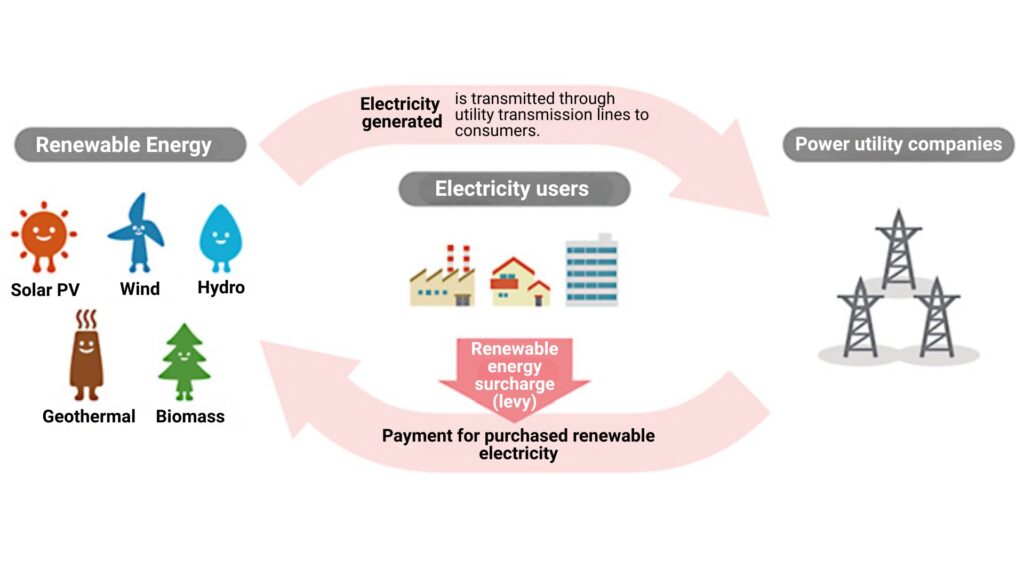
Source: METI Agency for Natural Resources and Energy website
1-1. Applicable Renewable Energy Sources
The FIT scheme applies to five categories of renewable energy: solar, wind, hydro, geothermal, and biomass. Eligible projects must meet national certification requirements and represent new power generation capacity.
In principle, all electricity generated by certified facilities is subject to purchase under FIT. However, for small- and mid-scale solar systems designed primarily for self-consumption, only surplus electricity exported to the grid is eligible. This reflects a policy distinction between utility-scale power generation and distributed energy use.
1-2. Renewable Energy Surcharge
The cost of purchasing renewable electricity under the FIT scheme is funded through a renewable energy surcharge collected from electricity consumers. The surcharge is added to monthly electricity bills and varies in proportion to electricity consumption.
By design, this mechanism socializes the cost of renewable energy deployment across electricity users nationwide. While it supports investment certainty for developers, it also introduces broader policy considerations regarding cost burden, transparency, and long-term sustainability of support levels.
2. FIP Scheme: Market-Linked Incentives
The FIP scheme represents a shift from fixed-price support toward market-linked revenue mechanisms. Under FIP, power producers sell electricity directly into the wholesale market and receive a premium on top of the market price.
This structure is intended to integrate renewable energy into electricity markets, encourage price-aware dispatch, and gradually increase producer responsibility for market participation.
2-1. Key Differences Between FIT and FIP
| Feature | FIT | FIP |
|---|---|---|
| Purchase Price | Fixed rate guaranteed by the government | Market price + premium |
| Imbalance Responsibility | Exempted | Power producers bear responsibility |
| Non-Fossil Value Trading | Not tradable (included in FIT price) | Tradable in the non-fossil certificate market |
2-2. Benefits of the FIP Scheme
Under the FIP scheme, power producers gain flexibility to respond to market signals and optimize sales strategies. In addition, projects that have completed their FIT procurement period may transition to FIP, allowing continued participation in support mechanisms while operating under market-based conditions.
At the same time, this flexibility comes with increased exposure to price volatility and operational responsibilities, marking a clear shift in risk allocation compared to FIT.
2-3. Which Scheme Applies to Offshore Wind in Japan?
In recent auction rounds, offshore wind projects in Japan are generally structured under the FIP framework rather than traditional FIT. This means developers participate in the wholesale electricity market and receive a premium determined through competitive bidding.
As a result, offshore wind projects are exposed to market price fluctuations and bear imbalance responsibility, reflecting Japan’s broader policy direction toward market integration of renewable energy.
Understanding this distinction is essential when assessing offshore wind project revenue structures under Japan’s evolving energy framework.
3. Challenges and Policy Responses
As renewable energy deployment has expanded, compliance and governance issues have become more visible. In some cases, projects certified under FIT or FIP were found to violate related laws, such as the Farmland Act or Forest Act, leading to temporary suspension of support.
These enforcement actions reflect a broader policy shift toward emphasizing legal compliance, environmental safeguards, and alignment with local communities, rather than focusing solely on capacity expansion.
4. Introduction of Generator-side Levy
To support long-term grid maintenance and expansion, Japan has introduced a generator-side levy, requiring power producers to share part of the system costs. This policy reflects growing attention to equitable cost allocation as renewable penetration increases.
Existing FIT- and FIP-certified projects will become subject to this levy after their procurement periods end, reinforcing the principle that renewable generators also contribute to system sustainability over time.
Conclusion
The FIT and FIP schemes form the backbone of Japan’s renewable energy revenue framework. FIT prioritizes revenue stability and early-stage deployment, while FIP promotes market integration and gradual exposure to price signals.
However, neither scheme is designed to guarantee project success on its own. They define revenue conditions and risk allocation, but execution outcomes remain dependent on market conditions, regulatory compliance, and project-specific assumptions.
Understanding FIT and FIP as policy frameworks—rather than simple financial incentives—is essential for assessing how renewable energy projects function within Japan’s evolving energy system.
For a broader understanding of Japan’s offshore wind legal system, policy structure, and support measures, be sure to check out our pillar article:
🌊 Japan’s Offshore Wind Policy & Regulatory Framework Explained
Explore more categories at DeepWind:
- 🔍Market Insights – Understand the latest trends and key topics in Japan’s offshore wind market
- 🏛️Policy & Regulations – Explore Japan’s legal frameworks, auction systems, and designated promotion zones.
- 🌊Projects – Get an overview of offshore wind projects across Japan’s coastal regions.
- 🛠️Technology & Innovation – Discover the latest technologies and innovations shaping Japan’s offshore wind sector.
- 💡Cost Analysis – Dive into Japan-specific LCOE insights and offshore wind cost structures.