Published: January 20, 2025 | Updated: September 10, 2026
TECHNOLOGY & INNOVATION
In July 2026, a consortium of J-Power, TEPCO Holdings, Chubu Electric, Kawasaki Kisen (K-Line), Sumitomo Heavy Industries, and Albatross Technology placed a 20 kW turbine in a bay off Iki, Nagasaki, and began a one-year sea trial. The output is trivial; the architecture is the point. This is a Floating Axis Wind Turbine (FAWT) — a vertical-axis rotor mounted on a rotating cylindrical float — and its entire rationale is cost. Conventional floating wind reduces cost by building bigger versions of the same high-center-of-gravity design; FAWT instead attacks Japan’s floating cost base at the level of the architecture itself. That makes it the most direct challenge to Japan’s cost problem — and, today, the least de-risked.
👉 Floating Offshore Wind in Japan: Market Structure, Costs, and Policy
→
Execution Reality
→
Bankability Test
A high center of gravity forces conventional floating platforms to be large and expensive to survive typhoons, and to be installed with heavy-lift vessels and large base ports. FAWT lowers the center of gravity, tolerates tilt, and lets the float shrink — targeting the exact cost drivers DeepWind tracks as Japan’s binding constraints.
Semi-submersible is expensive but de-risked; lenders can model it. A novel vertical-axis, rotating-float concept has no commercial track record, no established certification standard, and no full-scale reference. The 20 kW Iki unit proves technical feasibility, not commercial viability.
Three major utilities plus a shipping line, a heavy-industry fabricator, and the technology originator is a supply-chain and installability coalition, not a turbine club. It signals how hard the incumbents judge the conventional floating cost problem to be in Japan.
The Cost Logic Conventional Floating Wind Cannot Escape
Japan needs floating wind because it has almost no shallow water. Within a few kilometers of the coast, depths pass the point where fixed-bottom foundations remain economic, so accessing Japan’s strong offshore wind means putting the turbine on a moored float. The problem is what that float has to carry. A conventional turbine is a horizontal-axis machine with the nacelle and generator perched roughly 150 meters up the tower — a very high center of gravity. To hold that mass upright through typhoon-strength wind and waves, the platform and mooring must be large, heavy, and expensive.
That single fact ripples through the entire cost stack. Bigger platforms need more steel. Installing a tall machine offshore needs heavy-lift crane vessels — a class of asset not currently based in Japan. Marshalling and assembling those structures needs base ports with high ground-bearing capacity and large occupied areas. Japan’s installed floating CAPEX sits near roughly 908,000 JPY/kW on JWPA’s 2025 figures — around 2.4x the global category benchmark — and these physical constraints are a large part of why. Building the same architecture at larger scale spreads fixed costs, but it does not remove the underlying cost drivers.
👉 Floating Offshore Wind Platform Design: Engineering Fundamentals and Key Types
How FAWT Inverts the Floating Cost Base
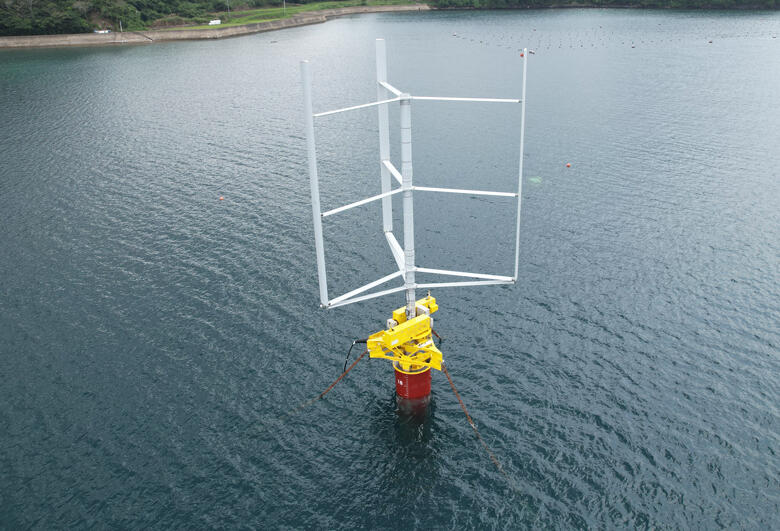
Figure 1: The FAWT experimental machine (20 kW, 9.3 m rotor) in sea trials at Iki
A vertical-axis rotor of three straight blades, supported by a rotating cylindrical float. Rotor and float turn together.
Source: FAWT consortium (J-Power / TEPCO HD / Chubu Electric / K-Line / Sumitomo Heavy Industries / Albatross Technology), 2026
FAWT (pronounced “fout”) starts from a marine-engineering premise rather than a wind-industry one: a floating structure is cheaper when its center of gravity is low and when it is allowed to tilt and move, rather than being forced upright. It uses a vertical-axis rotor — three straight blades turning around a vertical shaft — supported by a rotating cylindrical float, with the rotor and float turning together. Because a vertical-axis machine places heavy equipment, including the generator, low and near the sea surface, the structure is bottom-heavy and self-righting, like a roly-poly toy. According to the consortium, the design deliberately allows the platform to lean — tolerating up to about 20 degrees of tilt at rated output — because a vertical-axis rotor loses little performance when inclined, and permitting that tilt lets the float be made smaller.
The claimed cost consequences follow a consistent logic, summarized below. These are the developers’ design targets, verified so far by numerical analysis, tank testing, and onshore trials — not by commercial operation.
| Cost driver in conventional floating | FAWT design response (consortium) |
|---|---|
| Large float and mooring to keep a high-CoG machine upright | Low center of gravity + tilt tolerance allow a smaller float and lower structural cost |
| Large main bearing and drivetrain high in the tower | Rotating cylindrical float carries the turbine weight and overturning moment; no large main bearing needed |
| High O&M cost for equipment 100+ m above the sea | Generator sits near the waterline, lowering maintenance and operating cost |
| Long, imported supply chain for one-piece blades and large generators | Blades of constant cross-section, split lengthwise and made by continuous CFRP pultrusion; a 15 MW machine built from, e.g., fifteen 1 MW generators — geared to domestic mass production |
| Heavy-lift crane vessels and large base ports for installation | Assembly and installation without a large crane, cutting installation cost, schedule, and port footprint |
The efficiency question is where vertical-axis machines are usually dismissed, and the consortium addresses it directly. Small vertical-axis rotors do perform poorly, because the flow around their blades stays near a laminar boundary layer and separates, causing stall. At large scale, the consortium argues, the blades sit in a developed turbulent boundary layer that resists stall, so a large vertical-axis rotor can reach efficiency comparable to a horizontal-axis machine of similar size. That parity claim is central to the whole cost case — and it is precisely what a demonstration program, not a brochure, has to establish.
The 2023–2026 Milestone Chain, and Who Is Backing It
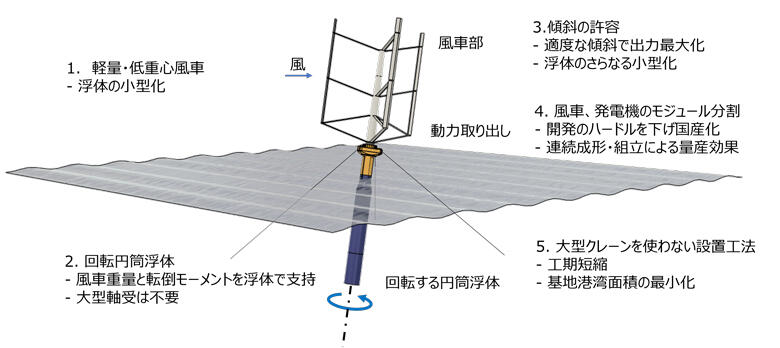
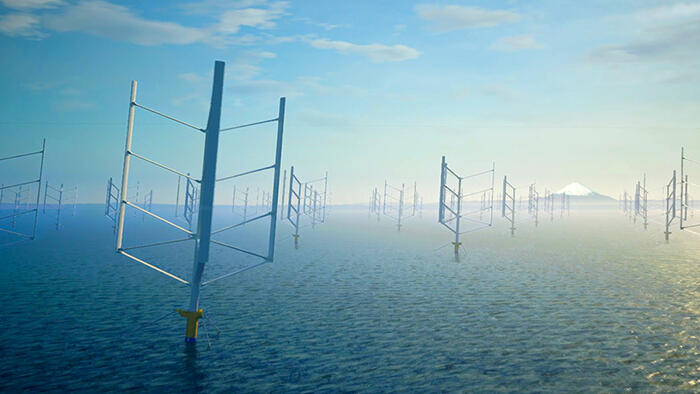
Figure 2: Concept image of a megawatt-class FAWT — the step beyond the small unit
The consortium targets a 5 MW-class large demonstrator as the next step after the small machine now at sea.
Source: FAWT consortium, 2024 (NEDO next-generation technology program)
FAWT is not a sudden announcement. It moved along two parallel tracks. A self-funded joint-research agreement, signed in May 2023, set out to build and float the small experimental machine; the September 2024 selection under NEDO’s next-generation floating wind program (“feasibility verification of a large floating vertical-axis turbine”) funds the separate, harder task of designing a megawatt-class commercial machine toward basic design approval. The consortium’s own illustrations target a 5 MW-class large demonstrator as the next step beyond the small unit now in the water.
| Project | FAWT small-scale sea demonstration |
|---|---|
| Location | Bay at Iki City, Nagasaki |
| Rating | 20 kW (rotor diameter 9.3 m; float diameter 1.7 m) |
| Status | Sea trial began 2 July 2026; planned duration ~1 year, then removal and component analysis |
| Platform / mooring | Vertical-axis rotor (three straight blades) on a rotating cylindrical float; three mooring lines to seabed anchors |
| Consortium (2026) | J-Power, TEPCO HD, Chubu Electric, K-Line, Sumitomo Heavy Industries, Albatross Technology |
| Key execution issue | Novel concept — no established safety/certification standard yet; must be created with a classification body |
| Key commercial issue | MW-scale efficiency parity and bankability unproven; concept remains pre-commercial |
Read the members, not just the device. Three of Japan’s largest utilities — J-Power, TEPCO HD, and Chubu Electric — sit alongside K-Line for marine operations, Sumitomo Heavy Industries for fabrication and production technology, and Albatross Technology as the concept originator, with universities and material-research centers supporting motion analysis, lightning protection, life-cycle assessment, and CFRP forming. In the NEDO track, roles are split accordingly: J-Power on certification process and supply-chain analysis, TEPCO HD on large-machine numerical methods, K-Line on installation and O&M cost reduction, and Sumitomo Heavy Industries Marine Engineering on large-machine design and production technology. This is the composition of a coalition trying to solve installability and domestic supply chain — the parts of Japan’s cost problem that scaling a semi-submersible does not, by itself, fix.
What the 20 kW Iki Trial Can — and Cannot — Prove
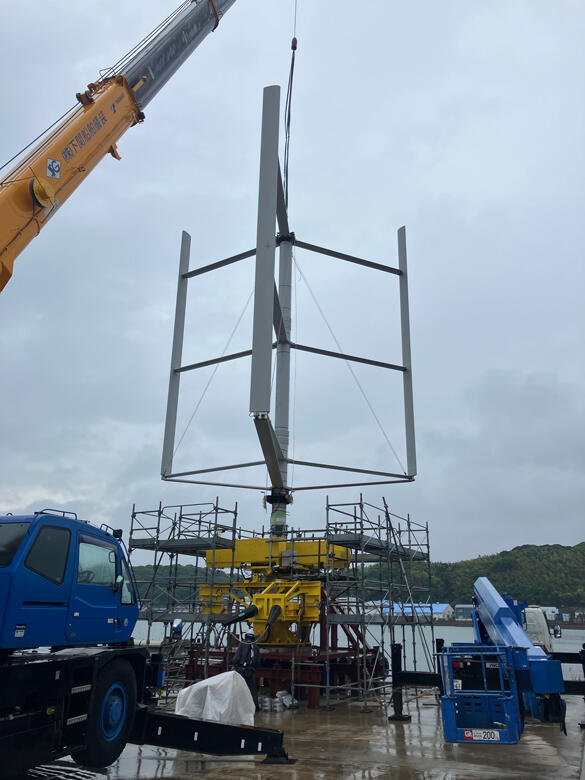
Figure 3: Onshore testing of the FAWT experimental machine before sea installation
Numerical analysis, tank testing, and onshore trials feed into the in-sea verification of technical feasibility.
Source: FAWT consortium, 2026
A one-year sea trial of a 9.3-meter rotor is a real and necessary step. It validates the analysis and design methods in actual waves, currents, and wind, and it feeds component condition data back into the design work for scale-up. What it cannot do is settle the commercial questions, and it is important to keep those separate.
Three gaps remain open. First, efficiency parity between a large vertical-axis rotor and a horizontal-axis machine is a consortium claim supported by their own numerical work; it has not been demonstrated at commercial scale, and a 20 kW unit is a scaled-down model, not proof of MW-class yield. Second, because the concept is new, there is no established certification standard — the consortium plans to develop one jointly with a classification body, which is itself a multi-year path. Third, even a successful large demonstrator faces the lender-acceptance gap that any first-of-a-kind design meets in Japan.
FAWT’s paradox is that the architecture with the lowest theoretical cost is the hardest to finance today. Project lenders underwrite floating wind on evidence — full-scale references, established motion data, and a certification basis that lets them model P90 energy yield and hold DSCR at or above 1.35x. A novel vertical-axis, rotating-float concept has none of these yet, so its risk-adjusted cost of capital is high even if its engineering cost is low. Semi-submersible sits at the opposite corner: costly to build, but de-risked enough to fund. FAWT only becomes bankable if the megawatt-class demonstrator, a certification standard, and operating data arrive together — most plausibly in the early 2030s at the earliest.
There is one further structural idea in the concept worth flagging, because it reframes financing rather than just cost. Because a floating turbine is legally a vessel, the consortium argues it can be relocated, resold, or leased — opening the door to ship-style finance, second-hand markets, and mid-life replacement with an improved machine, instead of the build-and-scrap logic of fixed-bottom wind. That is a genuinely different way to think about floating wind risk allocation. It is also, for now, a proposition rather than a market.
What happens after the trial is covered separately, following the September 2026 capital alliance.
FAWT is the clearest test of whether Japan can lower floating wind cost by changing the architecture rather than enlarging it.
Japan’s floating cost problem is not mainly the turbine. It is the float, the installation vessels, the ports, and the imported supply chain — the physical constraints DeepWind tracks as the binding ones. What makes FAWT analytically important is that it aims at exactly those drivers: a smaller float, no heavy-lift crane, a smaller base-port footprint, and a domestic, mass-produced CFRP supply chain. If the parity claim holds at scale, it is the most coherent attack on Japan’s specific cost base we have seen.
The caution is equal and opposite. Semi-submersible dominates Japan’s 2030 pipeline not because it is cheap but because it is fundable, and every incumbent is investing there in parallel. FAWT is a longer-dated, higher-variance bet that trades bankability today for a lower cost base later. The signal to watch is not the 20 kW trial itself but whether the NEDO megawatt-class design reaches basic design approval and attracts a certification standard. Until then, treat FAWT as a serious cost hypothesis under test — not as a settled game-changer.
Related DeepWind Articles
- Floating Offshore Wind in Japan: Market Structure, Costs, and Policy
- Floating Offshore Wind Platform Design: Engineering Fundamentals and Key Types
- Floating Offshore Wind Cost Structure and LCOE Reality
- Obayashi Secures World-First AiP for Hybrid TLP Floating Wind — A Second Path Beyond Semi-Sub
DeepWind Weekly tracks Japan’s offshore wind market beyond headline announcements, focusing on execution risk, cost structure, project viability, supply-chain constraints, and policy implications.
Subscribe to receive weekly intelligence on Japan’s offshore wind market.
Why Isn't Floating Wind Bankable in Japan Yet?
The synchronized supply-chain bottleneck, quantified node by node, with a full sensitivity ranking and a bankability ladder of scaling conditions. Includes Simulator Professional (β) access to reproduce every figure on your own assumptions.
See the full analysis →