Published: June 26, 2026 | Updated: July 12, 2026
MARKET DYNAMICS
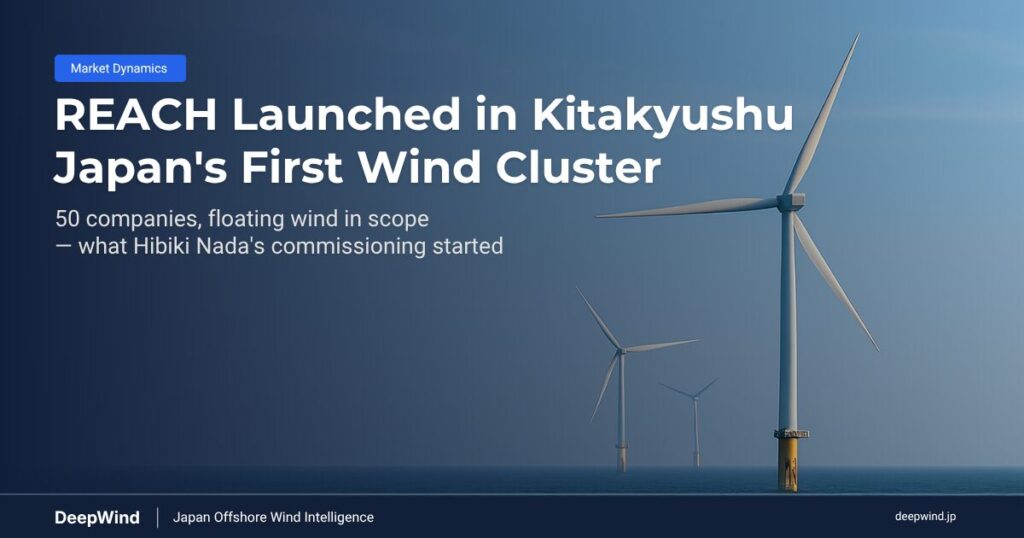
Japan commissioned its largest offshore wind project in March 2026 — the 220 MW Kitakyushu Hibiki Nada Offshore Wind Farm (nicknamed “Wind KitaQ 25”). Less than three months later, approximately 50 companies formally organized around it. On May 22, 2026, REACH — the Hibiki Nada Offshore Wind Industry Promotion Organization — was launched in Kitakyushu. Founding members include 九電みらいエナジー (Kyushu Electric Power subsidiary), Craftia, 西部ガス, 日本郵船, Japan Marine United, and 日本製鉄エンジニアリング, spanning the full supply chain.
👉 Kitakyushu Hibiki Nada Offshore Wind — Project Overview
→
Execution Reality
→
Bankability Test
Hibiki Nada’s commissioning in March 2026 provided Japan with its first cluster-scale operational anchor. Supply chain organizations form around certainty — actual construction records, O&M contracts, and documented port utilization — not around capacity targets or pending auctions.
The cluster is not a post-project administration body. One element of REACH’s stated scope stands out: floating wind is already in view, signaling that the organizations forming around Japan’s largest fixed-bottom project are building capability for the next technology cycle, not managing a single completed project.
Local cost absorption, contractor track records, and port infrastructure development are supply chain outcomes — not policy outcomes. They happen at the project level, in clusters like REACH, when projects actually complete. This is what execution-ready development looks like in practice.
1. The Anchor: What 220 MW Actually Enables
Japan’s offshore wind fleet has historically been characterized by port-constrained and demonstration-scale projects. Hibiki Nada at 220 MW is a different order of magnitude. By GWEC’s latest count, Japan’s total operational offshore wind capacity recently surpassed the 500 MW milestone — meaning Hibiki Nada alone accounts for roughly 44% of Japan’s operational fleet.
That scale matters for cluster formation. Supply chain investment follows project certainty, not planning ambitions. A 220 MW project requires real EPC contracting, real port logistics, real O&M staffing, and real grid connection management — over a multi-year construction period. The organizations that developed capability to serve Hibiki Nada are not theoretical; they have documented records. REACH formalizes that capability as a named, organized entity.
Japan’s fixed-bottom pipeline beyond Hibiki Nada remains constrained by the FID barrier that GWEC and others have identified. Clusters like REACH matter precisely because they preserve and extend supply chain capability developed during a completed project — rather than allowing it to disperse between project cycles.
2. REACH: Structure, Scope, and the Floating Wind Signal
REACH — the Hibiki Nada Offshore Wind Industry Promotion Organization (一般社団法人 響灘洋上風力産業推進機構) — was formally launched on May 22, 2026 in Kitakyushu. Founding members include 九電みらいエナジー (30% shareholder in the project operator ひびきウインドエナジー, whose remaining equity is held by J-POWER 40%, 北拓 10%, 西部ガス 10%, and 九電工 10%), Craftia, 西部ガス, 日本郵船, Japan Marine United, and 日本製鉄エンジニアリング — approximately 50 companies and organizations spanning power generation, EPC, port operations, heavy manufacturing, steel, shipping, maintenance, finance, and research. Its stated model is Aberdeen: the Scottish port city that built a global offshore energy services hub on the foundation of North Sea oil, and is now a center for offshore wind.
Kitakyushu’s position as the cluster’s geographic center reflects the port infrastructure that supported Hibiki Nada’s construction and that now supports its operation. Port capability developed for one project cycle is a resource for the next — if the organizational structure to deploy it is maintained.
One element of REACH’s stated scope is structurally significant: floating wind is explicitly in view (“浮体式模索” — exploring floating wind, per Nikkei). This is not a forward-planning document; it is a founding mission statement for an organization anchored to an operational project. The inclusion of floating wind signals that REACH’s founders are positioning the cluster not as Hibiki Nada’s legacy organization, but as a vehicle for extending fixed-bottom supply chain capability into Japan’s next offshore wind technology cycle.
In July 2026, Vestas announced plans for a final nacelle assembly base in Kitakyushu’s Wakamatsu ward, selected for METI’s GX Supply Chain subsidy. See 👉 our analysis of the GX Supply Chain subsidy and its capacity floors.
3. Supply Chain Implications for Japan’s Next Project Cycle
Japan’s offshore wind cost structure is well-documented: CAPEX at approximately JPY 908,000/kW (JWPA, November 2025) is roughly 2.4x the BVG Associates global benchmark. The domestic cost premium is not primarily a technology cost — it reflects supply chain immaturity, logistics cost, and the absence of established domestic contractor track records at commercial scale.
Clusters address all three:
- Local cost absorption: domestic contractors who have completed a 220 MW project can bid more competitively on the next one — their cost base is not speculative
- Contractor track records: lenders assessing the next Kyushu project can look at Hibiki Nada construction and O&M data rather than relying solely on European comparables
- Port infrastructure: Kitakyushu port capability developed for Hibiki Nada reduces logistics uncertainty for subsequent fixed-bottom and potentially floating wind projects in the region
These are not marginal improvements. In project finance, the difference between a domestic contractor with a documented 220 MW track record and one without is a direct input into the P90 risk model — and into DSCR calculations.
👉 Japan’s JPY 370 Trillion Growth Strategy: Where Offshore Wind Sits in the 17 Priority Fields
👉 How to Read Japan’s Offshore Wind Market: Investment, Cost, and Supply-Chain Constraints
REACH is not a post-project administration body. It is the formalization of Japan’s first operationally-anchored offshore wind supply chain asset — and the clearest evidence yet of what execution-ready development looks like in practice.
Japan’s offshore wind supply chain discussion has been largely forward-looking: what needs to be built, what capacity needs to develop, what skills need to be trained. REACH is one of the first instances where the conversation is anchored to something that already exists. The 220 MW Hibiki Nada project completed. The supply chain that served it is documented. The organizations that built capability around it are now formalized.
The floating wind scope is the most strategically significant element of REACH’s founding mandate. Japan’s government targets the formation of commercial floating wind projects in fiscal year 2029. The industrial pathway from fixed-bottom operational experience to floating wind supply chain capability runs through clusters like REACH — where fixed-bottom learnings, port infrastructure, and contractor records can be channeled toward a technology cycle that does not yet have its own track record. Whether REACH proves replicable in other regions of Japan’s offshore wind geography will be a relevant data point for assessing how quickly Japan’s domestic supply chain can shift from speculative to evidence-based.
Related DeepWind Articles
- Kitakyushu Hibiki Nada Offshore Wind — Project Overview
- Japan’s JPY 370 Trillion Growth Strategy: Where Offshore Wind Sits in the 17 Priority Fields
- How to Read Japan’s Offshore Wind Market: Investment, Cost, and Supply-Chain Constraints
Why Isn't Floating Wind Bankable in Japan Yet?
The synchronized supply-chain bottleneck, quantified node by node, with a full sensitivity ranking and a bankability ladder of scaling conditions. Includes Simulator Professional (β) access to reproduce every figure on your own assumptions.
See the full analysis →