Published: August 14, 2026 | Updated: August 14, 2026
MARKET DYNAMICS
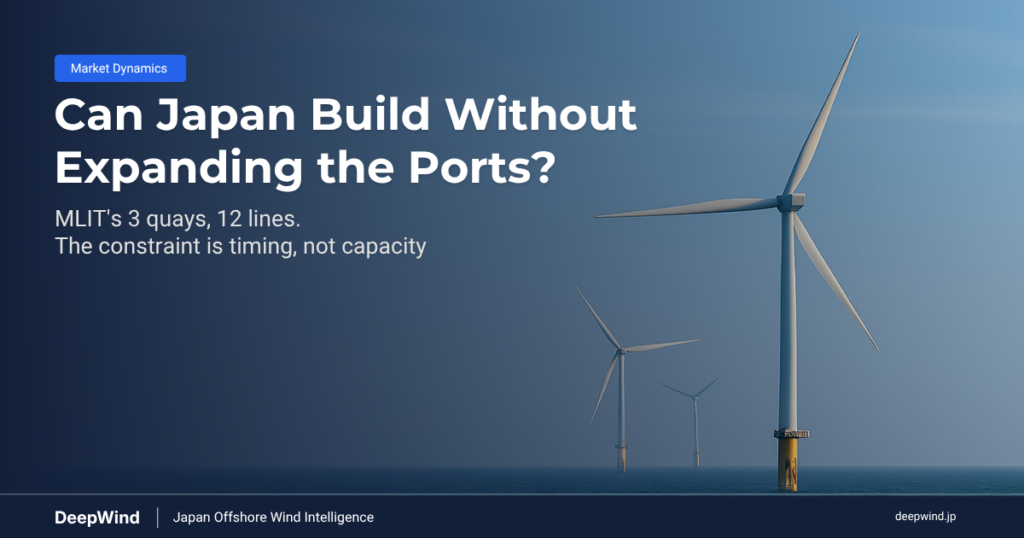
Three quays and twelve foundation fabrication lines. That, on MLIT’s modelling, is what it takes to build 1 GW of floating wind on Japan’s Sea of Japan coast in two years. A single typhoon then removes more than ten days from the programme. The obvious answer is to enlarge the ports. A JETRO-backed feasibility study, whose public summary EWindsA released to DeepWind for publication in August 2026, tried the opposite direction: move part of the marshalling and storage function off the quay and onto a relocatable floating platform. At concept level it found no fundamental technical barrier to doing so in Japan, and no regulatory one either, subject to project-specific approvals. The signal worth reading is not the vessel concept. It is that alternatives to permanent port expansion are now being examined at feasibility level.
→
Execution Reality
→
Bankability Test
Three quays and twelve lines are buildable. But permanent port works carry capital cost, approval processes and construction periods of their own, and those periods need not line up with an individual project’s build window. The shortfall is less about capacity than about when capacity becomes usable.
The platform can be built inside existing barge design and classification frameworks applied by ClassNK and other IACS societies, without creating a new vessel category. But that assessment is at concept level, and operation depends on project-specific approvals. The public summary discloses no construction cost, utilisation rate or charter rate, so the economics cannot be independently tested.
The platform is assessed as a reusable asset across several construction campaigns, which makes utilisation the deciding variable. Without firm projects the asset does not close; without visible logistics the construction programme does not firm up. The bottleneck circles back on itself.
Three quays, twelve lines, and the ten days a typhoon takes
Start with the size of the constraint. MLIT modelled a 1 GW floating wind farm at two build rates: 20 units per year for three-year completion, and 30 units per year for two years. The Sea of Japan outcome was three quays and twelve fabrication lines.
The reason is weather. The Pacific side works year-round, so one delivery quay and one installation quay are enough. The Sea of Japan side loses its marine window in winter, so turbine integration has to run in parallel within a compressed season: two installation quays plus one for delivery. Fabrication follows the same logic, five parallel lines on the Pacific side against twelve on the Sea of Japan side, because units must be stockpiled through winter for the spring campaign. Each line for a 15 MW-class floating foundation runs about 110 metres square, roughly 1.2 hectares. Add access routes and reinforced ground, and twelve lines is not a footprint a single Japanese port can offer.
👉 MLIT Simulations Reveal Massive Infrastructure Needs for 1GW Floating Wind
The time side is harsher still. MLIT’s 1 GW reference case assumes a construction cycle of two to three years depending on location. FLOWCON then applies the weather: if a typhoon develops while a turbine is being integrated onto a floating foundation, evacuation takes eight days and restart preparation two, so more than ten days go each time. Three events in a season consume close to a month. Workable-day rates run at roughly 40% year-round, and around 70% even if work is concentrated into the summer half-year, which is also typhoon season.
These numbers have long been read as proof that Japanese ports lack capacity. Laid side by side, they support a second reading. Three quays and twelve lines can be built. The open question is when they would be finished.
Five constraints in the study, and the sixth one underneath
The study was carried out by East Winds Asia with JETRO support, assessing a floating platform that combines transport with temporary storage across technical, market, regulatory and economic dimensions. As its starting point it names five structural limitations at Japanese ports being considered for offshore wind construction.
| Constraint named in the study | Scale visible in existing public material |
|---|---|
| Restricted yard space | Foundation fabrication needs about 110 m square (1.2 ha) per line; twelve lines for 30 units a year on the Sea of Japan side (MLIT) |
| Insufficient quay load capacity | Fabrication yards assume reinforced ground bearing capacity of 10 to 25 t/m² (MLIT) |
| Limited water depth and mooring facilities | Wet storage is modelled at 30 to 50 m depth, with anchor circle radii of 232 to 292 m per unit (MLIT) |
| Distance from offshore project sites | Multi-port sequencing takes 26 days per two units against 19 days for a single-port model (FLOWCON) |
| Competition with existing cargo | Wet storage berths and channels are occupied for around half a day at a time, requiring coordination with existing traffic (MLIT committee) |
All five were already in the discussion. What stands out is the sentence placed after them. Permanent port expansion, the study notes, can require substantial capital expenditure and long approval processes, with “construction periods that do not necessarily align with the schedules of individual offshore wind projects.” The constraint being named there is not area or depth. It is time.
Quay load capacity and wet storage are both solvable with construction. The difficulty is that the time to solve them can exceed the schedule that needs them, at which point a developer has to plan as if they do not exist. UK experience gives the order of magnitude: Offshore Solutions Group told DeepWind it spent close to three years assessing more than 200 candidate locations before reaching a short viable list, and its own Moray FLOW-Park in Scotland sits in year three of a plan expected to run six to seven. Permanent infrastructure tends to run on a longer clock than the build window it serves.
👉 Japan’s Wet Storage Gap: From Specification to Delivery in Floating Wind Logistics
What would have to be true for the floating answer to work?
The concept assessed combines transport capacity with temporary floating storage, staging and buffering for large components. It would sit near a port or construction area when needed and relocate to another project or region afterwards. The study is explicit that it complements existing base ports and feeder vessels rather than replacing them.
On technical and regulatory feasibility the conclusions are clear. The required deck loading capacity, stability, ballast capacity and structural configuration are achievable within existing barge design and classification frameworks, without a fundamentally new vessel category or unusual technical risk. Tug towing, loading and unloading at existing quays or temporary mooring locations, and deployment close to construction areas are all consistent with established maritime practice. And the concept can be operated within existing Japanese maritime and port-related regulatory frameworks.
The qualifiers carry as much weight as the conclusions. The technical assessment is explicitly at concept level, and regulatory operation is stated as subject to project-specific procedures and approvals. What the study establishes is the absence of a visible barrier, which is not the same as demonstrated execution.
On economics, conservative assumptions were applied to construction cost, operating expense, annual utilisation and charter rates, and the study found the concept could potentially achieve returns consistent with infrastructure assets, provided investment is linked to credible and executable projects rather than speculative future capacity. It identifies a staged model in which a final investment decision is connected to sufficient letters of intent or pre-charter commitments from several projects, so as to avoid building too early or depending on one project alone.
Tying FID to pre-charter commitments converts the asset’s utilisation risk into project pipeline risk. Read the other way, the infrastructure-grade return assumption fails the moment the utilisation case does. Because the public summary withholds construction cost, utilisation and charter rates, DeepWind cannot test the return level. For a lender the question is not what yield the model shows, but how many pre-charters the structure requires before FID, and whether that number is consistent with the count of Japanese projects realistically reaching construction in the same window.
Here the argument closes on itself. The asset works on utilisation across several campaigns, and utilisation depends on how many projects reach construction. Seen from the project side, whether a construction programme can be fixed depends on whether port and logistics capacity will be there. Projects will not firm up without logistics visibility, and the asset will not close without firm projects. One side has to move first, and the study itself notes that partner commitments, charter opportunities and governance all need further work before any FID. The loop is not yet broken.
The study also asks policymakers for clearer procedures on temporary floating infrastructure, more flexible rules for temporary mooring and storage around ports, and broader support for offshore wind logistics and marine infrastructure. Each is reasonable, but what policy can supply is procedure and flexibility. The number of projects actually reaching construction, which is what the utilisation case rests on, does not rise directly with a more flexible rulebook.
The installation layer is worth holding alongside this. MLIT’s Ports and Harbours Bureau selected seven R&D projects on floating wind marine construction methods on 24 July 2026, but the installation vessel layer itself still carries no funding. Holding storage and transport on a vessel closes the stage before installation, not the vessel gap itself, and that narrower claim is the accurate one.
👉 Japan Funds Floating Wind Installation R&D: Seven MLIT Projects, and the Vessel Question
Japan’s port constraint has been discussed as a capacity problem, but what actually binds is synchronisation.
The difficulty is aligning the date a port is finished with the window in which a project needs it. UK observations of permanent wet storage development run longer than the two to three year construction cycle in Japan’s own reference case. As long as that gap holds, projects will at some point have to plan around ports that are not yet built.
That gap is where relocatable floating logistics belongs. It is less a way of creating capacity than a way of buying time until capacity exists. The weakness specific to this answer is that its viability depends on pipeline certainty, the same variable the projects are waiting on. The de-synchronisation DeepWind has described in floating wind, where technology, cost, ports, installation, finance and policy each move at their own speed, appears to be reproducing itself one layer down in logistics. The signal worth tracking is not the vessel design. It is whether pre-charter commitments from multiple projects actually accumulate, and that is likely to happen on roughly the same schedule as Japan’s first floating projects reaching FID.
Related DeepWind Articles
- MLIT Simulations Reveal Massive Infrastructure Needs for 1GW Floating Wind: Three Quays and Twelve Lines on the Sea of Japan
- Japan’s Wet Storage Gap: From Specification to Delivery in Floating Wind Logistics
- The 10-Day Loss: FLOWCON Exposes the Reality of Japanese Floating Wind Construction
- The Shock of the 15MW Era: Port Scaling and Integrated Operations in the FLOWRA Report
- MLIT Estimates Reveal the Sea of Japan Handicap: Three Years Against Two on the Pacific Side
DeepWind Weekly tracks Japan’s offshore wind market beyond headline announcements, focusing on execution risk, cost structure, project viability, supply-chain constraints, and policy implications.
Subscribe to receive weekly intelligence on Japan’s offshore wind market.
Why Isn't Floating Wind Bankable in Japan Yet?
The synchronized supply-chain bottleneck, quantified node by node, with a full sensitivity ranking and a bankability ladder of scaling conditions. Includes Simulator Professional (β) access to reproduce every figure on your own assumptions.
See the full analysis →