
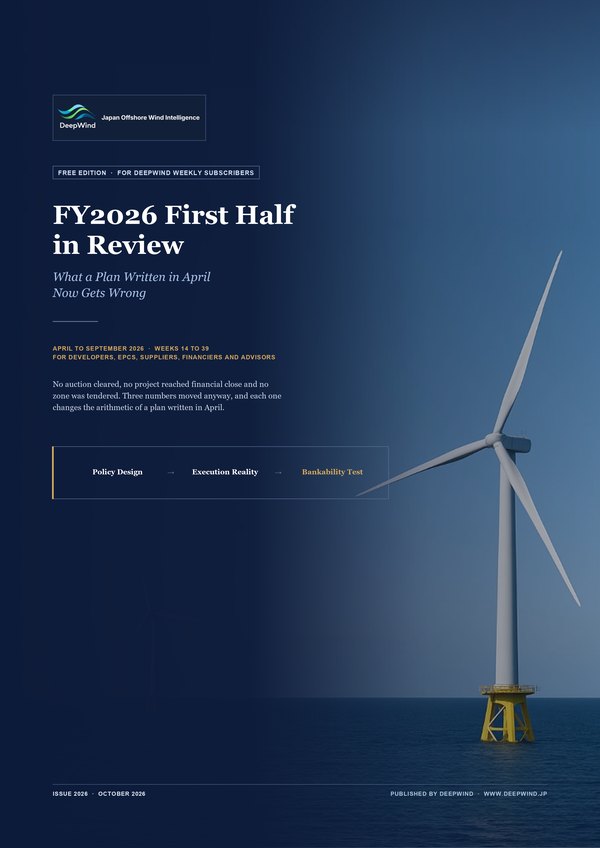
Free report · 17 pages · September 2026
FY2026 First Half in Review
What a Plan Written in April Now Gets Wrong
Between April and September 2026, Japan’s offshore wind market produced almost nothing that counts as news. No auction cleared. No project reached financial close. No zone was tendered. Three numbers moved anyway, and each one changes the arithmetic of a plan written in April.
- 400 kmtowing radiusA base port is now sized for a two-year build and a 400 km towing radius, not a three-year build and 20 km. The port serving your zone may not be the port beside it.
- ~110,000JPY/kW/yearA capacity payment now exists inside the band we estimate a Japanese project needs. Six already awarded projects can have it, the cap sits below the volume that qualifies, and the ministry has written that it goes no further.
- 21 of ~50monopiles a yearJapan made twenty-one monopiles at a plant that can make about fifty a year. The order runs out in March 2027, and nothing has been announced to follow it.
Seventeen pages on what those three change for a 2028 or 2029 schedule.
Get the report freeSent when you subscribe to DeepWind Weekly. One email a week. Unsubscribe any time.
Get the report
Enter your email and confirm it. The confirmation link opens the download page, with this report and The DeepWind Lens.
What is inside: each chapter starts from two numbers that collide
-
Chapter 1Ports2 yearsthe build target for a base port5 yearsthe wait for somewhere to park the finished floater
-
Chapter 2Auctions and revenueFinally enoughthe revenue floor finally matches what a project needs6 projectsthe only ones that can have it
-
Chapter 3WithdrawalsReported exitBP is reported to be leaving Yuza1 of 5the public record still lists it as an owner
-
Chapter 4Supply chain50 a yearwhat the Kasaoka monopile plant can make21its current order, which runs out in March 2027
-
Chapter 5Cost and viabilityCheapest zoneon our numbersNo floorit sits in the round with no revenue floor
The appendix scores nineteen calls we made in the Weekly this half against the public record, including the ones we got wrong.
Four terms the report uses, and why each one matters
Zero premium
A winning bid set at the auction floor, so the project earns close to the market price with almost no subsidy on top. It matters because the developer then carries nearly all of the price risk for about 30 years. Yuza, which bp is reported to be leaving, was awarded in a round where all seven bidders sat at that floor.
Capacity payment (LTDA)
Revenue paid per kW of capacity per year, rather than per kWh generated, under Japan’s Long-term Decarbonization Auction. It matters because it is the only instrument in Japan that gives a project revenue that does not depend on how much the wind blows, which is what a lender needs to see before committing debt.
Adjustment coefficient
The share of a wind project’s capacity that the auction counts as firm supply, 15.7 to 31.9 per cent by area at the fourth auction. It matters because published ceilings are quoted after dividing by it, so a headline figure overstates what a project receives several times over.
LCOE
The lifetime cost of a project divided by the electricity it produces, here always in real terms in constant 2026 JPY. It matters because it puts sites with different depths, distances and wind speeds on one number. Every zone figure in the report is a DeepWind estimate on identical assumptions, not an official figure.
Every zone figure can be rerun
The report’s estimates come out of the DeepWind Viability Simulator, which models Japanese offshore zones on LCOE, project IRR and minimum DSCR. The Free Explorer tier is open to anyone. The Professional tier adds the Round 2, 3 and 4 zones and the floating sites, and lets you switch the revenue model between FIP and a capacity payment. It is free for Weekly subscribers through 31 December 2026, and the access details arrive in your welcome email.
Also sent when you subscribe

The DeepWind Lens
Our framework for reading Japan’s offshore wind market as it moves from adjusting policy to testing whether projects can be financed. The half-year review applies it; the Lens sets it out.
Who reads DeepWind Weekly
Read by people at more than 250 companies and organisations in Japan and abroad, across EPCs and suppliers, government and research, developers, and investors, with about 60 per cent in Japan. One issue a week on Japan’s offshore wind market, focused on what happens after the announcement.
If you need the full workings behind a chapter, four longer reports are available as one-time purchases on the Premium Reports page.