Published: June 15, 2026 | Updated: June 15, 2026
MARKET DYNAMICS
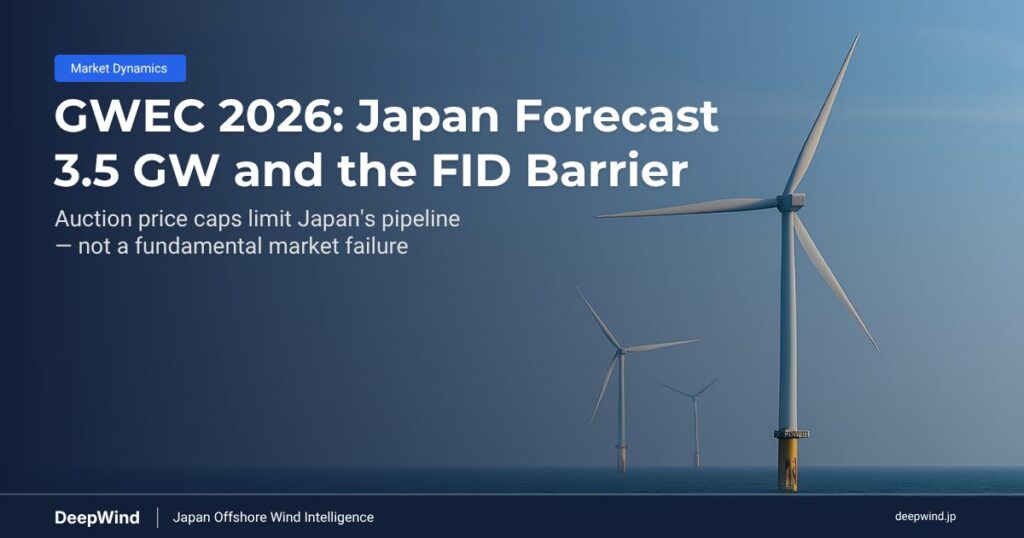
GWEC’s Global Offshore Wind Report 2026 forecasts Japan at 3.5 GW of installed offshore wind capacity by 2030 — less than a third of the government’s 10 GW project formation target. The gap is not a verdict on Japan’s offshore wind potential. GWEC describes it as the result of a single, correctable constraint: auction price caps set before the 2021–2023 global cycle of construction cost inflation, financing cost increases, and supply chain disruption. Japan has the institutional foundations in place — EEZ legislation enacted in April 2026, an established auction and permitting process, and a growing development pipeline. The constraint is commercially viable project conditions. Auction recalibration is now underway, but the critical question is whether it arrives in time to preserve the construction window for meaningful 2030 delivery.
👉 How to Read Japan’s Offshore Wind Market: Market Structure, Costs, and Policy
→
Execution Reality
→
Bankability Test
Only port-constrained projects and the 16.8 MW Goto floating demonstration have achieved financial close. GWEC attributes this to auction price caps that no longer reflect current construction, financing, and supply chain costs — not to fundamental opposition to offshore wind development in Japan.
Japan’s institutional foundations — EEZ law, auction system, permitting processes — are functioning. The commercial viability gap is what remains to be closed. This framing matters: it signals that Japan’s offshore wind trajectory is conditional on policy action, not structurally constrained.
Round 4 was redesigned before launch. Round 1 sites are proceeding to re-auction. The June 2026 auction guideline revision introduced a price floor mechanism. The open question is whether these reforms arrive quickly enough for projects to reach FID and contribute to the 2030 delivery count.
3.5 GW by 2030: What the Forecast Measures and What It Does Not
By the end of 2025, Japan had approximately 0.3 GW of operational offshore wind capacity. Following commissioning of the 16.8 MW Goto floating pilot and the 220 MW Kitakyushu Hibikinada fixed-bottom project in Q1 2026, Japan’s installed base surpassed 500 MW. GWEC projects this will grow to 3.5 GW by 2030 and 8.4 GW by 2035, driven by re-auctioned Round 1 sites and projects progressing through Rounds 2 and 3.
The government’s 10 GW figure requires context. Japan targets 10 GW of offshore wind project formation by 2030 — defined as the volume of projects brought to a tendering-ready state, not a guarantee of installed capacity. Project formation targets and delivery trajectories are not the same measurement. GWEC’s forecast models the delivery outcome under current and expected market conditions, not policy intent. The gap between 3.5 GW and 10 GW reflects the distance between stated ambition and commercially executable pipeline.
In the Asia-Pacific context, Japan represents approximately 4.2% of projected APAC offshore wind additions through 2034 — around 8 GW out of 193 GW total. China accounts for 79.2% of regional additions over the same period. Japan’s market is strategically significant domestically, but at a scale that gives international developers limited incentive to absorb commercial risk that does not exist in comparable markets elsewhere in the region.
The Single Correctable Problem: Auction Price Caps and the FID Gap
GWEC’s diagnosis is direct: Japan’s offshore wind market “has the institutional foundations in place but is constrained by a single correctable problem: the gap between auction price assumptions and market realities. This is a policy design issue with a known solution, not a fundamental market failure.”
Under current conditions, no general sea area auction project has reached FID (final investment decision). Only port-constrained projects and the Goto 16.8 MW floating demonstration have achieved financial close. The root cause is structural: auction price caps were calibrated before the 2021–2023 cycle of global cost inflation, financing cost increases, and supply chain disruption. Winning bids in Round 1 were established at price levels that proved undeliverable as Japan CAPEX rose significantly — JWPA places the current reference at approximately 908,000 JPY/kW for fixed-bottom offshore wind.
The investment chain consequence is significant. Without FID, the downstream commitment sequence cannot start:
- Binding turbine OEM supply agreements and long-lead component orders cannot be placed
- Port upgrade investment and onshore transmission works cannot be mobilized
- Installation vessel bookings — which require multi-year scheduling windows — cannot be secured
- Offshore construction contracts that require irreversible capital commitments cannot be executed
Each of these requires revenue certainty — a bankable offtake structure — before it can be justified. Without that, even well-structured projects at advanced development stages remain commercially stranded. Supply chain actors face the same constraint: without a credible FID pipeline, committing to Japan-specific manufacturing investment carries unacceptable market risk.
The developer response has been visible. The Mitsubishi-led consortium’s withdrawal from three Round 1 fixed-bottom sites in August 2025 — covering approximately 1,742 MW of pipeline capacity — is the most documented instance of this dynamic. GWEC notes that “some international offshore wind developers have scaled back investment or exited the Japanese market entirely,” citing elevated commercial risk perception relative to other Asia-Pacific markets.
👉 Mitsubishi’s Offshore Wind Exit: What the Profitability Constraints Reveal
Offshore wind construction in Japan typically requires four to five years from FID to commissioning, accounting for regulatory approval, procurement, fabrication, port mobilization, and installation sequencing. Round 4, with public tender targeted for H2 2026 at the earliest, implies FID at earliest in late 2027 and commissioning by 2031–2032. The 2030 delivery window for Round 4 projects has effectively closed. Achieving 3.5 GW by 2030 depends primarily on Round 2 and Round 3 projects already at advanced development stages and re-auctioned Round 1 sites that can reach FID rapidly under revised terms.
Recalibration Underway: Round 4 Redesign, Round 1 Re-Auction, and EEZ Extension
The market reform response to the FID barrier has been substantive. Several developments since mid-2025 reflect a structured recognition of the commercial viability gap:
Auction redesign. Round 4 was postponed from 2025 to 2026 specifically to allow auction design revision. The June 2026 guideline revision introduced a price floor mechanism (想定供給価格幅) — reducing the incentive to bid below commercially viable levels — and raised the viability score weighting to equal the price score, at 120 points each. This is the clearest formal acknowledgment yet that the previous auction design had created perverse incentives toward unsustainable bids.
Round 1 re-auction. Three sites from the withdrawn Mitsubishi-led consortium — Akita Noshiro/Mitane/Oga, Yurihonjo, and Choshi — are proceeding to re-auction, representing approximately 1,742 MW of pipeline capacity. Re-auction terms are expected to incorporate updated cost assumptions. If re-awarded at terms reflecting current market cost structures, these sites represent the most direct near-term path toward FID-ready pipeline.
EEZ framework. The revised Marine Renewable Energy Sea Area Utilization Act came into force in April 2026, extending Japan’s offshore wind legal framework to the Exclusive Economic Zone. This enables development of large-scale deepwater and floating projects beyond current coastal areas and supports Japan’s 15 GW floating wind target by 2040.
Supply chain signal. Vestas has announced plans for a nacelle assembly facility in Japan by 2029, with potential for further manufacturing expansion. This is the first major OEM supply chain commitment in Japan for offshore wind and signals sufficient developer confidence in Japan’s medium-term market viability to justify irreversible supply chain investment — a meaningful signal after a period of developer exits.
👉 The Total Withdrawal Pattern: International Developer Exits and Japan’s Market Signals
👉 Japan’s Offshore Wind Policy and Regulatory Framework: Complete Guide
GWEC’s “known solution” framing is precise. The harder question is not what the solution is, but whether it arrives in time.
Japan’s 2030 offshore wind target is not simply at risk; it is already partially closed as a window for new projects. Offshore wind construction requires four to five years from FID to commissioning under Japan’s conditions. Projects that do not reach FID in 2026 or 2027 will not contribute to 2030 delivery. Round 4 projects, awarded at the earliest in H2 2026, face commissioning timelines extending to 2031–2032. The relevant 2030 pipeline is now limited to re-auctioned Round 1 sites and projects from Rounds 2 and 3 already at advanced development stages.
GWEC states: “Decisions taken over the next two-to-three years will determine whether Japan can break through this structural barrier or remain constrained by it.” That two-to-three-year window has already started. The question has shifted from whether Japan will reform to whether reform will clear the 2027 FID window for meaningful 2030 volume. The 3.5 GW forecast is neither a floor nor a ceiling — it reflects GWEC’s baseline assessment of partial recalibration. How far Japan moves toward 10 GW depends on how quickly and completely the June 2026 auction reforms translate into market-clearing results and bankable offtake conditions.
GWEC’s 3.5 GW forecast assumes partial auction recalibration. For project finance, the operative question is whether post-recalibration auction prices can support DSCR ≥1.35x at current Japan CAPEX anchors (JWPA reference: 908,000 JPY/kW, OPEX approximately 27,600 JPY/kW/year). The June 2026 price floor mechanism addresses the downside risk of unsustainable low bids. Full bankability restoration requires that the price ceiling, risk-sharing mechanisms, and inflation indexation provisions jointly reflect current market cost structures. Until Round 4 market-clearing results confirm this alignment, DSCR modelling for Japan offshore wind projects remains scenario-dependent.
Related DeepWind Articles
- How to Read Japan’s Offshore Wind Market: Market Structure, Costs, and Policy
- Japan’s Offshore Wind Policy and Regulatory Framework: Auction System, Permitting, and EEZ
- Mitsubishi’s Offshore Wind Exit: What the Profitability Constraints Reveal
- The Total Withdrawal Pattern: International Developer Exits and Japan’s Market Signals
- Japan’s Offshore Wind Goals: 10 GW by 2030 and 30–45 GW by 2040
Why Isn't Floating Wind Bankable in Japan Yet?
The synchronized supply-chain bottleneck, quantified node by node, with a full sensitivity ranking and a bankability ladder of scaling conditions. Includes Simulator Professional (β) access to reproduce every figure on your own assumptions.
See the full analysis →