Published: February 17, 2026 | Updated: October 7, 2026
Following the FLOWRA report on the European “15MW standard” and the FLOWCON report on typhoon risks, the Japanese government has finally begun to define the official “baseline” for port infrastructure.
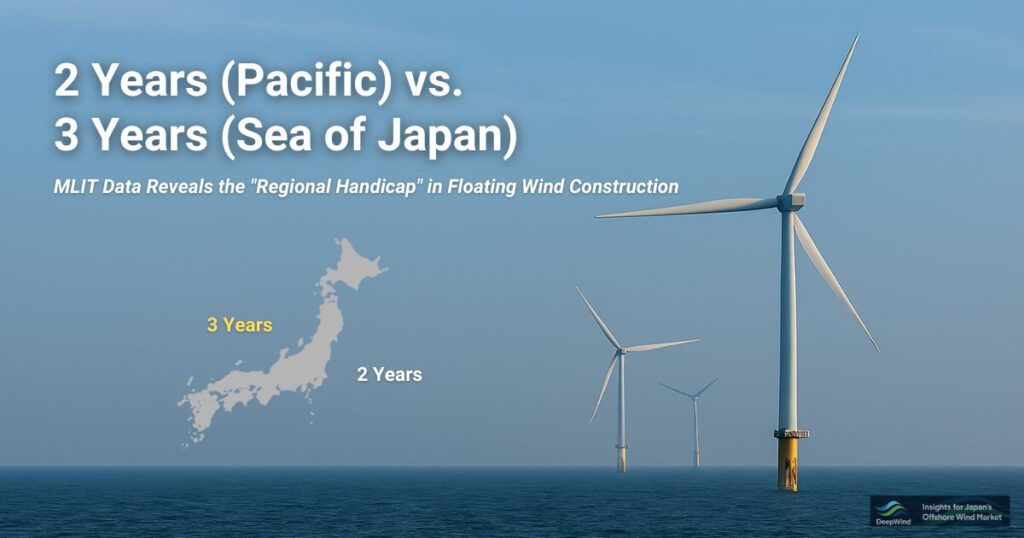
On January 14, 2026, the Ministry of Land, Infrastructure, Transport and Tourism (MLIT) presented a document titled “Conditions for Examining Facility Scale (Draft).” This document reveals a stark reality: although a 1GW scale is assumed, there is a significant efficiency gap due to metocean conditions. Specifically, construction capability on the Sea of Japan side is estimated to be roughly 1.5 times slower than on the Pacific side.
In this article, DeepWind analyzes the government’s new baseline assumptions and the emerging “regional handicap” that could reshape investment strategies in Japan.
While this article focuses on a specific topic, those looking to understand Japan’s overall offshore wind policy and regulatory framework should also read our comprehensive summary here:
👉 Japan’s Offshore Wind Policy & Regulatory Framework Explained
1. The Government’s “Standard Model”: Entering the 15MW/1GW Era
To determine the scale of port facilities (area, water depth, load capacity), prerequisites regarding “what” and “how much” to build are essential. The conditions presented by MLIT strongly reflect the reality of the global industry:
• Project Scale: Assumed to be 1GW class, reflecting global planning trends for 2030 and beyond.
• Turbine Size: Set at 15MW (60 units) or 20MW (50 units).
• Floater Type: Primary scenario is Semi-submersible / Steel, with Concrete considered as a derivative scenario.
Discussions on Japanese infrastructure, often stuck on “8MW to 10MW” assumptions, have finally been upgraded to the “15MW/1GW class” specifications, aligning with recommendations from groups like FLOWRA.
2. Pacific vs. Sea of Japan: The Decisive “Towing Speed” Gap
The most critical data in this document is the simulation of the construction cycle. Floating offshore wind requires “towing” massive assembled turbines from the port to the installation area. MLIT has set distinct differences in “Towing Speed” and “Availability” between the Pacific Ocean and the Sea of Japan.
Pacific Side: Riding the Black Current at “3.1 Knots”
Based on the actual towing data of the “Fukushima Shimpu” demonstrator (Nagasaki to Onahama: 1,530km in 11 days), the average towing speed is set at approx. 3.1 knots. Combining this speed with Pacific metocean conditions (days of rough weather), the number of units installable per year is calculated at “27 units.” This means a 1GW farm (60 units) can be completed in “approx. 2 years.”
Sea of Japan: Current Limits and “2.5 Knots”
Conversely, lacking sufficient public towing data for the Sea of Japan, MLIT set a more conservative speed of 2.5 knots, referencing port construction standards and overseas cases (like Kincardine). Furthermore, due to severe winter sea conditions (low availability), the annual installation capacity drops to “19 units.” Consequently, constructing the same 1GW farm is estimated to take “approx. 3 years.”
This implies that building the same 1GW power plant on the Sea of Japan side will take one year longer than on the Pacific side. This “regional handicap”—translating directly to increased CAPEX and risk—has now been visualized in official government estimates.
3. Infrastructure Requirements: 10t/m² for Steel, “Un-liftable” Concrete
Specific specs required for manufacturing and assembly hubs (Base Ports) were also clarified.
• Steel Floaters: A semi-submersible floater weighs 5,000-6,000 tons after assembly. Supporting this requires a ground bearing capacity of approx. 10 tons/m². This aligns with FLOWRA’s report (15t/m²), though reinforced paving may be needed depending on SPMT (Self-Propelled Modular Transporter) loading conditions.
• Concrete Floaters: With weights reaching 20,000 tons, the document explicitly states they are “difficult to lift” even with Japan’s largest floating cranes (4,000t capacity). Therefore, facilities must allow for “slipway launching” (sliding into the water) or manufacturing in floating docks, rather than lifting from a quay.
4. The Hidden Issue: Anchors and Wet Storage Mismatch
A point of contention remains regarding “Anchors” and “Wet Storage.” The MLIT document sets “Stockless (Drag) Anchors” as the default assumption, based on survey responses.
However, FLOWRA’s European survey warned that “Drag anchors are unsuitable for pre-laid mooring (due to unverified holding power; suction or pile anchors are essential).” Whether cost calculations are based on cheap drag anchors or the European standard (suction anchors) will significantly impact the required anchorage area and installation costs. This discrepancy will be a key focus in future public-private working groups.
👉 The installation methods behind the timeline: MLIT’s seven floating wind construction R&D projects
【DeepWind Insight】
This MLIT document highlights a structural “East-West Disparity” in Japanese floating wind. While the Sea of Japan side (Hokkaido, Tohoku, Hokuriku) offers excellent wind resources and promising sites, it suffers from a structural disadvantage in “Construction Efficiency” compared to the Pacific.
If the premise is that “Sea of Japan projects take 1.5 times longer,” policy design may need to adapt. This could involve area-specific adjustments in FIT/FIP pricing or extended deadlines for Commercial Operation Dates (COD) in auctions. To bridge this gap, as suggested by FLOWCON, securing “large fleets of construction vessels” to maximize the summer weather window and establishing “buffer zones (temporary storage)” will be matters of survival, especially for projects on the Sea of Japan side.
The government’s estimate is merely a “standard scenario.” The challenge now is how to shorten this timeline and reduce costs. The solution likely lies in the broad-area coordination provided by a “Port Integrator,” moving beyond individual project optimization.
[References]
This article is based on materials submitted at the “2nd Study Group on Port Infrastructure for Offshore Wind Power” held on January 14, 2026:
・MLIT Document 4 “Conditions for Examining Facility Scale (Draft)“
For a broader understanding of Japan’s offshore wind legal system, policy structure, and support measures, be sure to check out our pillar article:
🌊 Japan’s Offshore Wind Policy & Regulatory Framework Explained
Why Isn't Floating Wind Bankable in Japan Yet?
The synchronized supply-chain bottleneck, quantified node by node, with a full sensitivity ranking and a bankability ladder of scaling conditions. Includes Simulator Professional (β) access to reproduce every figure on your own assumptions.
See the full analysis →