Published: January 26, 2026 | Updated: September 3, 2026
POLICY & REGULATION
Japan’s Long-Term Decarbonization Power Supply Auction (LTDA) pays annual capacity revenue (JPY/kW/year) rather than energy revenue (JPY/kWh), guaranteeing recovery of fixed costs over a 20-year period. In the third auction (bid year 2025), whose results were published in May 2026, offshore wind won zero capacity. Offshore wind projects under the Marine Renewable Energy Act (FIP projects) are, as a rule, not eligible for LTDA, because the scheme is designed to prevent double recovery of fixed costs. On 31 August 2026 METI settled a narrow exception: “zero-premium” projects from the earlier Rounds 2 and 3 may enter from the fourth auction. Six projects qualify, and the measure applies once. Roughly 90% of market-derived revenue is still returned to the system, capping upside while removing the downside risk that makes project financing difficult under FIP alone.
👉 Japan’s Offshore Wind Policy & Regulatory Framework
→
Execution Reality
→
Bankability Test
FIT and FIP both reward generation volume. LTDA pays a contractually fixed annual capacity revenue for 20 years, creating a cash flow stream independent of output volume. In project finance, this narrows the P50-P90 revenue gap and supports DSCR above 1.35x, a threshold FIP-only projects struggle to meet at current prices.
In the third auction (results published May 2026) offshore wind won zero, and it continues on the FIT/FIP track. FIP projects under the Marine Renewable Energy Act cannot join, to prevent double recovery of fixed costs. On 31 August 2026 METI settled an exception for Round 2 and 3 “zero-premium” projects that reset their supply price to JPY 0/kWh: six of them, around 700 MW on an expected-capacity basis after the area adjustment coefficient. The same document states the measure is not intended for later tenders. The ~90% return of market revenue is unchanged.
DeepWind’s cost model shows the project reaching break-even in about 13 years at a capacity payment of JPY 100,000 per installed kW per year. Expressed as a bid, that is roughly JPY 370,000/kW/year in the Tohoku area, about 91% of the JPY 408,857 ceiling there. The case describes what happens near the top of the biddable range, not at an expected clearing price.
1. The Core Mechanism: Paying for Capacity, Not Output
The Long-Term Decarbonization Power Supply Auction (LTDA) was introduced to solve a structural problem in Japan’s energy transition: decarbonized power sources (offshore wind, nuclear, large-scale hydro) require enormous up-front capital, but Japan’s power market does not provide the long-term revenue visibility that project finance requires.
The core design response is to separate fixed-cost recovery from energy revenue. Under LTDA:
- Winning bidders receive an annual capacity payment (JPY/kW/year) for 20 years
- Payment is based on capacity, not generation volume (kWh)
- This payment is designed to cover CAPEX amortization and fixed O&M costs
Government documents describe the scheme as “a mechanism that guarantees a level of capacity revenue equivalent to fixed costs.” The effect is to convert what would otherwise be a merchant revenue stream into a contracted, volume-independent cash flow, improving bankability for capital-intensive projects.
One detail matters throughout this article. For variable sources such as wind, the capacity that counts is not the capacity installed. Section 5 sets out how the area adjustment coefficient works and why it changes how every published figure should be read.
2. How LTDA Differs from FIT and FIP
FIT and FIP both reward energy output. LTDA rewards capacity availability. That distinction reshapes the entire financial structure of a project.
| Scheme | Revenue Basis | Market Exposure | Primary Objective |
|---|---|---|---|
| FIT | kWh (fixed purchase price) | None | Accelerate early renewable deployment |
| FIP | kWh + market premium | Partial (market-linked) | Integrate renewables into the wholesale market |
| LTDA | kW (capacity value) | Yes, but market upside and downside are largely neutralized | Stabilize long-term investment in decarbonized power |
Under FIT, the generator is fully insulated from wholesale prices. Under FIP, the generator sells into the market and receives a premium above a reference price, carrying price risk but able to capture upside. Under LTDA, the generator participates in the market but returns about 90% of what it earns there; in exchange, it receives a stable capacity payment that covers costs regardless of market conditions.
Japan’s offshore wind auctions shifted from FIT (Round 1) to FIP (Round 2 onward). Round 3 bids came in at effectively zero premium, meaning revenue depends almost entirely on the wholesale price generators can capture. LTDA is the mechanism intended to restore the fixed-cost coverage that zero-premium FIP cannot provide, though, as Section 4 explains, offshore wind FIP projects can access it only through a narrow and time-limited exception.
👉 Japan’s Offshore Wind Policy Enters a New Phase
3. The 90% Revenue Return Rule: Capping Upside to Guarantee Fixed-Cost Recovery
LTDA’s most distinctive operational feature is the revenue return mechanism. Approximately 90% of all market-derived revenue must be returned to the system.
Revenue streams subject to return include:
- JEPX (Japan Electric Power Exchange) spot market income
- ΔkW balancing market income
- Non-fossil value certificate revenue
- PPA revenue equivalent to market prices
The generator retains approximately 10% of market revenue. In exchange, it receives the full capacity payment designed to cover fixed costs. The trade-off is explicit: accept a ceiling on revenue upside; receive a floor on cost recovery.
LTDA creates a structural tension with corporate PPAs. Any PPA priced above the market reference is treated as “other market revenue”: approximately 90% of the premium above market is returned. High-margin PPAs therefore do not improve the generator’s economics under LTDA. The scheme is designed for cost recovery, not profit optimization.
4. Third Auction Results and Offshore Wind Eligibility: Zero Awards and the “Zero-Premium” Exception
On 13 May 2026, the Organization for Cross-regional Coordination of Transmission Operators (OCCTO) published the results of the third auction (bid year 2025). Decarbonized power sources were awarded 4.261 GW of the 5.0 GW solicited; including LNG-only thermal, nationwide awarded capacity reached 7.299 GW, 67% of the 10.856 GW bid.
| Power source (decarbonized) | Awarded capacity |
|---|---|
| Li-ion batteries / pumped hydro (excl. new-build) | 0.819 GW |
| Non-Li-ion batteries / pumped hydro (new) / LDES | 0.886 GW |
| Decarbonized thermal (hydrogen / ammonia / biomass) | 0.517 GW |
| Existing nuclear: safety upgrade investment | 0.558 GW |
| Other decarbonized (new / replacement nuclear, etc.) | 1.482 GW |
| Decarbonized total | 4.261 GW (of 5.0 GW solicited) |
LDES is Long Duration Energy Storage. In the breakdown by generation type, the “other / general hydro / solar / wind, etc.” category, which includes offshore wind, was awarded zero. Offshore wind won no capacity in this auction and continues on the FIT/FIP track (Source: OCCTO, “73rd Capacity Market Review Meeting, Document 3,” published 13 May 2026).
This outcome follows directly from the scheme’s design. FIT/FIP projects, including public tenders under the Marine Renewable Energy Act, are, as a rule, not eligible for LTDA, in order to prevent double recovery of fixed costs. The zero result therefore says nothing about the level of the price cap: offshore wind could not bid at all.
Only “Zero-Premium” Projects, and Only Once: Settled 31 August 2026
Following discussion at the 39th Offshore Wind Promotion Working Group (19 November 2025) and the system-review working group (12 December 2025), METI settled the treatment on 31 August 2026. Among the earlier Round 2 and 3 tenders, only “zero-premium” projects are admitted to the auction’s eligible sources, from the fourth auction onward.
A zero-premium project is one that has changed the supply price in its public occupation plan to JPY 0/kWh, eliminating any possibility of a premium. The condition for participation is that the project forgo the FIP subsidy equivalent to balancing costs. Under that condition, officials assess that no double recovery of fixed costs arises.
The scale is stated. Six projects may enter, together around 700 MW on an expected-capacity basis after the area adjustment coefficient is applied. The solicitation cap for offshore wind in the fourth auction is 500 MW. METI gives its reason plainly: the offshore wind ceiling sits above the JPY 200,000/kW/year threshold that applies to other technologies, so the burden on consumers had to be weighed.
What is easy to miss is that the supply prices of the Round 2 and 3 awarded projects are already low, around JPY 3/kWh (only the Saikai-Eshima site in Nagasaki is higher, at JPY 22.18/kWh). Because resetting the supply price to JPY 0/kWh gives up very little, the value of gaining a 20-year capacity-revenue offtake option becomes correspondingly large.
This is a one-off. METI states that the measure applies only to the Round 2 and Round 3 projects of the market’s formative period, and that participation is not intended for the tenders that follow. LTDA should therefore be read not as a permanent support scheme for offshore wind, but as a limited backstop to help already-committed projects reach completion. For anyone planning around Round 4 and later, this route is not on the table.
Other Related Changes in the Fourth Auction
Two further changes are relevant to offshore wind. First, the applicable period is capped: the current “20 years or more” becomes “20 to 40 years” (to keep the capital-cost share from becoming excessive). Sources whose price-cap parameters are being raised, general hydro, new-build pumped storage, LDES, nuclear, and LNG-only thermal, have this cap shortened to 30 years, but offshore wind is not subject to that shortening.
Second, wind is subject to a new decommissioning-cost reserve requirement. This applies the FIT/FIP framework and explicitly excludes public tenders under the Marine Renewable Energy Act, i.e., promotion-zone offshore wind. Offshore wind projects selected in the promotion zones are therefore not caught by this reserve requirement.
5. The Cap Is Quoted Per Counted kW, Not Per Installed kW
LTDA sets a price cap for each power source. The offshore wind cap indicated at the third auction was:
- Price cap: JPY 180,655 to 200,000/kW/year (as set for the third auction)
That figure cannot be read as an amount received. Wind cannot be relied on to produce at peak demand, so the capacity market counts only a share of the capacity a project bids in. That share is the area adjustment coefficient, which for wind ran from 15.5% to 34.3% at the third auction. The cap is quoted after dividing by that coefficient, and a winning project is paid its bid price multiplied by capacity times the same coefficient.
Converted to what a project would receive per kW of installed capacity, the third-auction cap was:
- Kyushu (coefficient 15.5%): about JPY 31,000/kW/year
- Tohoku (coefficient 28.0%): about JPY 56,000/kW/year
- Shikoku (coefficient 34.3%): about JPY 62,000/kW/year
DeepWind’s estimate of the capacity revenue needed to cover fixed costs is JPY 100,000 to 120,000 per installed kW per year. On that basis the third-auction cap reached only 30% to 60% of the level a project would need.
The JPY 200,000 figure was also not calculated for offshore wind. A threshold of JPY 200,000/kW/year applied to every technology, and eight of the nine areas hit it. Shikoku shows the odd figure of 180,655 because its coefficient was high enough that the calculated value fell below the threshold.
Read the unit before reading the number. Published ceilings are stated per counted kW, and dividing through by the coefficient makes them three to six times larger than what a project receives per kW installed. The spread across areas is driven mainly by the coefficient rather than by any difference in project economics: Kyushu has the lowest coefficient and therefore the highest published ceiling.
The Fourth Auction: What the Higher Number Contains
The terms were settled on 31 August 2026. The offshore wind cap is set separately for each of the nine areas from Hokkaido to Kyushu, at JPY 345,220 to 701,172/kW/year.
That spread is again a product of the division. Converted to installed kW, all nine areas land at about JPY 110,000/kW/year (DeepWind calculation), because the formula is 110,000 divided by the area coefficient.
The 110,000 is built as follows:
- JPY 31.9/kWh × 8,760 hours × 39.3% capacity factor = about JPY 110,000/kW/year
What changed between the two auctions is where the per-kWh figure comes from. The third auction used JPY 18/kWh, the ceiling of the third offshore wind tender. The fourth auction uses JPY 31.9/kWh, derived from the JPY 30.9/kWh generation cost for offshore wind in Japan’s cost verification exercise (2023), less JPY 1.3/kWh of budget-related policy expense, then adjusted to 2025 prices using the construction cost deflator. The reference moved from what the tender allows to what the cost review says it costs. METI states the reason: the most recent tender ceiling is still JPY 18/kWh, and setting the LTDA cap on that basis raises the concern that no bids would come.
Offshore wind is also now exempt from the JPY 200,000/kW/year threshold, so the values that were previously capped come through in full.
Measured by what a project would actually receive, the increase varies by area (DeepWind calculation):
| Area | Third auction (per installed kW) | Fourth auction (per installed kW) | Multiple |
|---|---|---|---|
| Kyushu | about JPY 31,000 | about JPY 110,000 | about 3.5x |
| Tohoku | about JPY 56,000 | about JPY 110,000 | about 2.0x |
| Shikoku | about JPY 62,000 | about JPY 110,000 | about 1.8x |
The 3.5x reported at the time compares published figures. On a received basis the increase runs from 1.8x to 3.5x depending on the area.
The new cap sits at roughly the level DeepWind estimates a project needs. Two things follow for the third auction. The zero awards were not a verdict on the cap: offshore wind could not bid at all. But the cap itself was below the level a project would have needed. Had participation been open, bids would have been unlikely at that level. METI’s own reason for changing the reference points the same way.
A ceiling is still a maximum allowable bid, not a payment: awards are set by competition, so bidding at the ceiling is rarely a viable strategy. Whether offshore wind bids into the fourth auction will depend on the height of the cap and on how far cost inflation in equipment and construction can be absorbed.
6. Capacity Factor Requirements Are Being Formalized
Government documents explicitly require:
“Generators must achieve annual capacity factors appropriate for each power source.”
For offshore wind, specific thresholds remain under discussion. However, the direction of travel is clear: capacity factor performance will become a formal condition for receiving capacity payments.
For project finance, this introduces a compliance risk layer. Capacity factors for offshore wind depend on site wind resources and turbine availability, both subject to P90 modeling uncertainty. Lenders assessing LTDA-eligible projects will need to stress-test capacity factor scenarios to confirm that the 90th percentile performance band still meets the eligibility threshold.
7. Profitability in Practice: The Murakami-Tainai (690 MW) Case Study
DeepWind uses the Murakami-Tainai offshore wind project (Niigata Prefecture) as a reference case for LTDA profitability analysis. The project, led by Mitsui & Co. and Osaka Gas, is a Round 2 fixed-bottom project selected at a supply price of JPY 3/kWh, making it one of the very projects that could realistically consider the zero-premium route described above.
Updated Configuration (January 2026 Revision)
In January 2026, the project consortium announced a turbine revision: the original 18 MW GE Vernova turbines (discontinued) would be replaced by 46 units of 15 MW turbines. DeepWind’s cost model (May 2026) reflects this configuration:
- CAPEX: approximately JPY 640 billion (estimated)
- OPEX: approximately JPY 19 billion per year (estimated)
- Capacity: 690 MW
- Operating period: 30 years (assumed)
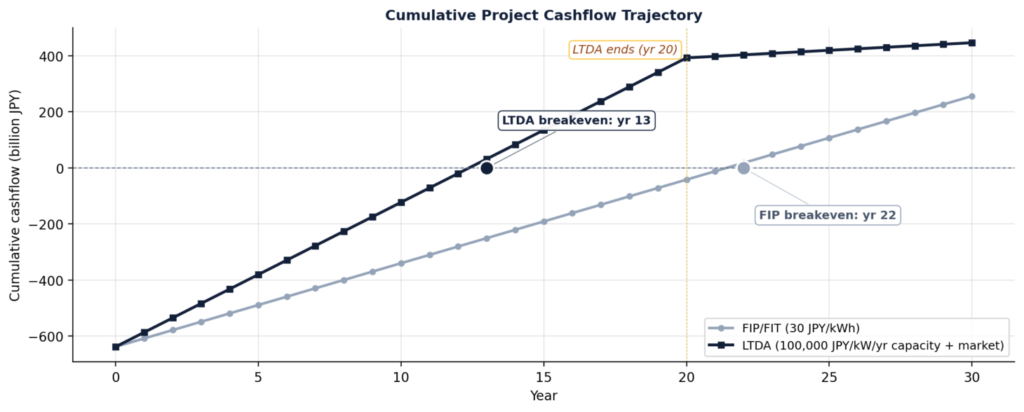
Scenario: JPY 100,000 per Installed kW per Year
- Capacity payment received: JPY 100,000 per installed kW per year (assumed)
- Annual capacity revenue: approximately JPY 69 billion (690,000 kW × 100,000)
- Market revenue: ~90% returned → approximately 10% retained (excluded from base calculation)
On that assumption, cumulative capacity revenue covers cumulative fixed costs at approximately year 13. If capacity payments continue for 20 years, fixed-cost recovery is complete well inside the term.
It is worth testing how strong that assumption is. The JPY 100,000 is an amount received per installed kW, so expressing it as a bid means dividing by the area coefficient. Murakami-Tainai sits in Niigata, inside the Tohoku area, where the fourth-auction coefficient is 26.9%.
- 100,000 ÷ 0.269 = about JPY 370,000/kW/year as a bid
- Tohoku fourth-auction ceiling: JPY 408,857/kW/year
- Position against the ceiling: about 91%
The case therefore describes what happens when a project clears just short of the ceiling. Clearing prices are set by competition and normally settle below it. Read year 13 as the upper end of the range this assumption allows, not as a central expectation.
Under LTDA, capacity revenue is treated in project finance as a contractual, volume-independent cash flow. To access it, a Round 2 or 3 project must go zero-premium, resetting its supply price to JPY 0/kWh and forgoing the FIP subsidy equivalent to balancing costs. Since the original supply price is already low (around JPY 3/kWh), the amount given up is small, and in exchange a 20-year fixed revenue absorbs most P90 downside. For a 690 MW project receiving JPY 100,000 per installed kW per year, the roughly JPY 69 billion annual capacity revenue provides a floor that narrows the P50-P90 spread and supports DSCR above 1.35x under current lender risk appetite in Japan. When comparing any of these figures with a published ceiling, convert to the same unit first.
👉 BP’s Reported Exit from 450 MW Yuza: Winning an Auction Is Not the Same as Getting Financed
8. What LTDA Means for Developers and Offtakers
Developer Perspective
| Dimension | Benefit | Constraint |
|---|---|---|
| Revenue certainty | Capacity payments guarantee fixed-cost recovery for 20 years | ~90% of market upside is returned to the system |
| Financing | Improved bankability, easier to meet DSCR thresholds | Capacity factor compliance risk if performance falls short |
| PPA strategy | Low default risk makes generator an attractive PPA counterparty | High-margin PPAs do not improve developer economics |
| Planning horizon | A contracted floor for Round 2 and 3 zero-premium projects | Not available for Round 4 and later tenders |
Offtaker Perspective
For offtakers seeking long-term corporate PPAs, LTDA-supported generators offer a specific advantage: the generator’s fixed-cost burden is already covered by capacity revenue, meaning default risk is structurally lower. The PPA is an overlay on an already-stable revenue base, not a lifeline for a financially stressed project.
The constraint is that the generator has limited room to offer favorable PPA pricing. With most market-equivalent revenue returned under LTDA, the economics of above-market PPA terms are largely nullified on the generator side. PPAs on LTDA projects are stability arrangements rather than yield-enhancement tools, and an offtaker expecting a discount in exchange for a long commitment will find that incentive missing.
👉 What Is a Corporate PPA? Japan Market Guide
9. LTDA and Japan’s 2050 Grid Build-Out
Japan’s 2050 grid expansion plans add a layer of context to the 20-year horizon LTDA is designed to cover. Large-scale offshore wind supported by a capacity payment is expected to contribute to system stability, and the long-term transmission build-out creates the conditions under which a 20-year contracted revenue stream is worth having.
That context also frames the limits of the current measure. The capacity route is open to six already-committed projects and closes behind them. Whatever the fourth auction shows in January 2027, the projects being planned for Round 4 and beyond will be financed against tender revenue alone unless something else changes.
👉 Japan’s 2050 Grid Master Plan Review: Offshore Wind Scenarios
LTDA is a financial architecture tool, not a subsidy, and the door it opens for offshore wind closes behind six projects.
The government’s goal is not to fund offshore wind directly. It is to change the risk profile of the revenue stream well enough that lenders can model it. Capacity revenue that is contractually fixed for 20 years converts what would otherwise be a merchant project into something closer to a contracted project. For Round 2 and 3 projects that bid at near-zero FIP premiums, LTDA capacity revenue may be the difference between a DSCR above 1.35x and one that falls below the bankable threshold.
What was settled on 31 August is narrower than it first appears. Six projects qualify, the solicitation cap sits below the capacity that could enter, and METI has said the measure is not intended for later tenders. The more durable signal is in how the ceiling was rebuilt: the reference moved from what an offshore wind tender allows to what the cost review says offshore wind costs. That reasoning is available to the tender side as well, and it is the part of this decision most likely to matter after January 2027. The capacity route itself is not open to Round 4.
Related DeepWind Articles
- Japan’s Offshore Wind Policy & Regulatory Framework: Auction, Zones, and Legal Basis
- BP’s Reported Exit from 450 MW Yuza: Winning an Auction Is Not the Same as Getting Financed
- Japan’s Offshore Wind Policy Enters a New Phase
- What Is a Corporate PPA? Japan Market Guide
DeepWind Weekly tracks Japan’s offshore wind market beyond headline announcements, focusing on execution risk, cost structure, project viability, supply-chain constraints, and policy implications.
Subscribe to receive weekly intelligence on Japan’s offshore wind market.
Why Isn't Floating Wind Bankable in Japan Yet?
The synchronized supply-chain bottleneck, quantified node by node, with a full sensitivity ranking and a bankability ladder of scaling conditions. Includes Simulator Professional (β) access to reproduce every figure on your own assumptions.
See the full analysis →