Published: June 29, 2025 | Updated: March 6, 2026
Introduction
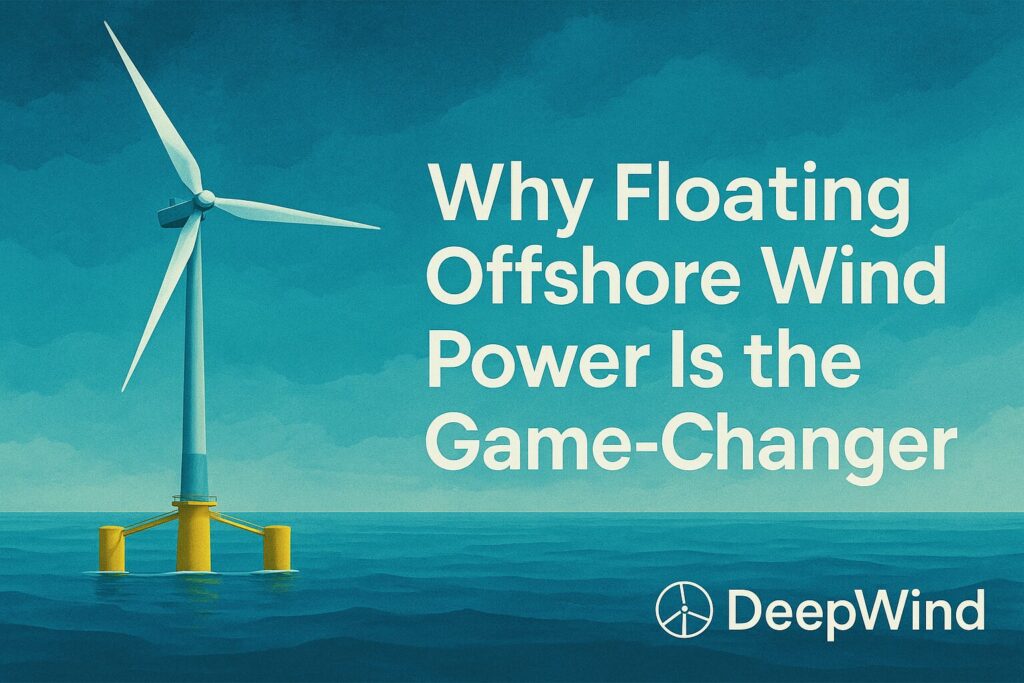
Deploying renewables as a primary energy source has become an urgent priority amid accelerating climate change impacts and resource competition. Offshore wind power, with its stable output profile and large-scale deployment potential, stands out as a “game-changer.” Yet fixed-bottom offshore wind is constrained to around 50 m depths, leaving much of Japan’s deep coastal waters untapped. This article examines why floating offshore wind is emerging as Japan’s next-generation energy strategy, highlighting its core advantages.
The topics covered in this article are part of a broader analysis examining floating offshore wind from a structural perspective — spanning technology, costs, regulations, and project viability. For a comprehensive overview, see the full guide below.
👉 Floating Offshore Wind in Japan|A Structural Guide to Markets, Costs & Policy
For a structured overview of Japan’s offshore wind market—including policy, investment dynamics, costs, and supply-chain constraints—see our pillar article.
👉 Japan Offshore Wind Market Analysis (Pillar)
1. Why Now?
- Alignment with Global & Domestic Targets
The EU targets 60 GW by 2030 and 300 GW by 2040, while the US aims for 30 GW by 2030 and 110 GW by 2050. Japan has set goals of 10 GW by 2030 and 30–45 GW by 2040, backed by strong public funding. - Major Regulatory Reform
In June 2025, Japan amended its Marine Renewable Energy Act to allow installations within the Exclusive Economic Zone (EEZ), opening vast deep-water areas. Promotion zones can now be designated at roughly 1 GW per year. - Maturing Technology & Cost Reductions
Demonstrations with 15 MW+ turbines and stable floating platform operations have reduced project risks. Standardized installation and O&M processes, plus insights from Equinor’s Hywind projects, are now available to Japanese developers.
2. Limitations of Fixed-Bottom Offshore Wind
Fixed-bottom foundations become prohibitively expensive beyond approximately 50 m depth, often accounting for over 50 % of total project CAPEX. Coastal siting triggers stringent landscape and noise regulations, prolonging permitting. Extensive seabed disturbance also demands high-level environmental mitigation measures.
3. Core Advantages of Floating Offshore Wind
- Deep-Water Resource Access
Nearly 99 % of Japan’s offshore area exceeds 50 m depth, unlocking over 100 GW of potential capacity previously unreachable by fixed-bottom solutions. - Dynamic Stability & High Availability
Semi-submersible and spar platforms use ballast and mooring tension to passively absorb wave energy, achieving annual availability rates above 95 %. - Minimal Environmental Footprint
Anchor-only moorings drastically reduce seabed disturbance, and artificial-reef effects can enhance marine biodiversity. - Efficient Fabrication & Installation
Platforms are assembled in port and towed to site, reducing heavy-lift vessel time and cutting installation costs and schedules.
4. Strategic Significance for Japan
Floating offshore wind is essential for unlocking Japan’s deep-water wind resources and achieving its 2050 net-zero targets. It will drive the formation of a new industrial cluster spanning shipbuilding, marine construction, and control systems, creating regional jobs. Early R&D and demonstration hubs supported by government funding will position Japan as a leading technology exporter and project partner in the global market.
Conclusion & Next
Floating offshore wind power is the critical technology for harnessing Japan’s deep-water wind potential and meeting its carbon-neutral goals. This article outlined the strategic, technical, and market drivers behind its rise. In Part 2, we will delve into the design fundamentals and characteristics of key floating platforms—semi-submersible, spar, barge, and TLP—to identify optimal application scenarios.
The topics covered in this article are part of a broader analysis examining floating offshore wind from a structural perspective — spanning technology, costs, regulations, and project viability. For a comprehensive overview, see the full guide below.
👉 Floating Offshore Wind in Japan|A Structural Guide to Markets, Costs & Policy
Japan’s offshore wind market cannot be understood through a single lens. A cross-cutting view—integrating policy, investment behavior, cost structures, and execution capability—is consolidated in our pillar article.
👉 Japan Offshore Wind Market Analysis (Pillar)
Why Isn't Floating Wind Bankable in Japan Yet?
The synchronized supply-chain bottleneck, quantified node by node, with a full sensitivity ranking and a bankability ladder of scaling conditions. Includes Simulator Professional (β) access to reproduce every figure on your own assumptions.
See the full analysis →