Published: October 13, 2026 | Updated: October 13, 2026
MARKET DYNAMICS
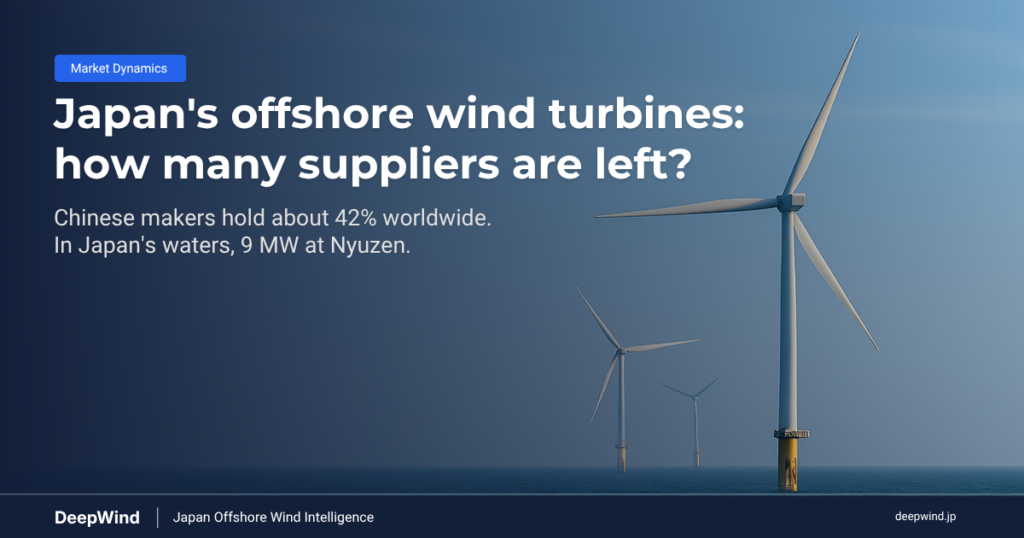
Four Chinese manufacturers account for about 42% of the offshore wind turbines installed worldwide. Japan’s register of certified offshore wind farms lists three Chinese units: the 3 MW turbines at Nyuzen, off Toyama, 9 MW in total. Japan buys its offshore turbines from a handful of Western makers. For the 15 MW class planned for Round 2 and later projects, two names are in play. Developers, EPC contractors and lenders preparing for Round 4 and the re-tendered Round 1 zones now face the same question: which maker can deliver, when, and at what price. The answer bears directly on whether a project closes.
👉 How to Read Japan’s Offshore Wind Market: Investment, Cost, and Supply-Chain Constraints
→
Execution Reality
→
Bankability Test
Chinese makers hold about 42% of the global offshore installed base. Of the six offshore wind farms on ClassNK’s certification register, one uses Chinese turbines: three 3 MW units at Nyuzen.
After GE Vernova stopped developing its largest turbine, Murakami-Tainai switched from 18 MW to 15 MW units and pushed offshore works back a year, according to press reports. Vestas and Siemens Gamesa are the makers named as likely suppliers.
Nyuzen shows a Chinese turbine can be certified and run commercially in Japanese waters. It does not show how a 15 MW unit performs in Japanese typhoons, how local service would work, or how auction scorers and lenders would treat it.
About 42% of the world’s offshore turbines, 9 MW in Japan
At WIND EXPO in September 2026, the Japan Wind Power Association (JWPA) presented manufacturer market shares based on GWEC’s Supply Side Data 2025. By cumulative offshore capacity at the end of 2025, Siemens Gamesa leads with 30.81%. Mingyang is second at 13.75%, followed by Shanghai Electric Wind Power (Sewind) at 13.51%. Add Goldwind (8.78%) and Envision (6.25%), and four Chinese makers hold about 42% between them.
ClassNK, Japan’s classification society, certifies that a wind farm’s site assessment and design meet the required standards. Its register of certified offshore wind farms, current to 30 September 2026, has six entries. The table sets the leading global suppliers against the turbines those six farms use.
| Manufacturer | Global offshore share (cumulative, end 2025) | Japan offshore farms on ClassNK register |
|---|---|---|
| Siemens Gamesa | 30.81% | Ishikari Bay New Port (8 MW × 14) |
| Mingyang (China) | 13.75% | Nyuzen (3 MW × 3) |
| Sewind (China) | 13.51% | None listed |
| Vestas | 12.97% | Akita Port and Noshiro Port (4.2 MW × 33); Kitakyushu Hibikinada (9.5 MW × 25) |
| Goldwind (China) | 8.78% | None listed |
| Envision (China) | 6.25% | None listed |
The register covers farms certified by ClassNK, so it may not capture every offshore turbine in Japan. Within it, the world’s second-largest offshore turbine maker accounts for 9 MW.
Four Western makers hold 76% of Japan’s fleet
The national picture, onshore included, points the same way. JWPA counts 6,434 MW of turbines in operation in Japan at the end of 2025. GE and its predecessors hold 23%, Siemens 20%, Vestas 17% and Enercon 16%. Hitachi with Fuji Heavy Industries (9%), Mitsubishi Heavy Industries (5%) and Japan Steel Works (4%) follow. No Chinese maker appears among the named suppliers. The deck does not break down its 3% “Others” category.
The 625 MW that started operating in 2025 is even more concentrated. Siemens Gamesa supplied 41%, GE 38% and Enercon 20%. JWPA notes that Japan sees so few projects each year that one order can swing the annual ranking.
How many suppliers can deliver a 15 MW turbine to Japan?
For the large projects still to be built, the field is narrower again. At Murakami-Tainai, a Round 2 zone off Niigata, the project company led by Mitsui originally planned 38 GE Vernova turbines of 18 MW, 684 MW in total. GE Vernova then stopped developing its largest turbine. At the statutory council meeting on 20 January 2026, the company said it would install 46 turbines of 15 MW instead, according to Wind Journal. Offshore construction moved from April 2027 to April 2028.
The company has not named the new supplier. Wind Journal expects either Vestas or Siemens Gamesa, the two makers with delivery records in Japan’s earlier projects. The occupancy plan for Yuza (450 MW, Yamagata) already specifies 30 Siemens Gamesa 15 MW units. No 15 MW turbine is yet operating in Japan.
👉 Niigata Murakami Tainai Offshore Wind Project
Vestas has also made clear that local capacity depends on orders. On 10 July 2026, METI published the adoption list for the offshore wind equipment round of its GX supply chain subsidy. It named one company: Vestas Japan, for final assembly of nacelles, the housing on top of the tower that holds the generator, in Kitakyushu. Vestas said it would proceed only if the market grows and it wins orders in Japanese projects. Makers wait for orders before committing factories; developers wait for factory capacity before fixing plans.
A turbine change moves the schedule and the revenue case together. Murakami-Tainai is reported to be reviewing its whole timetable, covering the new turbine specification, the change of supplier and a possible bid into the Long-Term Decarbonization Auction. A later start of operation pushes back the first sales revenue. The debt service coverage ratio (DSCR), which measures how many times a project’s cash flow covers each year’s debt payments, is sensitive to construction delay and cost overrun. With two suppliers, competition for factory slots is more likely to reach projects as schedule risk (DeepWind analysis).
What Nyuzen proves, and what it cannot
Nyuzen Marine Wind, owned by Wenti Japan, JFE Engineering and Hokuriku Electric Power, built the farm off Nyuzen town. It installed three Mingyang 3 MW-class turbines and started operating on 22 September 2023, with output capped at 7,495 kW. The power is sold under Japan’s feed-in tariff. ClassNK issued its wind farm certificate on 18 November 2022, alongside separate statements for site conditions, design basis, integrated load analysis, the turbine and the support structure.
The fact it establishes is simple: a Chinese turbine can be certified and operated commercially in Japanese waters. The scale is the limit. Nyuzen’s units are one fifth the size of the 15 MW class that Japan’s large projects now assume. Typhoon performance at that size, a domestic parts and service network, and factory capacity for a 600 MW order are all outside what Nyuzen can tell anyone.
Mingyang’s WIND EXPO deck points to a 16 MW floating turbine on a tension-leg platform in 136 m of water. It was connected to the grid in August 2026 and is designed for Force 17 typhoon conditions. The company also says earlier floating units came through Typhoon Yagi in September 2024. These are the company’s own statements; DeepWind has not found independent verification.
Five checks before a Chinese turbine goes on the shortlist
DeepWind does not recommend or rule out any manufacturer. A developer weighing a Chinese turbine should consider these five points early.
- Type certification and comparable operation: how far the model is certified by ClassNK or equivalent bodies. Also check how many units of the same size already run in conditions like Japan’s typhoons and Sea of Japan winter storms.
- Local service: during the warranty period, when the manufacturer guarantees performance, the maker usually carries out turbine maintenance. Spare parts and technicians in Japan decide how long a failed turbine stays down.
- Auction scoring: Japan’s revised auction rules give more weight to project feasibility and domestic supply chains. In the documents DeepWind reviewed, no scoring criterion is framed around a supplier’s nationality. How a supply plan is scored for feasibility still needs checking in each zone’s guidelines.
- Lenders and insurers: loan and insurance terms depend on a maker’s track record, balance sheet and warranty package. A model with little operating history in Japan may take longer to negotiate.
- Policy direction: debate over cybersecurity and economic security in power equipment continues in Japan and abroad. Whether Japan will add rules on turbine procurement has not been settled.
👉 Inside Japan’s ¥83.3bn GX Supply Chain Subsidy: Manufacturing Capacity Floors vs Pipeline Reality
Japan’s turbine problem is less about which country a maker comes from than about how few makers it can choose from.
The suppliers that build about 42% of the world’s offshore turbines are almost absent from Japan. That leaves the large projects concentrated on two Western makers with a delivery record here. In a two-supplier market, buyers have little say over price or delivery dates. Murakami-Tainai showed what that means in practice: one maker leaving the largest turbine class was enough to redesign a Round 2 project and delay its offshore works by a year.
Two things are worth watching ahead of Round 4 and the re-tenders. The first is how much Japan-bound factory capacity Vestas and Siemens Gamesa commit; whether the Kitakyushu assembly line actually starts is a useful signal. The second is how auction scorers and lenders treat makers with a thin Japanese record. Whether Chinese turbines gain ground in Japan is likely to be settled there, before technology becomes the deciding question.
Related DeepWind Articles
- Inside Japan’s ¥83.3bn GX Supply Chain Subsidy: Manufacturing Capacity Floors vs Pipeline Reality
- Hokkaido Offshore Wind Supply Chain: 27 Firms Mapped Against a JPY 768bn Target
- REACH Launched in Kitakyushu: What Japan’s First Operational-Anchor Offshore Wind Cluster Means
- BP’s Reported Exit from 450 MW Yuza: Why Winning Japan’s Offshore Wind Auction Isn’t the Same as Financing It
- Japan’s Offshore Wind Supply Chain: Progress and Future Challenges
DeepWind Weekly tracks Japan’s offshore wind market beyond headline announcements, focusing on execution risk, cost structure, project viability, supply-chain constraints, and policy implications.
Subscribe to receive weekly intelligence on Japan’s offshore wind market.
Why Isn't Floating Wind Bankable in Japan Yet?
The synchronized supply-chain bottleneck, quantified node by node, with a full sensitivity ranking and a bankability ladder of scaling conditions. Includes Simulator Professional (β) access to reproduce every figure on your own assumptions.
See the full analysis →