Published: July 9, 2026 | Updated: October 8, 2026
COST & COMMERCIAL VIABILITY
BP is reportedly in talks to leave the 450 MW Yuza offshore wind project in Yamagata — one of two zones Japan awarded in its Round 3 auction in December 2024. The Marubeni-led consortium is reported to continue, and BP says nothing has been decided, so the exit should be read as reported, not confirmed. The more durable story sits underneath the headline. Yuza was won with a zero-premium bid — the same structure every Round 3 winner used — and that structure is what makes these projects difficult to finance, regardless of which partner stays or leaves. The question worth asking is not why BP might exit, but whether a zero-premium award was financeable in the first place, and what could change that.
👉 Offshore Wind Cost Structure and Economics in Japan
→
Execution Reality
→
Bankability Test
In Round 3, all seven bidders bid at the ¥3/kWh floor, so winners were chosen on delivery capability, not price. A zero-premium project earns close to merchant or PPA prices with almost no subsidy top-up, which means the developer absorbs nearly all of the price risk across a roughly 30-year operating life.
Mitsubishi Corporation exited its Round 1 sites in August 2025; BP is now reportedly stepping back from Yuza. The actors are different — a Japanese trading house and a global oil major — but the economics being tested are the same, and elevated CAPEX makes them tighter.
In an illustrative DeepWind Simulator run, the Yuza site shows a minimum DSCR of about 1.61 under a merchant/FIP path and about 1.81 under a 20-year LTDA capacity payment — barely different as numbers. The difference is what they rest on: the FIP figure assumes JPY 30/kWh materializes; the LTDA figure does not depend on price at all. LTDA does not raise the DSCR so much as convert an assumption into a contract.
What Yuza actually is: a 450 MW zero-premium award
The Yuza zone, off the town of Yuza in Yamagata Prefecture, was one of two areas awarded in Japan’s third offshore wind auction (Round 3), announced in December 2024. The winning bidder — a consortium led by Marubeni with Kansai Electric Power, Tokyo Gas, and local partners — plans 30 turbines of 15 MW each (Siemens Gamesa) for a total of 450 MW, targeting commercial operation in June 2030. Our Yamagata Yuza project overview sets out the full scope, timeline, and CAPEX/OPEX assumptions in more detail.
| Project / Area | Yuza Offshore Wind (Yamagata) |
|---|---|
| Capacity | 450 MW (30 × 15 MW) |
| Auction | Round 3, awarded December 2024 |
| Revenue basis | FIP, zero-premium bid (¥3/kWh floor) |
| Target COD | June 2030 |
| Status | BP’s exit reported (Nikkei, July 2026); consortium reported to continue |
| Key commercial issue | Merchant/PPA price risk under a zero-premium structure |
The detail that matters most is the pricing. In Round 3, every one of the seven bids came in at the ¥3/kWh floor — the lowest allowed — so price could not separate the field, and selection came down to non-price criteria such as how credibly each bidder could deliver. Yuza, in other words, was not won on an aggressive number that one company overreached to hit. Zero premium was the entry ticket for everyone.
Why zero premium is a financing problem, not a price win
Under Japan’s Feed-in Premium (FIP) system, a project’s revenue is the market price plus a premium equal to the gap between a fixed base price and a market reference price. A zero-premium bid sets the base price at roughly the reference-price level, which means the premium is close to nothing. In practice the project earns market or corporate-PPA prices with little or no subsidy top-up, and the developer carries almost all of the price risk across the life of the asset. For a deeper walk-through of that revenue mechanism, see our guide to how FIT and FIP actually pay an offshore wind project.
That risk allocation is exactly what lenders scrutinize. Project finance sizes debt against the cash flow a project can be relied on to produce in a downside case — the P90 energy yield, tested through the Debt Service Coverage Ratio (DSCR). When revenue depends on merchant and PPA prices rather than a fixed 20-year offtake, the downside case widens, the DSCR falls, and the financeable amount of debt shrinks. Add steel and equipment costs that remain elevated, and a zero-premium structure leaves very little headroom for CAPEX inflation, currency movement, or schedule slip.
In an illustrative DeepWind Simulator run of the Yuza site (450 MW, real 2026 JPY), a FIP/merchant revenue path priced at JPY 30/kWh produces a minimum DSCR of about 1.61 and a simple payback near year 13. On the number alone, that clears the 1.35x bankability threshold. These are model outputs on DeepWind assumptions, not the project’s own figures, and are indicative rather than a project-specific forecast.
But that 1.61 rests on an assumption: that JPY 30/kWh actually materializes, every year, for three decades. A zero-premium bid is precisely the decision not to contract that price. What is contracted is not the revenue — it is who carries the risk of it not arriving.
This is why the pattern across Japan matters more than any one company. Mitsubishi Corporation walked away from its three Round 1 sites in August 2025; BP is now reportedly stepping back from Yuza. One is a Japanese trading house, the other a global oil major that has been scaling back offshore wind worldwide — very different motives are possible. But both projects sit on the same side of the same test, and that is the structural signal.
What changes the test: a 20-year LTDA capacity payment
The financeability gap is not fixed. What most directly changes it is the offtake structure — and Japan is now consulting on exactly that. The government has proposed allowing Round 2 and Round 3 zero-premium projects to participate in the Long-Term Decarbonization Auction (LTDA), which pays a fixed capacity revenue in yen per kW per year for 20 years rather than energy revenue per kWh. For a project whose problem is merchant price risk, a long-dated capacity payment is close to the ideal fix: it replaces the volatile part of the revenue with a contracted one, exactly where lenders size the downside.
The same illustrative Simulator run shows the effect. Holding the site, the turbines, and the CAPEX constant and changing only the offtake to a 20-year LTDA-style capacity payment (assumed at JPY 100,000/kW/year) gives a minimum DSCR of roughly 1.81 and a simple payback around year 12.
Note what that does — and does not — do. The DSCR barely moves: from 1.61 to 1.81, about two-tenths. At a site with wind as good as Yuza’s, LTDA does not transform the headline financing metric.
What changes is what the number rests on. The FIP 1.61 holds only if JPY 30/kWh arrives. The LTDA 1.81 holds whatever the power price does, because LTDA fixes revenue per kW and returns roughly 90% of market income — decoupling the project from price almost entirely. LTDA’s function is not to raise the DSCR. It is to replace an assumption with a contract. That distinction is exactly what a lender is looking at.
This structure cuts both ways. Because capacity revenue is fixed per kW, more generation does not mean more income. When we revised the power curve assumption and Yuza’s gross capacity factor rose from 39.6% to 45.15%, the LTDA case moved only from 1.80 to 1.81. The same revision moved the FIP case from 1.33 to 1.61. The better the wind resource, the less LTDA is worth in relative terms. It is insurance, and the premium looks expensive precisely where the asset is strongest.
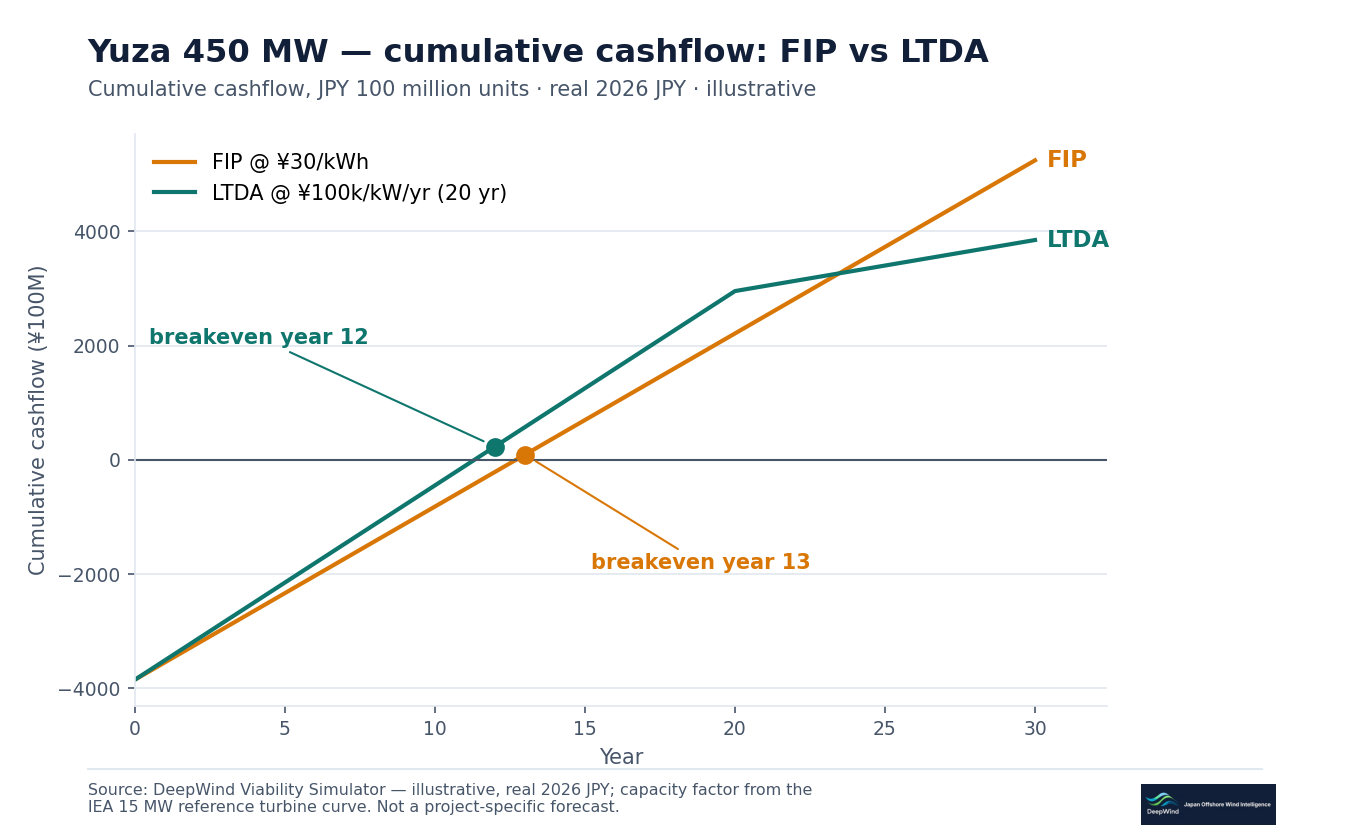
Figure 1: Yuza cumulative cashflow — FIP vs LTDA
Same site, same CAPEX; only the offtake structure differs. The gap is narrow — breakeven around year 12 versus year 13, and a minimum DSCR of ~1.81 versus ~1.61. The significance is not the size of the gap but what sits underneath it: the FIP figure depends on JPY 30/kWh arriving; the LTDA figure does not depend on price.
Source: DeepWind Viability Simulator (illustrative; real 2026 JPY; capacity factor derived from the IEA 15 MW reference turbine power curve). Not a project-specific forecast.
That number has now been set. On 31 August 2026 METI settled the terms of the fourth LTDA auction, putting the offshore wind ceiling at JPY 345,220-701,172/kW/year across nine areas. That figure is quoted per counted kW, after dividing by the area adjustment coefficient (15.7% to 31.9% for wind), so it is not what a project receives. Converted to installed kW, all nine areas land at about JPY 110,000/kW/year (DeepWind calculation) — close to the JPY 100,000/kW/year assumed in this article. The concern that the ceiling would be set too low has eased, but there is no headroom in it either, and a ceiling is a maximum allowable bid rather than a payment.
A ceiling is still a maximum allowable bid, not a payment: awards are set by competition. The rule admitting zero-premium projects was settled on 31 August 2026, and applies to the second and third rounds only.
Reading BP’s reported exit
None of this explains BP’s specific decision, and it is not meant to. BP has not stated a reason, the reporting is unconfirmed, and a global major recalibrating its worldwide portfolio can be moving for reasons that have nothing to do with any single site. The useful reading is narrower and more durable: a project structured on zero premium carries a bankability question from the day it is awarded, and that question does not depend on whether BP stays or goes. Consider it a prompt to look at the structure, not a verdict on a company — and certainly not a comment on whether any bid should or should not have been made.
Winning an auction and clearing the bankability test are two different tests — and Japan’s zero-premium rounds settled only the first.
Because every Round 2 and Round 3 bid came in at the floor, these auctions selected for delivery capability, not for financeability. Financeability was assumed to follow. BP’s reported step-back at Yuza is a reminder of how much weight that assumption carries: the same structure that made the auction easy to win makes the project hard to finance.
What matters next is not the BP headline but the policy plumbing behind it. Access itself was settled on 31 August 2026: zero-premium Round 2 and Round 3 projects can bid into the fourth auction. What remains open is whether the terms draw bids. Converted to installed kW the ceiling lands at about JPY 110,000/kW/year, which only just reaches the level DeepWind estimates a project needs. A ceiling sets the range a project may bid in; it does not set what the project is paid.
Frequently Asked Questions
Related DeepWind Articles
- 450 MW Yamagata Yuza Offshore Wind Project: Scope, Timeline, and Economics
- Japan’s LTDA Explained: How the Long-Term Decarbonization Auction Works for Offshore Wind
- Japan FIT vs FIP: How Offshore Wind Revenue Actually Works
- Offshore Wind Cost Structure and Economics in Japan
Why Isn't Floating Wind Bankable in Japan Yet?
The synchronized supply-chain bottleneck, quantified node by node, with a full sensitivity ranking and a bankability ladder of scaling conditions. Includes Simulator Professional (β) access to reproduce every figure on your own assumptions.
See the full analysis →