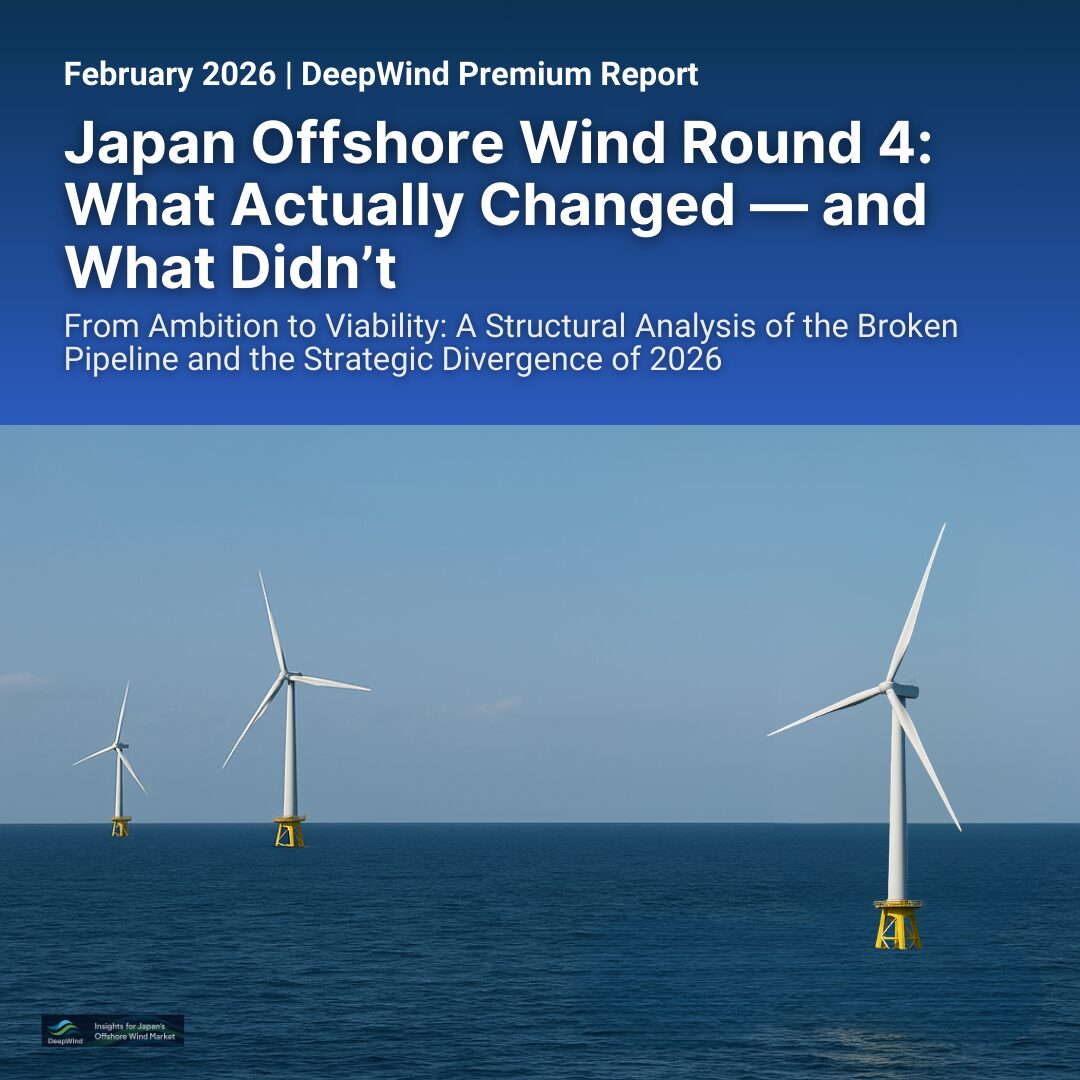

This article provides a detailed explanation of the key points from the official document titled “New Offshore Wind Auction System to Ensure Project Completion” published by Japan’s Agency for Natural Resources and Energy and the Ministry of Land, Infrastructure, Transport and Tourism on November 19, 2025.
While this article focuses on a specific topic, those looking to understand Japan’s overall offshore wind policy and regulatory framework should also read our comprehensive summary here:
👉 Japan’s Offshore Wind Policy & Regulatory Framework Explained
Background: Early Project Withdrawals Expose Flaws in the System
Since the enactment of the Renewable Energy Sea Area Utilization Act, Japan has conducted three auction rounds to select suitable developers for offshore wind projects. However, by late 2024, projects in three Round 1 sites—two in Akita and one off Choshi—were withdrawn. Government analysis pointed to key structural challenges: inflation-driven material cost hikes, weak domestic supply chains, long design lead times, and difficulties securing long-term PPA buyers.
These issues had not been visible during the initial design of the auction scheme, and consequently, the winning proposals may have lacked true feasibility.
Six Pillars of Reform: What’s Changing in the New Auction System
1. Rebalanced Evaluation Points for Feasibility
The score for “implementation speed” is halved (from 20 to 10 points), while more weight is placed on execution plans and supply chain robustness (each increased to 25 points), prioritizing credible over optimistic timelines.
2. Granular Scoring with a Checklist-Based System
Japan will abandon its previous percentile-based grading (“Top Runner” to “Minimum Level”) and introduce a detailed checklist system. Each item is scored based on basic presence and advanced quality, making evaluations more objective and transparent.
3. Flexible Scheduling with Buffer Time
A two-year buffer will be introduced for construction timelines to reduce pressure. Rather than favoring unrealistic early completions, the revised scoring will reward realistic timelines relative to peer bidders, based on comparative start dates.
4. Revamped Pricing Score with Bid Ranges
A lower and upper limit will be set for supply prices. Bids below the minimum or above the maximum are disqualified. Full points (120) are awarded at the lower limit, while bids at the upper limit still receive substantial scores (e.g., 100 points), softening the previous “zero-premium” bias.
5. Reintroduction of a 1GW Cap per Bidder
As in Round 2, a maximum of 1GW will be allocated per bidder to ensure diversity and avoid over-concentration. Priority is given to the project with the widest score gap from the runner-up.
6. Stricter Rules for Withdrawals
If a developer withdraws, its parent and sibling companies will also be disqualified from the next round. Additionally, developers must share data (e.g., geotechnical surveys) free of charge to enable smoother re-auctioning of abandoned sites.
What This Means for Japan’s Offshore Wind Ambitions
This reform marks a major shift from emphasizing low-cost, high-speed deployment toward more resilient, achievable projects. The new rules aim to reduce the likelihood of future failures by favoring mature planning, risk mitigation, and long-term feasibility.
For developers, this means enhanced expectations: not only in terms of engineering, but also stakeholder coordination, financial robustness, and supply chain planning. As Japan pushes offshore wind toward industrial maturity, this policy reset may serve as a blueprint for other emerging markets balancing affordability and bankability.
For a broader understanding of Japan’s offshore wind legal system, policy structure, and support measures, be sure to check out our pillar article:
🌊 Japan’s Offshore Wind Policy & Regulatory Framework Explained
📘 DeepWind Premium Report
Round 4 Is Not a Reset.
A concise, decision-oriented structural brief on what actually changed —
and what remains structurally broken.