
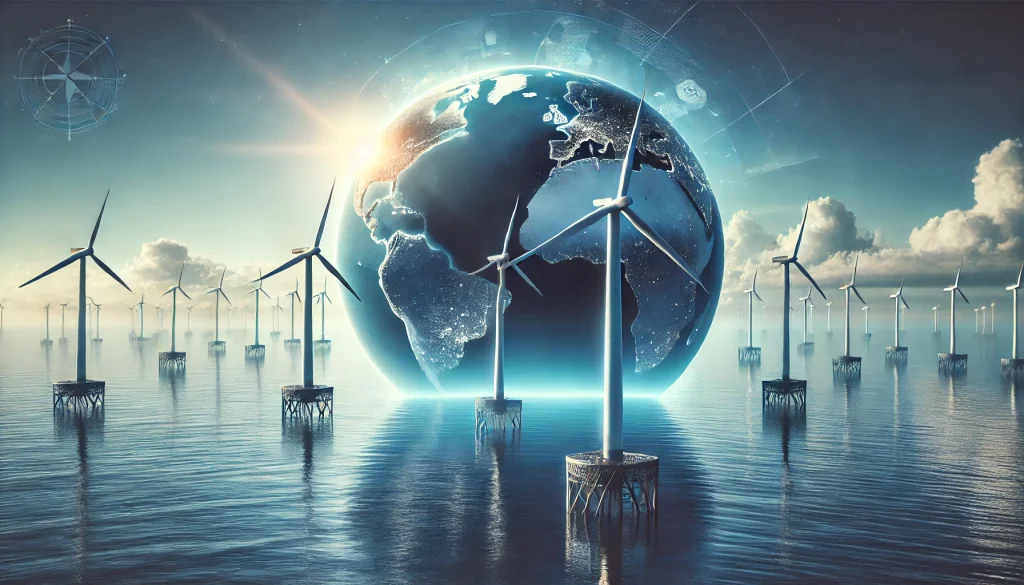
Floating offshore wind technology is a game-changer for renewable energy in regions with deep coastal waters. While conventional fixed-bottom turbines are limited to shallow seas, floating platforms open opportunities for deeper waters. With global targets accelerating and key projects underway, this article explores international trends and development examples of floating offshore wind power.
For a structured overview of Japan’s offshore wind market—including policy, investment dynamics, costs, and supply-chain constraints—see our pillar article.
👉 Japan Offshore Wind Market Analysis (Pillar)
Global Trends in Floating Offshore Wind Power
1. Expanding Opportunities in Deep Waters:
• Floating wind turbines are suitable for waters deeper than 50–60 meters, where fixed-bottom solutions are impractical.
• This technology unlocks vast areas for renewable energy development globally.
2. Projected Growth:
• By the end of 2021, only 0.12 GW of floating wind capacity had been installed globally, compared to 57.2 GW for offshore wind overall.
• However, 8 GW of floating wind projects are currently under development, with projections of 10 GW by 2030 and 270 GW by 2050, as estimated by the U.S. National Renewable Energy Laboratory (NREL).
3. Government-Led Initiatives:
• Several nations, including the UK, France, and the U.S., are setting ambitious targets to integrate floating wind technology into their renewable energy portfolios.
International Development Examples
United Kingdom
• Projects:
• ScotWind Leasing: 14.5 GW allocated for floating projects.
• Notable developments include White Cross (100 MW) and Erebus (96 MW).
• Targets:
• 50 GW of offshore wind, including 5 GW of floating capacity by 2030.
France
• Projects:
• Provence Grand Large (25 MW) and Groix & Belle-Île (28 MW), among others.
• Targets:
• Aiming for robust pilot projects to pave the way for commercial deployment.
United States
• Projects:
• California aims to develop up to 8.4 GW through its lease auctions.
• Maine has initiated research arrays like the Gulf of Maine Floating Wind Research Array.
Japan
• Notable Projects:
• Goto City offshore floating project (16.8 MW).
• Challenges and Focus:
• Japan leverages its expertise in shipbuilding to scale up floating technology, while addressing unique ocean conditions like typhoons and seismic activity.
Conclusion
Floating offshore wind power is rapidly gaining momentum as nations seek innovative solutions to decarbonize energy. With significant growth expected in the coming decades, countries are actively investing in development and deploying pilot projects to commercialize this transformative technology. As global collaboration intensifies, floating offshore wind will undoubtedly become a cornerstone of the renewable energy future.
Japan’s offshore wind market cannot be understood through a single lens. A cross-cutting view—integrating policy, investment behavior, cost structures, and execution capability—is consolidated in our pillar article.
👉 Japan Offshore Wind Market Analysis (Pillar)
Explore more categories at DeepWind:
- 🔍Market Insights – Understand the latest trends and key topics in Japan’s offshore wind market
- 🏛️Policy & Regulations – Explore Japan’s legal frameworks, auction systems, and designated promotion zones.
- 🌊Projects – Get an overview of offshore wind projects across Japan’s coastal regions.
- 🛠️Technology & Innovation – Discover the latest technologies and innovations shaping Japan’s offshore wind sector.
- 💡Cost Analysis – Dive into Japan-specific LCOE insights and offshore wind cost structures.