
Published: January 14, 2025 | Updated: January 9, 2026
As Japan accelerates its renewable energy transition, its offshore wind market is becoming an increasingly attractive destination for global investors. With clear government policies, advanced technologies, and a robust manufacturing sector, Japan offers diverse opportunities for investment. Here are five concrete ways investors can strategically enter Japan’s offshore wind market, along with real-world examples and actionable insights.
For a structured overview of Japan’s offshore wind market—including policy, investment dynamics, costs, and supply-chain constraints—see our pillar article.
👉 Japan Offshore Wind Market Analysis (Pillar)
1. Direct Investment (Equity Investment)
🔹 Method:
• Equity Stake in Projects: Investors can directly invest in Japan’s offshore wind projects by acquiring equity or ownership stakes.
• Example: BP recently partnered with Marubeni Corporation to secure a stake in Japan’s offshore wind projects, such as the Akita and Noshiro wind farms.
• Joint Ventures: Establish joint ventures with Japanese companies to leverage local expertise and regulatory know-how.
• Example: Equinor, a Norwegian company, has partnered with JERA and J-Power to co-develop floating wind projects in Japan.
💡 Benefits:
• Direct access to project revenues and long-term returns.
• Greater control over operational decisions.
⚠️ Challenges:
• Lengthy regulatory approval processes.
• Securing agreements with local communities for project support.
2. Investment via Infrastructure Funds
🔹 Method:
• Renewable Energy Funds: Invest in Japanese infrastructure funds that specialize in renewable energy and offshore wind.
• Example: Japan Infrastructure Fund (JIF) listed on the Tokyo Stock Exchange focuses on renewable energy projects, offering a low-risk entry point for foreign investors.
• Global Fund Expansion: U.S.-based funds, like BlackRock, have expanded into Japan’s offshore wind market by partnering with local asset managers.
💡 Benefits:
• Risk diversification through pooled investments.
• No need for direct project management.
⚠️ Challenges:
• Returns may be lower than direct investments due to fund management fees.
3. Debt Financing (Bonds and Loans)
🔹 Method:
• Project Finance Loans: Provide long-term loans to offshore wind projects.
• Example: The Asian Development Bank (ADB) and Japan Bank for International Cooperation (JBIC) have co-financed large-scale wind projects like the Goto Islands floating wind farm.
• Green Bonds: Invest in environmentally focused bonds issued by Japanese institutions or project developers.
• Example: Mitsubishi UFJ Financial Group has issued green bonds to fund renewable energy projects in Japan.
💡 Benefits:
• Stable returns with minimal involvement in operations.
• Supports ESG investment goals.
⚠️ Challenges:
• Returns depend on interest rates and project risks.
4. Supply Chain Investments
🔹 Method:
• Invest in Component Manufacturers: Focus on companies producing essential components like turbines, floating foundations, and electrical cables.
• Example: GE Renewable Energy collaborates with Japanese firms to supply turbines for domestic projects.
• Form Local Partnerships: Work with Japanese manufacturers to co-develop advanced technologies or scale production.
• Example: Siemens Gamesa has partnered with Japanese companies to localize wind turbine production.
💡 Benefits:
• Broader revenue streams beyond project-level investments.
• Strengthened relationships within Japan’s energy ecosystem.
⚠️ Challenges:
• Market dynamics and competition among suppliers can affect profitability.
5. Partnerships and Technology Provision
🔹 Method:
• Technology Licensing and Support: Offer cutting-edge technology such as AI-based monitoring systems or floating turbine designs.
• Example: U.S.-based Hexagon AB provides digital solutions to optimize Japan’s offshore wind operations.
• O&M Contracts: Enter long-term contracts for the operation and maintenance of wind farms.
• Example: European players like Vestas have already secured such agreements in Japan.
💡 Benefits:
• Rapid market entry through technology transfer.
• Opportunities to build long-term relationships with Japanese developers.
⚠️ Challenges:
• Technologies must comply with Japanese regulations and market needs.
Navigating Japan’s Market: Key Considerations
1. Regulatory Transparency:
Japan’s energy policies are stable, but approvals often involve comprehensive environmental and community impact assessments.
2. Cultural Adaptation:
Building trust and understanding Japan’s business etiquette is critical for successful partnerships.
3. Local Collaboration:
The Japanese government prioritizes projects that include local stakeholders and supply chain integration.
Conclusion
Japan’s offshore wind market presents a diverse range of opportunities for investors, from direct equity participation to supply chain and technology investments. Its ambitious goals to achieve 10 GW by 2030 and 30–45 GW by 2040. For investors seeking stability, innovation, and long-term returns, Japan’s wind energy sector offers immense potential.
Japan’s offshore wind market cannot be understood through a single lens. A cross-cutting view—integrating policy, investment behavior, cost structures, and execution capability—is consolidated in our pillar article.
👉 Japan Offshore Wind Market Analysis (Pillar)
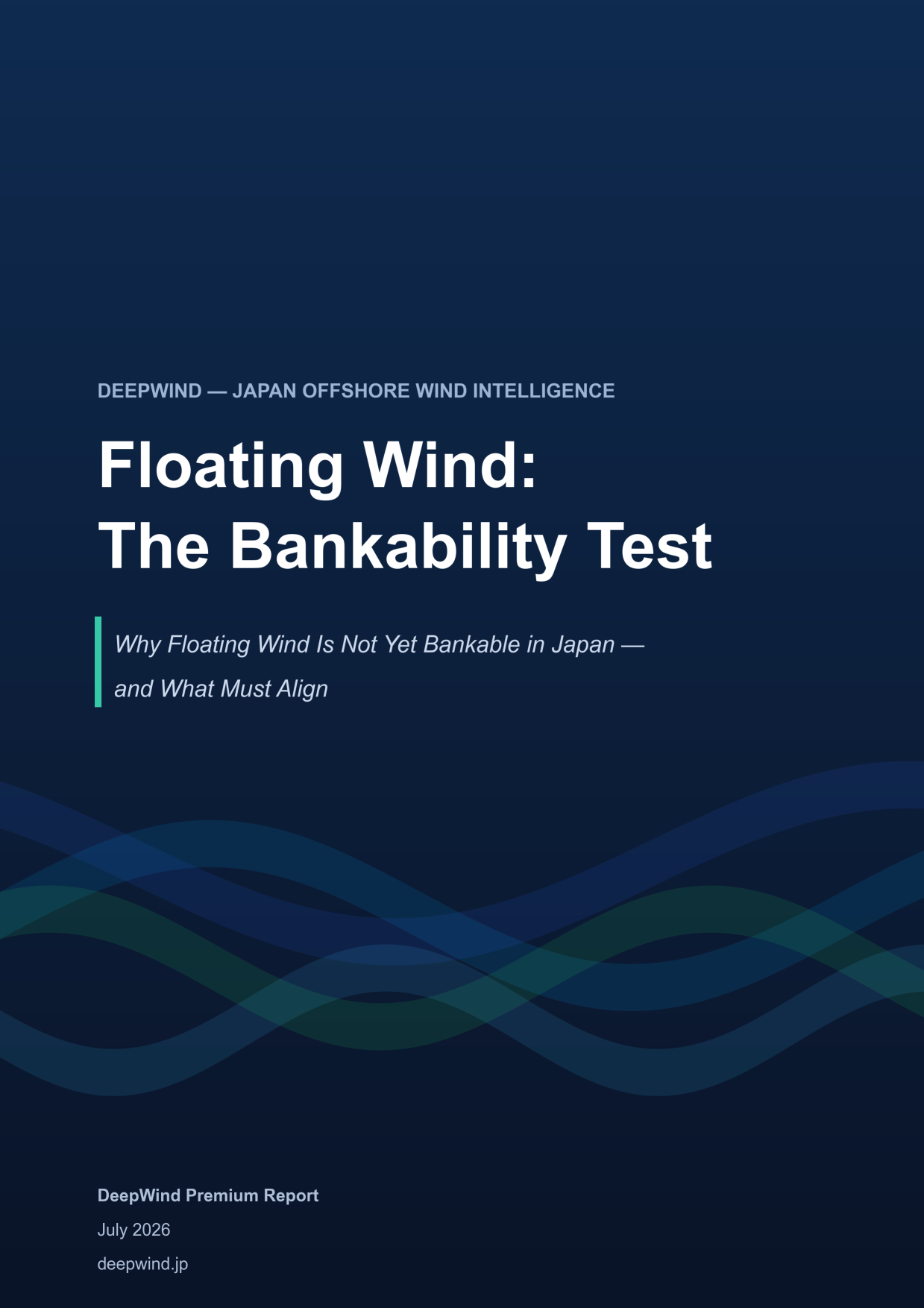
Why Isn't Floating Wind Bankable in Japan Yet?
The synchronized supply-chain bottleneck, quantified node by node, with a full sensitivity ranking and a bankability ladder of scaling conditions. Includes Simulator Professional (β) access to reproduce every figure on your own assumptions.
See the full analysis →