Published: October 17, 2025 | Updated: June 26, 2026
FLOATING WIND
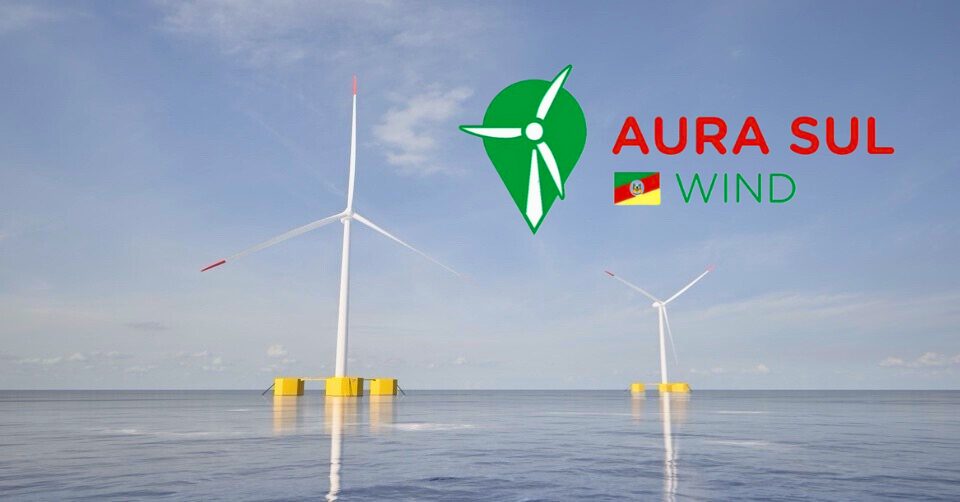
On June 2, 2026, JB Energy (Japan Blue Energy) officially launched Phase 2 of the Aura Sul Wind Project at the Brazil Offshore Wind & Power-to-X 2026 conference in Natal, Rio Grande do Norte. Twelve months after the project’s announcement, Phase 1 has been completed on schedule: the project site has been defined, a 30+ organization consortium assembled, and IBAMA (Brazil’s federal environmental authority) has issued the Environmental Terms of Reference — the formal scope document governing Phase 2 environmental studies. Located 65 km offshore from the Port of Rio Grande, Aura Sul Wind will deploy the Raijin Float®, Japan’s prestressed concrete semi-submersible platform, supporting an 18.5 MW turbine, with installation targeted for 2030. Brazil’s first floating offshore wind pilot has moved from concept into licensed engineering execution.
👉 Floating Offshore Wind in Japan: Market Structure, Costs, and Policy
→
Execution Reality
→
Bankability Test
Within 12 months of launch, Aura Sul Wind defined its site, assembled a 30+ organization consortium, and received IBAMA’s Environmental Terms of Reference — the regulatory scope document that governs Phase 2 environmental studies and marks entry into Brazil’s formal environmental licensing process.
The Raijin Float’s prestressed concrete design is engineered for full domestic manufacturing. JB Energy frames this not as greenfield industrialization but as a supply chain transition — redirecting Brazil’s established oil & gas fabrication infrastructure (shipyards, specialized vessels, port logistics) toward floating renewables.
Adding BV and ABS to the Phase 2 consortium — alongside FEED engineering and independent metocean data collection — means Aura Sul Wind is now building the technical record that project finance lenders look for when backing a first-of-kind floating wind deployment.
Project Specifications and Site Context
| Project | Aura Sul Wind |
|---|---|
| Location | 65 km offshore, Rio Grande do Sul, Brazil (32.37°S, 51.50°W) |
| Water depth | 44 m |
| Foundation | Floating semi-submersible — Raijin Float® (prestressed concrete) |
| Turbine | 18.5 MW, single unit (MingYang MySE 18.5-260) |
| Mooring | Seabed-anchored; grid-connected via submarine export cable |
| Phase 2 launched | June 2, 2026 (Brazil Offshore Wind & Power-to-X 2026, Natal) |
| Installation target | 2030 |
Rio Grande do Sul combines high-quality offshore wind resources, an established port at Rio Grande with existing oil & gas logistics, and proximity to Brazil’s civil engineering industrial base. The 44-meter water depth falls at the lower boundary of the floating wind range — a deliberate pilot-scale choice that reduces installation complexity while demonstrating the Raijin Float’s performance at a commercially meaningful turbine size.
The Raijin Float: Why Concrete, Why Brazil
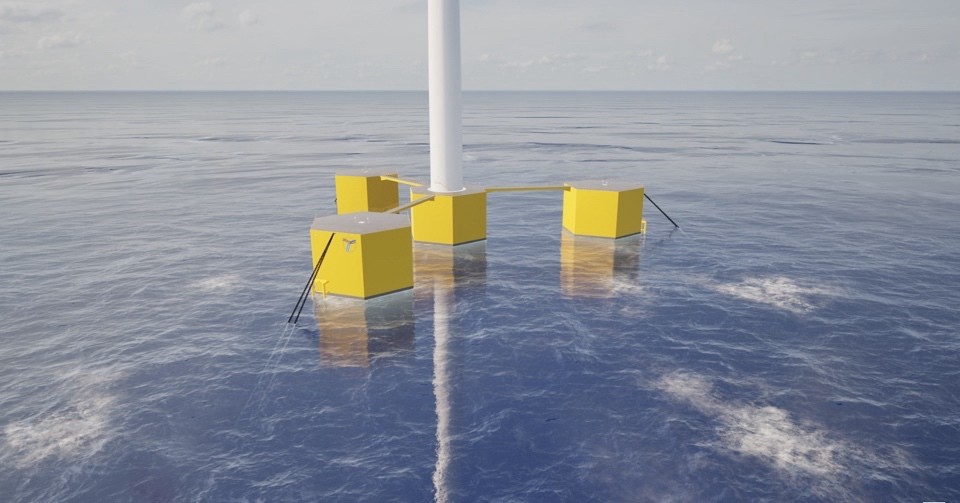
The Raijin Float diverges from the dominant European approach — steel semi-submersibles — by using prestressed concrete as the structural material. JB Energy’s rationale rests on two propositions.
Cost structure. Prestressed concrete fabrication is substantially cheaper than equivalent steel in markets with established cement industries. JB Energy projects CAPEX reductions of up to 50% compared to steel foundations. The directional case is credible: Brazil holds one of the world’s largest cement and concrete industrial bases, and supply chains for prestressed concrete offshore structures have been developed through decades of oil & gas operations.
Localization. A steel semi-submersible requires heavy fabrication infrastructure and experienced offshore steel welding capacity that most emerging floating wind markets are still developing. Prestressed concrete construction can be performed in a wider range of facilities, enabling genuine domestic supply chain development — which Estaleiro EBR (Brazil’s shipyard capacity partner) and the supply chain workstream in Phase 2 are designed to validate.
Phase 1 Completed: From Announcement to IBAMA Terms of Reference
Phase 1 ran from June 2025 to June 2026 and delivered four foundational milestones:
- Project site and offshore area defined — 65 km from Porto Rio Grande, 44 m depth, with grid connection and port logistics scoped
- Strategic partnerships established — a consortium spanning technology, engineering, certification, academia (9 Brazilian universities + University of Tokyo), and institutional support
- Technical and institutional foundation built — regulatory pathway mapped, project governance structured, government and trade association engagement secured
- Environmental Terms of Reference obtained from IBAMA — the formal scope document from Brazil’s federal environmental authority defining the environmental studies required for the Preliminary Environmental License (Licença Prévia)
The Terms of Reference is a concrete regulatory milestone. It confirms that IBAMA has reviewed the project’s scope and that Phase 2 environmental studies will be conducted against an agreed regulatory framework — reducing the risk of later scope disputes during formal licensing review.
Phase 2 Focus Areas: FEED to Supply Chain
Phase 2, formally launched June 2, 2026, runs seven workstreams in parallel:
- FEED Engineering Development — front-end engineering design covering platform structure, turbine integration, mooring system, and installation sequence
- Environmental Studies and Licensing — executing the assessment scope defined by IBAMA’s Terms of Reference, targeting the Preliminary Environmental License
- Metocean Data Collection — independent wave, current, and wind resource measurement at the Aura Sul site
- Marine Fauna Monitoring — baseline biodiversity surveys required for environmental licensing
- Navigation and Maritime Safety Studies — route analysis, exclusion zones, and maritime traffic impact assessment
- Risk Assessments and Certifications — Bureau Veritas and ABS-led technical certification of the Raijin Float design
- Supply Chain and Industrial Development — mapping and qualifying Brazil-based suppliers for concrete fabrication, mooring, and offshore installation
FEED completion and the Preliminary Environmental License are the dual critical-path items for the 2030 installation target. Both must advance in parallel; slippage in either delays the schedule.
Consortium Architecture: Technology, Engineering, Certification, and Academic Layers
The Phase 2 consortium reflects the multi-disciplinary complexity of a first-of-kind floating wind deployment in a market without prior floating wind precedent.
Technology and Industry Partners
- JB Energy (Japan) — consortium lead, Raijin Float® technology developer
- MingYang Smart Energy (China) — MySE 18.5 MW turbine supply
- Prysmian (Italy) — submarine export cable
- Hitachi Energy (Switzerland / Japan) — grid connection and power conversion systems
- Fugro (Netherlands) — geotechnical and metocean survey services
- blueOASIS (Portugal) — HydroTwin marine environmental monitoring
- Sabik Offshore (Finland) — marine signaling and safety lighting
- Mammoet (Netherlands) — heavy lift and transport logistics
Engineering, Certification, and Legal
- Technomar Engenharia (Brazil) — digital twin and offshore engineering
- ENGETI Consultoria (Brazil) — engineering consulting
- PORTOS RS (Brazil) — port authority, infrastructure and logistics
- Bureau Veritas (France) — technical certification
- American Bureau of Shipping — ABS (USA) — classification and marine certification
- Arvut (Brazil) — technical consulting
- Estaleiro EBR (Brazil) — fabrication and shipyard capacity
- Licks Attorneys (Brazil) — legal support
Universities and Research Institutions
- Federal University of Rio Grande do Sul (UFRGS) / NIEPIEE UFRGS
- Federal University of Rio Grande (FURG)
- Federal University of Santa Maria (UFSM)
- Universidade do Vale do Rio dos Sinos (UNISINOS)
- Federal University of Santa Catarina (UFSC)
- Federal University of Paraná (UFPR)
- Federal University Fluminense (UFF)
- University of São Paulo (USP)
- University of Tokyo (Japan)
Institutional Support
- Prefeitura Municipal do Rio Grande / Governo do Estado do Rio Grande do Sul
- Embassy of Japan in Brazil
- ABEEólica / Sindienergia-RS / Sinduscon-RG
- Invest RS / ApexBrasil
Brazil’s Three Offshore Wind Pilots: Parallel Regulatory Benchmarking
Aura Sul Wind is one of three offshore wind pilots that have entered IBAMA’s environmental licensing process in Brazil:
- Aura Sul Wind (Rio Grande do Sul) — floating semi-submersible, Raijin Float® / 18.5 MW, Japanese concrete technology
- Petrobras-led project (Rio de Janeiro) — leveraging O&G offshore infrastructure and expertise
- SENAI-led project (Rio Grande do Norte) — technology and workforce training focus
Each pilot uses a distinct technology and operates under different site and regulatory conditions. Collectively, they are establishing the environmental assessment frameworks, regulatory precedents, and cost data that Brazil’s offshore wind industry — and its investors — will need before commercial-scale development becomes viable.
Japan’s Floating Wind Export Logic
Until Aura Sul Wind, Japan’s floating offshore wind projects had been limited to domestic demonstration sites: Fukushima (2013–2020), Kitakyushu, and Goto City (16.8 MW commissioned early 2026). The decision to pilot internationally in Brazil reflects a specific set of market conditions.
Industrial base alignment. Brazil’s prestressed concrete sector and offshore O&G heritage create a direct match for Raijin Float’s fabrication requirements — a supply chain already exists, it just needs to be redirected. This mirrors Japan’s own industrial position: the domestic concrete and civil engineering capacity that could serve a commercial floating wind build-out already exists, but the regulatory and certification framework to deploy it commercially is still being built.
Certification precedent. Bureau Veritas and ABS certification of the Raijin Float design in Brazil creates a certified technical record. That record travels: a certified design in Brazil reduces the technical due diligence burden for subsequent deployments in Japan or other markets, compressing the timeline from pilot to commercial.
Global market scale. GWEC projects 19 GW of floating offshore wind installed globally by 2034. Brazil’s deep-water coastline and established energy policy framework position it as a meaningful share of that — and the Aura Sul pilot, if it progresses on schedule, gives JB Energy a first-mover reference asset in one of the few markets where the supply chain prerequisites are genuinely in place.
With Phase 1 having laid the groundwork, attention now shifts to keeping FEED and the environmental studies on schedule. Whether this first step in Brazil becomes a foothold for taking Japanese floating wind technology into global markets will be measured by the progress that follows.
Related DeepWind Articles
- Floating Offshore Wind in Japan: Market Structure, Costs, and Policy
- Floating Offshore Wind Platform Design: Engineering Fundamentals and Key Types
Why Isn't Floating Wind Bankable in Japan Yet?
The synchronized supply-chain bottleneck, quantified node by node, with a full sensitivity ranking and a bankability ladder of scaling conditions. Includes Simulator Professional (β) access to reproduce every figure on your own assumptions.
See the full analysis →