
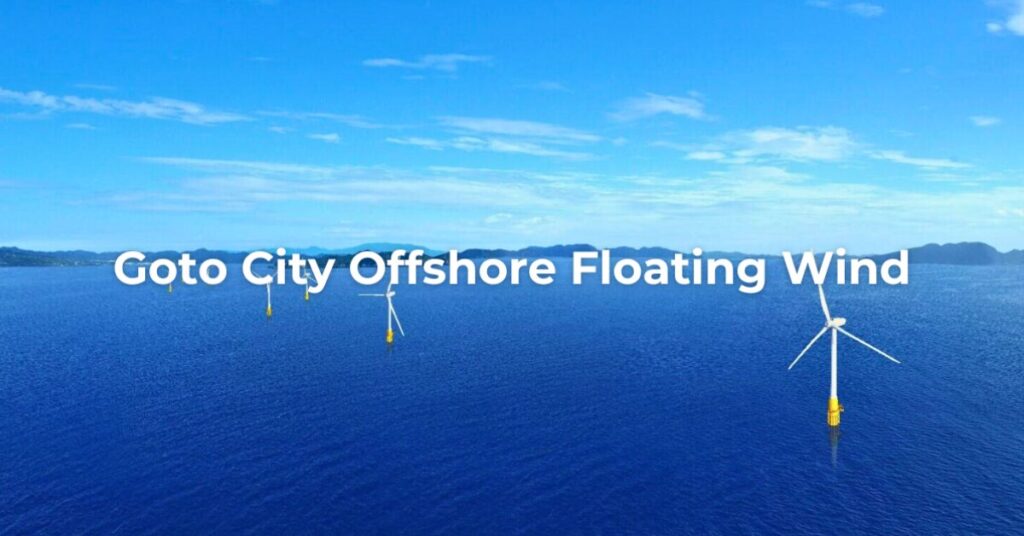
Published: February 19, 2026 | Updated: February 19, 2026
Introduction
This article introduces the designated Promotion Area of Nagasaki Goto city offshore under Japan’s Offshore Renewable Energy Act.
We explore the site’s characteristics, estimated power capacity, potential platform types, and development outlook.
➡ For an overview of all ten Promotion Areas as of 2025, see:
Promotion Areas for Offshore Wind in Japan – 2025 Overview
1. Project Overview
| Project name | Goto City Offshore Floating Wind Power Project |
| Developer | Goto Floating Wind Farm LLC |
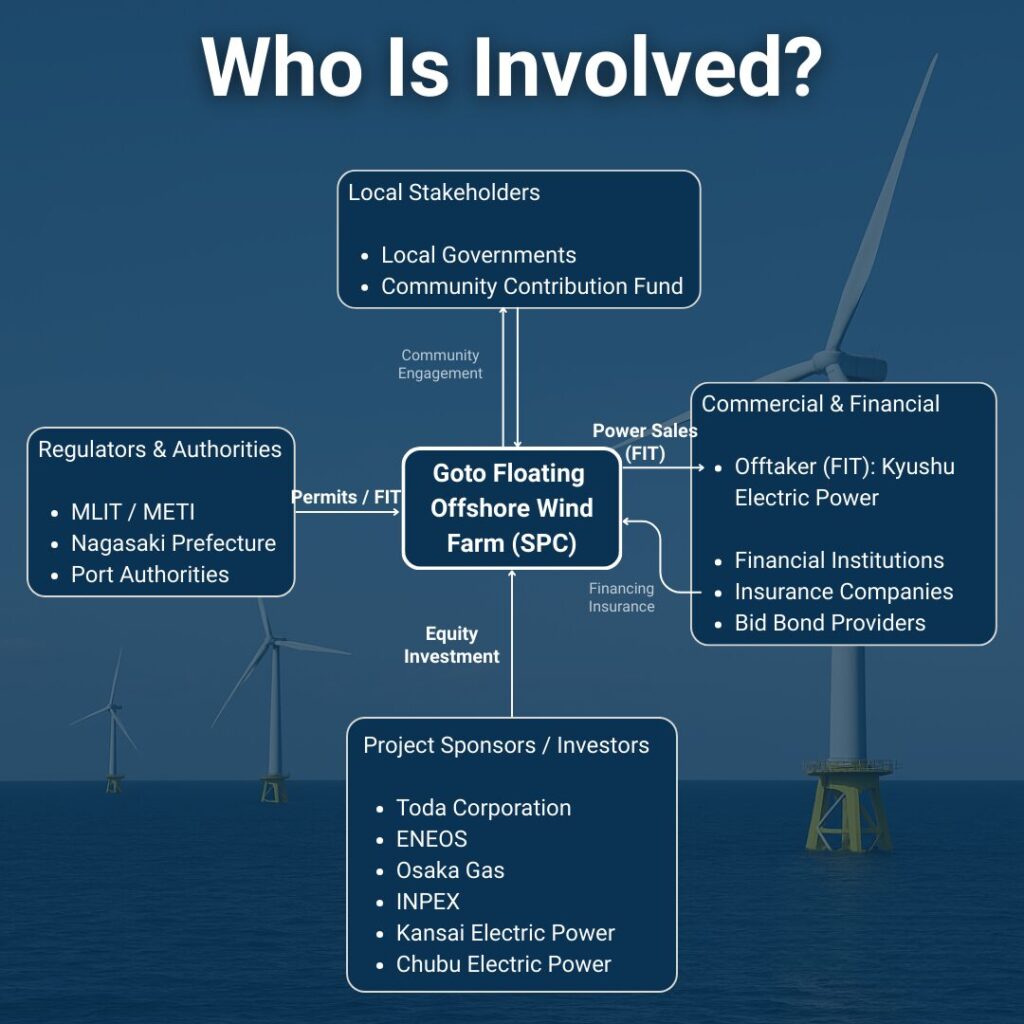
| Stakeholders | Toda Corporation, ENEOS, Osaka Gas, INPEX, Kansai Electric Power, Chubu Electric Power |
| Location | Offshore Goto City, Nagasaki Prefecture |
| Type | Floating Offshore Wind Power (Hybrid Spar-Type, Three-Point Mooring System) |
| WTG | Hitachi |
| Price | 36 JPY/kWh |
| Capacity | 16.8 MW (2.1 MW × 8 turbines) |
| Start of Construction | July 2020 |
| COD | January 2026 – december 2043 |
1-1. Notes: Change in COD
According to Toda Corporation, COD of this project was originally scheduled for January 2024, but due to delays in the construction process caused by defects found in the floating structure during construction, an application was submitted to change the public occupancy plan to change the COD to January 2026, and was approved by METI on September 22, 2023.
2. Location
2-1. Sea & Geographical Features
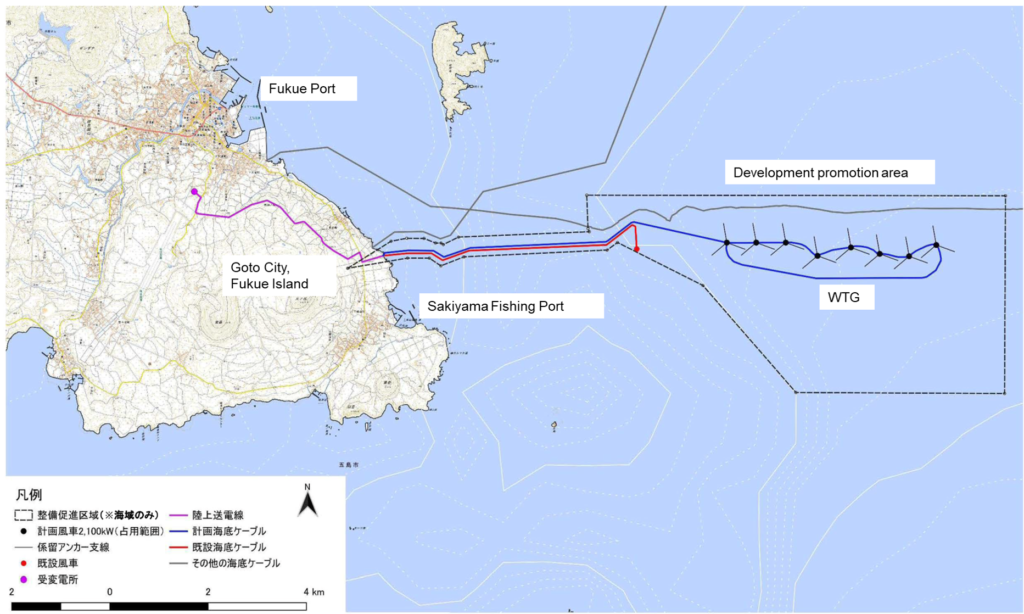
Located about 7 to 11 km off the coast of Sakiyama on Fukue Island in the Goto Islands, in an area with a depth of 120 to 135 m. This is Japan’s first commercial-scale floating project, and was designed to accommodate sea conditions in the path of a typhoon.
2-2. Port Infrastructure & Grid Connection
A construction yard was set up in Fukue Port, and the floating structure was constructed and launched. A submarine cable was planned to connect Goto to the Kyushu mainland power grid. Specialized construction materials for the installation of floating structures, such as large crane ships, were used.
3. Overview of Wind Power Facilities
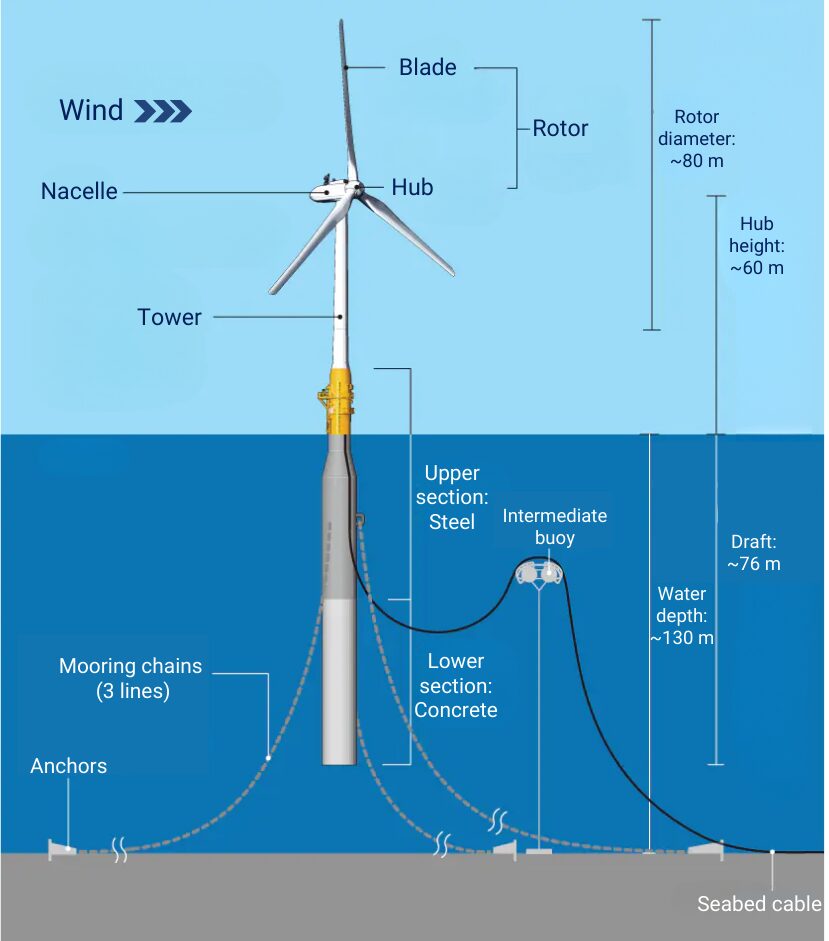
The hybrid spar-type floating foundation adopted for this wind farm features a structure with steel in the upper section and concrete in the lower section.
The technology was designed and constructed by Toda Corporation, the lead company of the project SPC, and represents the world’s first commercial application of this hybrid spar concept.
(Source: Toda Corporation official website)
4. Consortium Members
Toda Corporation (Lead Company)
Business Overview:
Comprehensive construction and engineering services, including research, planning, design, supervision, and construction of building and civil engineering projects; integrated engineering and consulting services; research, planning, design, supervision, and construction related to regional and urban development; real estate sales, leasing, brokerage, management, and appraisal; and power generation businesses utilizing renewable energy sources.
ENEOS Renewable Energy Corporation
Business Overview:
Preliminary studies, planning, design, procurement and sales of related equipment and materials, civil works, electrical works, construction, operation, and maintenance of power generation plants (including wind power, solar power, biomass power, and other renewable energy generation), as well as electricity sales.
Osaka Gas Co., Ltd.
Business Overview:
Manufacture and sale of gas, and generation and sale of electricity.
INPEX Corporation
Business Overview:
Exploration, development, production, and sales of oil, natural gas, and other mineral resources in Japan and overseas, as well as the development of new energy businesses including renewable energy, hydrogen, carbon capture and storage (CCS), and methanation technologies.
Kansai Electric Power Company, Incorporated
Business Overview:
Electric power business, heat supply business, telecommunications business, gas supply business, and related services.
Chubu Electric Power Co., Inc.
Business Overview:
Renewable energy business, nuclear power business, overseas business, and community support–related infrastructure businesses.
5. Project Implementation Structure
6. Project Timeline
6-1. Overall schedule
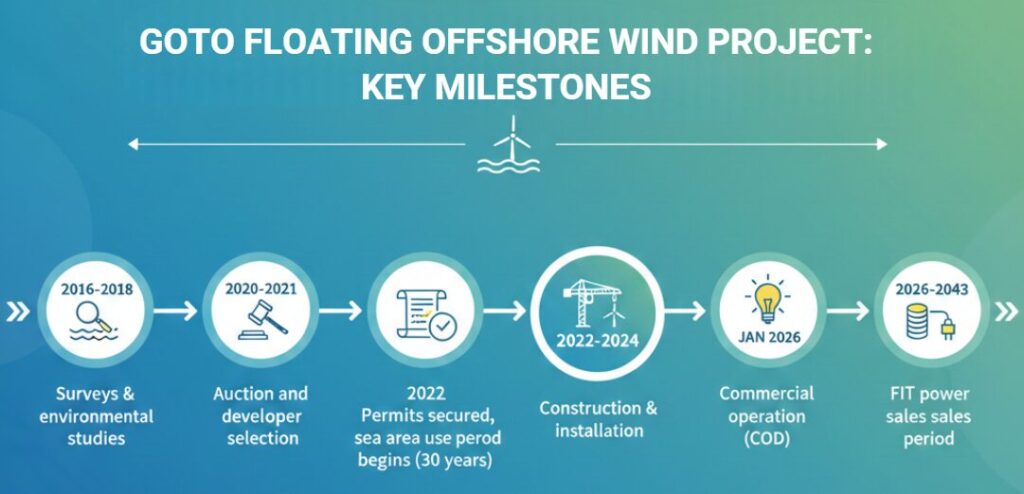
Development Phase (2016–2022)
- Environmental impact assessments, wind conditions, wave, and seabed geological surveys
- FIT approval and permitting processes
- Local stakeholder briefings and consensus-building
- June 2021: Project operator selected
- June 2022: Construction plan submitted
Construction Phase (2020–2025)
- July 2020: Onshore construction commenced
- July 2022: Offshore construction commenced
- 2025: Wind turbine assembly and installation scheduled
Operation & Maintenance Phase (2026–2043)
- Jan 2026: COD
- Wind turbines: Regular inspections and repairs through remote monitoring and on-site checks
- Floaters: Inspections of the platform structure, mooring system, and anchors
Turbine Decommissioning & Reuse Phase (2044–2051)
- January 2044: Decommissioning work begins
- 2051: Occupancy period of the promotion zone ends
6-2 EIA status
| 事業名称 Project name | 事業者名 Developer | 手続段階 EIA Stage | 容量 Capacity | 基数 Turbines | 出力 Rating | 更新日 Last Updated |
|---|---|---|---|---|---|---|
| (仮称)五島市沖洋上風力発電事業 Goto City Offshore Floating Wind Power Project | 戸田建設株式会社 Toda Corporation | 評価書 Final EIA Report | Up to 22MW | 8 | 2.1MW | 2025/07/07 |
Source: Environmental Impact Assessment Case Information (Ministry of the Environment, Japan)
7. Business Scheme
Electricity generated by a floating offshore wind farm off Goto City is supplied to local consumers through a designated wholesale supply scheme and a regional aggregator, enabling local production for local consumption of renewable energy.
Generation
Renewable electricity is generated by the Goto Floating Wind Farm using floating offshore wind turbines off the coast of Goto City.
Aggregation & Procurement
Floating Wind Aggregation (FWA) procures the electricity from the wind farm through the designated wholesale supply scheme, while managing environmental attributes and origin certification.
Supply
The electricity is delivered via a local retail electricity provider to specific consumers within Goto City, including public facilities and commercial users.
Key Feature
By combining the FIT scheme with designated wholesale supply, the model enables local consumption of locally generated renewable electricity, supporting Goto City’s decarbonization goals.
8. LCOE and IRR Estimation
Evaluating the bankability of offshore wind projects requires close attention to key cost indicators such as LCOE (Levelized Cost of Energy) and IRR (Internal Rate of Return). However, in Japan’s Promotion Zones, detailed project-level cost information remains limited in publicly available materials. As a result, investors and developers often lack sufficient data to form a fully informed assessment.
To address this gap, DeepWind applies a proprietary cost model using representative site conditions for each project, including wind resource (capacity factor), water depth, distance to port, and distance to grid connection point. Based on these input parameters, we estimate CAPEX, OPEX, LCOE, and IRR in a consistent framework.
This approach allows us to provide a cross-project comparison of the relative economic positioning of Japan’s Promotion Zone projects.
▶ For the latest model assumptions and updated relative positioning, please refer to the cost analysis Pillar article below.
👉 Cost Realities of Japan’s Offshore Wind: Analyzing LCOE and IRR Across 12 Promotion Zones (Latest Edition)
9. Key Features of the Project
9-1. Innovative Technology
The hybrid spar-type floating platform used in this project is uniquely designed to withstand deep waters and typhoon-prone regions. Each turbine, with a capacity of 2,100 kW, incorporates cutting-edge engineering to maximize efficiency and durability.
9-2. Construction Plan
- Manufacturing:
Steel components are constructed in Nagasaki Prefecture’s shipyards, leveraging local expertise in maritime engineering.
Concrete float components are fabricated locally to boost cost efficiency and involve regional construction firms. - Assembly and Installation:
Components are assembled at the Fukue Port in Goto City before being transported to designated offshore sites for installation.
9-3. Economic and Regional Impact
The project actively contributes to the local economy through:
- Procurement of construction materials and services from regional businesses.
- Employment opportunities during construction and operation phases.
- Strengthening local supply chains and maritime infrastructure.
9-4. Environmental and Social Harmony
This project includes measures to monitor and mitigate environmental impacts, such as:
- Ongoing assessments of marine ecosystems, including fish populations and seabird activities.
- Collaborative efforts with local fishermen and stakeholders to ensure coexistence with existing marine activities.
Conclusion
The Goto City Offshore Floating Wind Farm is part of Japan’s broader strategy to achieve carbon neutrality by 2050. By setting a benchmark in floating offshore wind technology, the project aims to attract further investments and inspire similar developments in other regions. Through technological advancements, local collaborations, and environmental stewardship, the project paves the way for a sustainable and energy-independent future.
To explore how this area compares nationally and understand Japan’s offshore wind roadmap, visit:
Promotion Areas for Offshore Wind in Japan – 2025 Overview —
your guide to Japan’s offshore wind Promotion Areas.
The synchronized supply-chain bottleneck, quantified node by node, with a full sensitivity ranking and a bankability ladder of scaling conditions. Includes Simulator Professional (β) access to reproduce every figure on your own assumptions.Why Isn't Floating Wind Bankable in Japan Yet?
- 🔍Market Insights – Understand the latest trends and key topics in Japan’s offshore wind market
- 🏛️Policy & Regulations – Explore Japan’s legal frameworks, auction systems, and designated promotion zones.
- 🌊Projects – Get an overview of offshore wind projects across Japan’s coastal regions.
- 🛠️Technology & Innovation – Discover the latest technologies and innovations shaping Japan’s offshore wind sector.
- 💡Cost Analysis – Dive into Japan-specific LCOE insights and offshore wind cost structures.