Published: February 4, 2026 | Updated: March 12, 2026
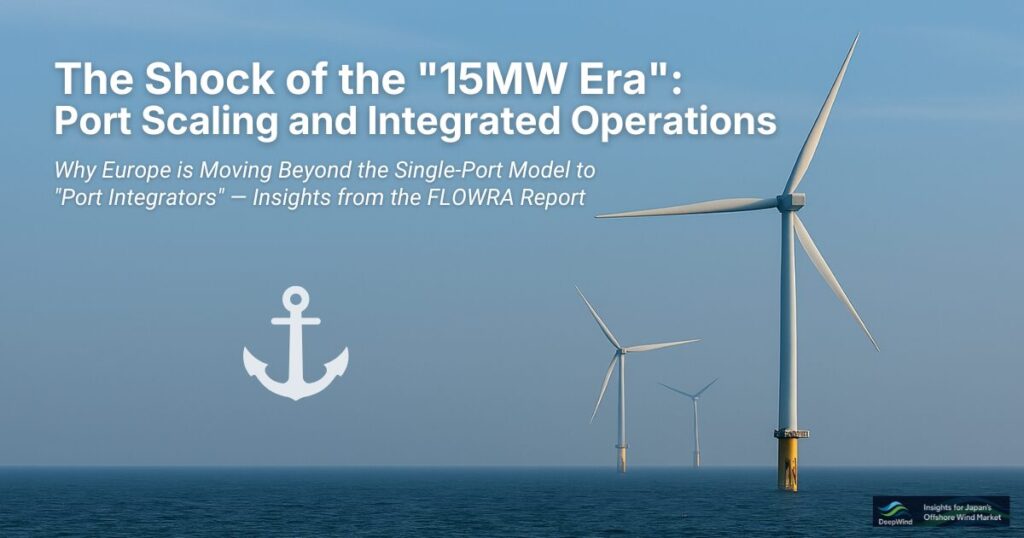
On January 14, 2026, during the “2nd Study Group on Port Infrastructure for Offshore Wind Power,” the Floating Offshore Wind Technology Research Association (FLOWRA) submitted a pivotal report. Based on extensive field research in Europe, the document lays bare the “upsizing reality” and “structural shifts in the supply chain” facing the floating offshore wind industry.
In this article, DeepWind analyzes the technical and strategic insights from the report. Why is the “single-port model” being rejected in Europe? Why do concrete floaters require ground bearing capacity of “50 tons per square meter”? And what exactly is the “Port Integrator” model that Japan needs to emulate?
The topics covered in this article are part of a broader analysis examining floating offshore wind from a structural perspective — spanning technology, costs, regulations, and project viability. For a comprehensive overview, see the full guide below.
👉 Floating Offshore Wind in Japan|A Structural Guide to Markets, Costs & Policy
1. The Cold Reality of the Turbine Market: A World where “15MW” is Standard
The first reality to face is the relentless upsizing of wind turbines. According to the FLOWRA report, orders for Siemens Gamesa and Vestas since 2021 have shifted entirely to the “14-15MW class.”
Specifically, Siemens Gamesa’s “SG 14 series” and Vestas’ “V236 15.0 MW” have become the mainstays. For European developers, these are no longer “challenging new models” but the “default” choice.
Crucially, neither company has announced plans to manufacture “dedicated floating turbines” at this stage. This means floating projects must accommodate the same massive nacelles and blades as bottom-fixed projects.
This places immense pressure on port infrastructure. Floating foundations do not make the turbine lighter or smaller. Instead, to support a 15MW giant on unstable waters, the floater structure itself inevitably becomes more massive and heavier. Japan’s port planning must redefine its specs based on this “15MW + Floater” operational set.
2. Port Specs by Method: Steel vs. Concrete
Floating offshore wind primarily utilizes “Steel” or “Concrete” approaches. The report outlines specific port requirements for each.
Steel Floaters: Manageable with Existing Upgrades?
For steel floaters (approx. 4,000 tons per unit), the required ground bearing capacity is cited as around 15 tons/sqm. This is generally achievable within existing heavy-load ports through reinforcement works.
However, the challenge is “space.” The report estimates that assuming a floater design of 100m x 100m, the assembly area alone requires 120m x 120m. Including component delivery routes and handling lanes, a vast site of nearly 20 hectares or more is required. Furthermore, load-out typically involves Self-Propelled Modular Transporters (SPMTs) loading onto semi-submersible barges, making the securing of traffic lines to the quay essential.
Concrete Floaters: Massive Infrastructure as the Cost of Local Content
Concrete floaters offer a significant advantage: they are “easy to involve local companies with.” Materials and formwork construction can generate economic ripples for the local construction industry.
However, the infrastructure requirements skyrocket as a tradeoff. When mounting a 15MW turbine, the total floater weight can reach 20,000 tons (5,000t steel rebar + 15,000t concrete). To build this onshore, piles must be driven and dedicated rails laid, requiring an extremely high ground bearing capacity of 50 tons/sqm or more.
Moreover, launching a completed 20,000-ton giant requires either sliding it down a slipway or utilizing dedicated facilities (like floating docks) at the quay side. Due to the enormous initial investment, the choice of construction method is being carefully weighed in Europe.
3. The Overlooked Bottlenecks: “Wet Storage” and “Commissioning”
Serious challenges have also emerged regarding “sea-side” infrastructure, not just the “land-side.”
Large Water Areas Don’t Guarantee Capacity: The “Density” Problem
After floater assembly or turbine installation, “Wet Storage” (temporary mooring) is needed for towing delays or weather evacuation. However, FLOWRA’s investigation reveals constraints beyond mere surface area.
In the case of Cromarty Firth in the UK, even with a water area sufficient for 70 units, safety margins (collision prevention distances, etc.) limit the actual mooring capacity to about 40 units. Maps may show vast waters, but usable capacity might be half that—optimistic estimates here could cause supply chain gridlock.
Additionally, “Pre-laid” mooring systems are essential for shortening installation time. The report notes that this requires suction or pile anchors capable of guaranteed holding power; cheap drag anchors are deemed unsuitable.
The Dilemma of “High Wind Commissioning”
Another critical point is “High Wind Commissioning.” Tests for stable operation near rated output or emergency stops can only be conducted at the offshore site where strong winds actually blow.
Accessing turbines under these conditions requires Construction Service Operation Vessels (CSOVs) with advanced motion compensation. In Europe, CSOVs are expected to cover wide ranges (e.g., from the North Sea to the Mediterranean). Strategic placement of “appropriate scale/location hubs” for these vessels is analyzed as a key factor in O&M efficiency.
4. The European Answer: The “Port Integrator” Model
Completing “manufacturing, assembly, installation, and load-out” for massive turbines and floaters at a single port is becoming physically and economically impossible. The report’s biggest strategic insight is the “departure from the single-port completion model.”
However, dispersing functions across multiple ports complicates logistics. It is inefficient and risky for power developers to coordinate individually with multiple port authorities. This has led to the rise of the “Multi-Port Operator (Port Integrator)” business model in Europe.
Separating Management and Operations: The French Example
The case of Port La Nouvelle in France is symbolic. The Occitanie Region (Port Landlord) invested approximately €490 million in infrastructure but outsourced actual operations to “SEMOP,” a public-private joint venture. SEMOP includes EUROPORTS, a private company with a track record of operating over 40 ports. By letting professionals handle operations while the government takes infrastructure risk, they successfully attract developers through flexible pricing and detailed services.
The Role of the Port Integrator
The “Multi-Port Operator” envisioned in Europe is not merely a facility lessor. According to the report, they are expected to undertake the following advanced functions:
• Unified Interface: Integrated management of supply chains across multiple ports, serving as a single contact point for developers.
• Attracting Long-term Investment: Aggregating demand over 10-25 year spans to induce infrastructure investment that market forces alone cannot drive.
• Vessel Packaging: Long-term chartering of critical vessels (semi-submersible barges, CSOVs, etc.) that are feared to be in short supply, providing them as a package to projects.
In short, they act as “Comprehensive Logistics Solution Providers,” providing port and vessel infrastructure as a set and shouldering project risks.
5. DeepWind View: Japan Needs Its Own Integrators
FLOWRA’s report is a wake-up call for Japan’s offshore wind industry. With the adoption of 15MW turbines becoming inevitable, there is no time left to debate at the level of inter-municipal competition over “which port gets selected.”
What is needed is the cultivation of “Japanese Port Integrators” that oversee port functions across entire regions (e.g., all of Kyushu or Tohoku) and organically link manufacturing, assembly, wet storage, and O&M bases. The government builds the hardware (quays), and the private sector handles the software (integrated operations/vessel arrangement). Establishing this public-private scheme early will be key to launching floating offshore wind in Japan with cost competitiveness.
[References] This article is based on the “Report on Hearing Results in Europe” submitted by FLOWRA at the “2nd Study Group on Port Infrastructure for Offshore Wind Power” held on January 14, 2026.
The topics covered in this article are part of a broader analysis examining floating offshore wind from a structural perspective — spanning technology, costs, regulations, and project viability. For a comprehensive overview, see the full guide below.
👉 Floating Offshore Wind in Japan|A Structural Guide to Markets, Costs & Policy
Why Isn't Floating Wind Bankable in Japan Yet?
The synchronized supply-chain bottleneck, quantified node by node, with a full sensitivity ranking and a bankability ladder of scaling conditions. Includes Simulator Professional (β) access to reproduce every figure on your own assumptions.
See the full analysis →