Published: December 18, 2025 | Updated: December 24, 2025
Introduction
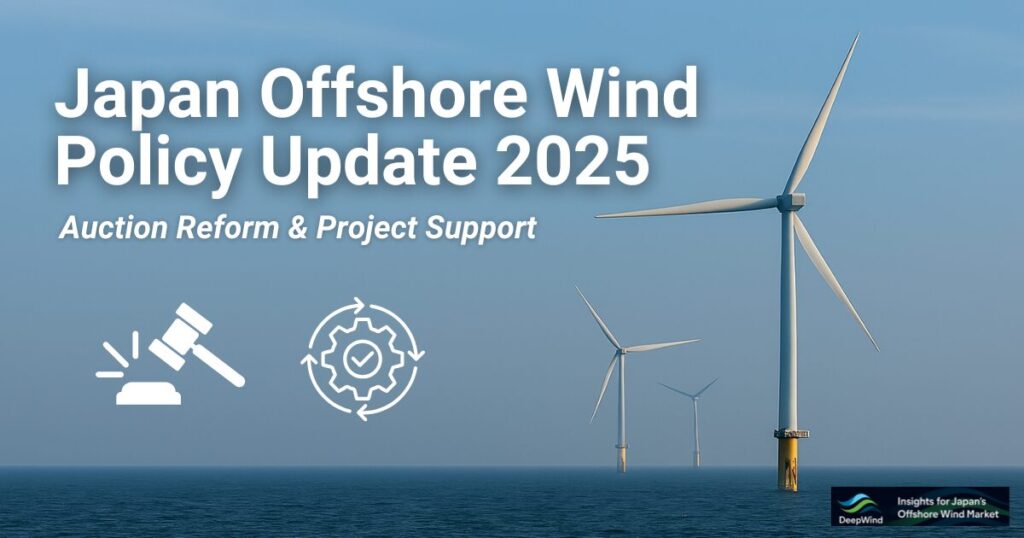
Between November and December 2025, a series of policy updates were announced concerning Japan’s offshore wind sector, covering both reforms to the auction system and new measures to improve the project execution environment.
At first glance, these may appear to be a collection of separate institutional adjustments. However, when read together, they reveal a clearer shift in policy priorities and underlying concerns on the government side.
This article does not treat auction reform—how developers are selected—and project environment measures—how selected projects are supported—as separate topics. Instead, it examines them as a single, integrated policy package, and explores what these changes mean for Japan’s offshore wind market.
While this article focuses on a specific topic, those looking to understand Japan’s overall offshore wind policy and regulatory framework should also read our comprehensive summary here:
👉 Japan’s Offshore Wind Policy & Regulatory Framework Explained
1. Policy concerns behind the system reform
Japan’s offshore wind auction system has, to date, delivered a certain level of success from an institutional design perspective.
Highly competitive bidding drove supply prices down significantly, and from the standpoint of limiting public burden, the system can be said to have produced tangible results.
At the same time, a number of external factors have emerged in recent years.
• Global inflation
• Exchange rate volatility, particularly yen depreciation
• Rising interest rates
• Sharp increases in turbine and construction costs
Against this backdrop, the withdrawal of a Round 1 offshore wind project made clear that being selected through an auction does not necessarily guarantee that a project will ultimately reach completion.
The latest policy revisions can be understood as a direct response to this gap between auction outcomes and project deliverability.
2. Auction system reform: redefining the role of price competition
Approach to supply pricing
In the recent policy documents, the traditional concept of a “minimum supply price” has been replaced by the notion of an “indicative supply price range.”
This shift does not imply the introduction of rigid price controls. Rather, it can be interpreted as an attempt to discourage unrealistic underbidding and to indicate price levels that are considered reasonable from the perspective of project completion.
Accordingly, attention is moving away from how low a bid price is in absolute terms, and toward whether that price is based on assumptions that can realistically support the delivery of the project.
Greater emphasis on execution capability
The direction of the evaluation framework itself has also been clarified.
Rather than focusing on formal score accumulation or the apparent completeness of submitted documents, the system places greater weight on practical execution capability, including the following elements.
• Robustness of the financial plan
• Security of the supply chain
• Realism of construction and O&M plans
• Identification of risks and corresponding mitigation measures
The policy documents also explicitly note the strengthening of review structures through the involvement of external experts and third-party perspectives.
Repositioning of schedule-based evaluation
In past auctions, early commercial operation dates were treated as a key evaluation factor.
In practice, however, many bidders proposed similar timelines, making it difficult for schedule-related criteria to meaningfully differentiate between projects.
The latest revisions reduce the weighting assigned to schedule-based evaluation and rebalance it against other criteria.
While speed remains important, it is no longer positioned as the sole or dominant competitive axis.
3. Project environment measures: addressing post-selection risks
Auction system reform primarily affects future projects. In contrast, the project environment measures are intended to address the challenges faced by projects that have already been selected.
Use of the Long-term Decarbonized Power Auction
For Round 2 and Round 3 offshore wind projects, the government has indicated that participation in the Long-term Decarbonized Power Auction may be permitted under certain conditions.
Specifically, projects are expected to shift to a zero-premium structure, with the supply price set at JPY 0/kWh, while avoiding double recovery under the FIP scheme. In return, projects can secure capacity revenues over a 20-year period, thereby improving revenue stability.
At the same time, the policy documents emphasize that this measure is exceptional and temporary, and is not intended to be generalized to future auction rounds.
Limits of the price adjustment scheme
Requests from developers to retroactively reflect inflation impacts back to the start of the auction period have not been accepted, and this position remains unchanged.
The reasons cited include the fact that such retroactive adjustments would alter the assumptions underlying the original competitive outcome, as well as concerns regarding fairness and consistency within the overall制度 framework.
Accordingly, support measures are positioned as responses to future uncertainties, rather than mechanisms to revisit or rewrite past auction results.
Flexible treatment of changes to approved project plans
One of the most substantive aspects of the recent policy package concerns the treatment of changes to approved occupancy and project plans.
For Round 2 and Round 3 offshore wind projects, flexibility may be granted on a case-by-case basis, even where proposed changes result in lower evaluation scores or schedule delays, provided such changes are deemed unavoidable for the continuation of the project.
At the same time, safeguards are maintained through the involvement of third-party committees, as well as checks on potential impacts on auction fairness and the public interest.
Separating “rescue measures” from precedents
The series of measures outlined above are intended to ensure the completion of Round 2 and Round 3 offshore wind projects, and are not designed to relax the auction framework as a whole.
While priority is given to enabling existing projects to reach completion, a clear distinction is maintained to ensure that the competitive rules governing future auctions remain intact.
Conclusion (DeepWind perspective)
The recent policy revisions should not be interpreted as a rejection of competition.
Rather, they reflect a reassessment of what kind of competition should be encouraged within Japan’s offshore wind market.
In addition to price levels, increasing attention is being paid to whether projects can realistically be built, operated, and sustained over time.
While these changes may involve short-term adjustment costs, they can also be viewed as a step toward strengthening the credibility and long-term resilience of Japan’s offshore wind market.
Reference
Reference materials
・New Auction Framework to Ensure the Completion of Offshore Wind Projects (December 17, 2025, METI)
・Project Environment Measures to Ensure the Completion of Offshore Wind Projects (December 17, 2025, METI)
For a broader understanding of Japan’s offshore wind legal system, policy structure, and support measures, be sure to check out our pillar article:
🌊 Japan’s Offshore Wind Policy & Regulatory Framework Explained
Why Isn't Floating Wind Bankable in Japan Yet?
The synchronized supply-chain bottleneck, quantified node by node, with a full sensitivity ranking and a bankability ladder of scaling conditions. Includes Simulator Professional (β) access to reproduce every figure on your own assumptions.
See the full analysis →