As climate change mitigation and energy security are increasingly being questioned at the same time, making renewable energy a primary power source has become a shared global challenge. Among these, offshore wind power has been positioned as a “core technology for decarbonization,” given its relatively stable generation characteristics and its potential for large-scale deployment.
In Japan, however, the sea areas where conventional fixed-bottom offshore wind can be expanded at scale are limited. This is because fixed-bottom foundations—generally suitable for relatively shallow waters of around 50–60 meters—cannot sufficiently utilize the deepwater areas that surround the Japanese archipelago. Approximately 99% of Japan’s surrounding waters fall into depth conditions that are unfavorable for fixed-bottom offshore wind, meaning this constraint exists as a “geographic precondition” that comes even before policy design or technological choices.
Against this backdrop, what has regained attention in recent years is floating offshore wind. In this article, we examine floating offshore wind not merely as an advanced technology, but by organizing it through a structural lens that includes markets, costs, policy/regulation, and commercial viability, and we provide a systematic overview of the current situation and future outlook in Japan and globally.
Why Floating Offshore Wind — and Why Now?
The reason floating offshore wind is often described as the “next game changer” lies not only in technological progress, but also in macro drivers such as rising geopolitical risk and the reconfiguration of energy supply structures. In particular, for Japan—where dependence on fossil fuels remains high—the importance of offshore wind as a means to increase the share of domestically available energy has been growing year by year.
A more detailed explanation of this context, including global market trends, is covered in the following article.
👉 Why Floating Offshore Wind Now? | Background and Market Context
Structural Drivers Making Floating Offshore Wind Unavoidable
Deepwater as an Untapped Energy Resource
The waters around Japan are characterized by steep seabed topography, with large areas exceeding 100 meters in depth. While Japan’s theoretical offshore wind potential is often cited as exceeding 100 GW, only a portion of that resource is accessible with fixed-bottom technology. Floating offshore wind is the only practical means of unlocking deepwater resources that could not previously be utilized as a source of energy supply.
Social Acceptance and EEZ Expansion
Floating offshore wind can be installed farther offshore, which can relatively mitigate social acceptance challenges such as visual impact, noise, and competition with fisheries. In addition, amendments to Japan’s legal framework governing the use of sea areas for renewable energy have made it institutionally possible to deploy projects in the EEZ (Exclusive Economic Zone), greatly easing spatial constraints.
That said, opening access to the EEZ does not imply “automatic commercialization.” Constraints related to costs, construction execution, and financing—discussed later in this article—still remain decisive.
Linkage with Global Markets
Floating offshore wind is not a challenge unique to Japan. Similar adjustments are ongoing in Europe, the United States, and across Asia—each grappling with the gap between “technical feasibility” and “commercial bankability.” Understanding the global deployment phase is essential for putting Japan’s market into perspective.
👉 A Detailed Analysis of Floating Offshore Wind Market Trends in Japan and Globally
An Overview of Floating Platform Technologies
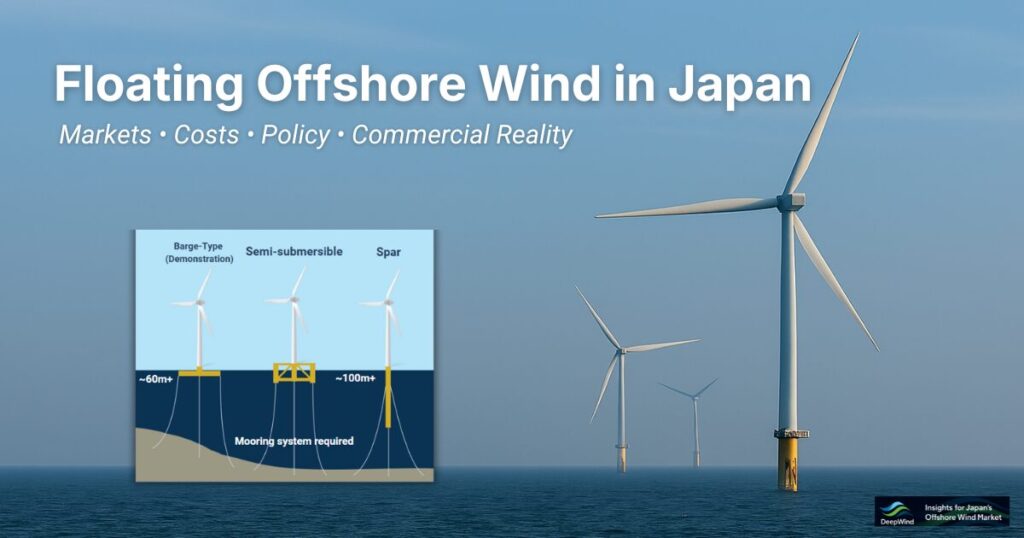
The core of floating offshore wind lies in floating platform design that enables stable power generation under harsh metocean conditions. The critical requirement is to balance “static stability”—driven by the relationship between the center of gravity and the center of buoyancy—with “dynamic stability,” which suppresses motion induced by waves and wind.
The four platform types most commonly considered today are as follows.
- Semi-submersible: Suitable for mid-depth waters; relatively high constructability and flexibility
- Spar: Suitable for deep water; highly stable, but strongly constrained by port and draft requirements
- Barge: Structurally simple, but requires robust motion-mitigation measures
- TLP (Tension Leg Platform): High efficiency, but with a high level of installation complexity
The “fit” of each platform type is not determined by technical characteristics alone. Port conditions, construction capabilities, and risk allocation can fundamentally change which designs are commercially suitable.
👉 Floating Offshore Wind Platform Design: Fundamentals and Key Types
The Cost Structure and LCOE Reality of Floating Offshore Wind
The largest barrier to commercialization of floating offshore wind is not simply “high cost,” but rather the fact that its cost structure is fundamentally different from that of fixed-bottom offshore wind. While floating projects do have room for reductions across individual CAPEX and OPEX components, structurally “sticky” cost elements still push up overall LCOE.
CAPEX: Where Costs Can Fall — and Where They Do Not
CAPEX for floating offshore wind can be broadly decomposed into (1) the turbine, (2) the floating structure, (3) mooring and anchors, (4) construction and installation, and (5) grid connection infrastructure. Among these, the turbine has many common elements with fixed-bottom projects and is a category where cost reductions are relatively expected through turbine upscaling and scale effects.
By contrast, floating structures and mooring systems are highly site-dependent, which limits the effectiveness of standardization and mass production. During the construction and installation phase, towing and placement schedules are strongly dependent on weather conditions, raising CAPEX through contingency allowances and EPC risk premiums that reflect schedule-delay risk.
A Critical Lens on Cost Projections
When discussing floating offshore wind costs, the key discipline is separating “costs will fall” optimism from “where costs cannot fall” realism. Understanding this structure correctly is what enables sound commercial judgment, avoiding both over-optimism and underestimation.
For a detailed cost breakdown and LCOE analysis, see the following articles.
👉 The Real Cost Structure and LCOE of Floating Offshore Wind
👉 Floating Offshore Wind | Post-2030 Technology and Market Trends
Ports and Construction Capacity: The Binding Constraint on Commercialization
Beyond technology and cost, what most concretely constrains floating offshore wind commercialization is port infrastructure and construction execution capacity. A series of critical industry and government reports published in 2025–2026 has now quantified Japan’s real limitations in this area with unprecedented specificity.
What the 15MW Era Demands from Ports
The 15MW-class turbines becoming mainstream in floating offshore wind demand port capabilities that even leading European facilities struggle to meet. The FLOWRA (Floating Offshore Wind Technology Research Association) European port survey submitted in January 2026 offers direct implications for the scale of port investment Japan will need.
👉 Floating Wind Port Strategy in the 15MW Era: A Deep Dive into the FLOWRA Report
Japan’s Typhoon Reality: The “10-Day” Construction Loss
Japan’s most distinctive construction risk is the typhoon. According to FLOWCON’s (Floating Offshore Wind Construction System Technology Research Association) construction simulation, a single typhoon passage generates over 10 days of lost time—8 days for evacuation and 2 days to resume operations. Summer months offer the highest workability at around 70%, but overlap entirely with typhoon season, creating a structural dilemma that cuts to the heart of Japan’s construction planning.
👉 Japan’s Floating Wind Reality: The “10-Day” Typhoon Risk & FLOWCON Report Analysis
MLIT’s 1GW Port Capacity Analysis: Pacific vs. Sea of Japan
Japan’s Ministry of Land, Infrastructure, Transport and Tourism (MLIT) has modeled the port facility scale required to achieve 1GW of floating offshore wind, revealing a structural gap in construction capacity between the Pacific and Sea of Japan coasts—with Sea of Japan projects facing construction timelines up to 50% longer. This analysis is essential reading for understanding regional viability and the direction of port investment priorities.
👉 MLIT Report: 50% Longer Construction Time for Sea of Japan Floating Wind Projects
Why Floating Offshore Wind Can Be Technically Feasible Yet Still Not Commercial
In Japan, the technical feasibility of floating offshore wind has been largely confirmed through demonstration projects. Yet commercialization remains limited—and the reason is not simply high costs or immature technology. The core issue is a structural disconnect between “technical readiness” and “commercial bankability.”
This disconnect becomes visible only when projects attempt to scale. Port infrastructure bottlenecks, construction risk allocation, and Japan-specific natural hazards (typhoons, earthquakes) combine to produce an assessment of “technically sound, but commercially immature as an integrated system.” This is not the failure of any individual developer—it is a market-wide structural challenge.
A review of Japan’s domestic demonstration projects reveals this pattern recurring consistently.
👉 Floating Offshore Wind: Demonstration Project Case Studies and Key Lessons
Common Patterns Emerging from Domestic and International Project Examples
Domestically, floating offshore wind demonstrations have advanced off the coasts of Goto and Akita. These have produced meaningful technical results while also clarifying the constraints that emerge at commercial scale.
Internationally, pioneering projects have emerged under different regulatory and market conditions. One case that stands out is the export of Japanese floating wind technology abroad.
👉 Japanese Floating Wind Technology Goes Global | The Brazil Aura Sul Project
Policy, Certification, and Japan-Specific Risks
Floating offshore wind in Japan requires navigating multiple regulatory layers—including the amended Act on Promoting the Use of Sea Areas for Renewable Energy, IEC standards, and third-party certification. Japan-specific risks from typhoons, earthquakes, and tsunamis further affect design requirements, financing terms, and insurance costs.
👉 Japan’s Floating Offshore Wind | Regulatory Framework and Certification Challenges
The Post-2030 Technology & Market Roadmap (A Practical View)
The path forward for floating offshore wind after 2030 will not follow a simple straight line from demonstration to commercial scale. The critical question is whether the pace of technology evolution can synchronize with practical conditions in ports, construction, and financing.
Technology advances only incrementally; port and construction capacity sets the ceiling on scale; and financing conditions improve only on the basis of demonstrated track records. Taken together, the post-2030 floating wind market is best understood not as a sudden breakthrough, but as a market that expands quietly, one viable project at a time.
👉 Japan’s Floating Offshore Wind | Technology and Challenges for EEZ and Extreme-Condition Deployment
Who Is Best Positioned for Floating Offshore Wind? (By Player Type)
Floating offshore wind is not uniformly attractive for all players. While its potential is widely discussed, actual commercial viability varies significantly by balance sheet strength, risk tolerance, and execution capability.
- Major utilities and integrated energy companies: Long-term perspective and grid/O&M expertise are strengths. Policy uncertainty remains a key constraint.
- General contractors, shipbuilders, and marine engineers: Well-suited as EPC and supply-chain players. Taking on development risk directly can lead to overexposure.
- Trading companies and infrastructure investors: Selective, later-stage participation in projects with clear policy frameworks is the realistic approach. Over-commitment to early-stage demonstration is a risk.
- International developers and technology holders: Partnership with domestic players is essential. Direct replication of European business models is unlikely to succeed.
- Poor fit: Players entering on the assumption of short-term returns or rapid cost reduction trajectories comparable to fixed-bottom offshore wind.
Conclusion | Floating Offshore Wind as a “Conditional Commercial Reality”
Floating offshore wind represents one of Japan’s most theoretically significant energy options—a technology capable of simultaneously advancing energy self-sufficiency and decarbonization by opening up the country’s vast deepwater resource. But as this article has shown, floating offshore wind is also a sector where technology readiness alone does not translate into commercial deployment. Cost structure, port and construction capacity, financing conditions, and policy design must all align simultaneously for commercialization to advance.
From 2026 onward, quantitative data from industry consortia—FLOWRA, FLOWCON—and government agencies like MLIT has begun to serve as a concrete, evidence-based foundation for port investment decisions, construction planning, and policy design. Reading these numbers accurately is a prerequisite for sound decision-making in the next phase.
Floating offshore wind is not “a dream technology that will inevitably bloom.” It is, more precisely, a conditional commercial reality—one that expands only where and when the enabling conditions are in place. DeepWind will continue to analyze this sector not through the lens of expectation, but through the lens of structure.
📘 DeepWind Premium Report
Round 4 Is Not a Reset.
A concise, decision-oriented structural brief on what actually changed —
and what remains structurally broken.