Published: February 1, 2025 | Updated: October 7, 2026
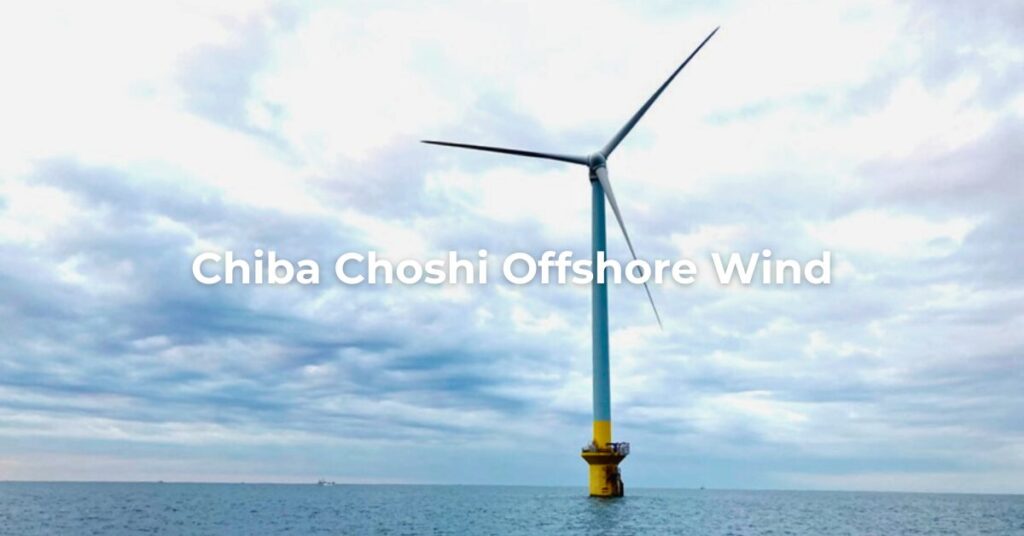
Offshore Choshi City, Chiba Prefecture is a designated Promotion Zone under Japan’s Renewable Energy Sea Area Utilisation Act. A developer was selected in Round 1 of Japan’s offshore wind auctions, but that developer withdrew in August 2025 and the project has not proceeded. Neither the timing nor the terms of the re-tender have been published (as of September 2026).
This article sets out the conditions of the zone itself, the sea area, water depth, wind resource, ports and grid connection, alongside what Round 1 planned and why it stopped. Items that the re-tender will decide are marked TBD.
➡ For an overview of all ten Promotion Areas as of 2025, see:
Promotion Areas for Offshore Wind in Japan – 2025 Overview
1. Zone Profile and Re-tender Status
This area remains a designated Promotion Zone, but the developer selected in Round 1 withdrew in August 2025. Neither the timing of the re-tender nor the terms of the occupancy guidelines have been published (as of September 2026). The developer, price, equipment configuration and schedule are therefore undetermined, and the table below marks them TBD. Round 1 figures are kept as a record of what was planned before the withdrawal, not as an input to the re-tender.
| Project name | Offshore Choshi City, Chiba Prefecture (Promotion Zone) Round 1 project name: Chiba Choshi Offshore Wind |
| Developer | TBD, pending the re-tender Round 1: Chiba Choshi Offshore Wind LLC (withdrawn) |
| Partners | TBD, pending the re-tender Round 1: Mitsubishi Corporation Offshore Wind Ltd.C-TECH CORPORATIONMitsubishi Corporation (withdrew in August 2025) |
| Location | Offshore CHoshi City, Chiba Prefecture |
| Type | Fixed-bottom Offshore Wind Power |
| WTG | TBD Round 1 plan: GE |
| Price | TBD Round 1 awarded price: 16.49 JPY/kWh |
| Capacity | TBD Round 1 plan: 403 MW (13 MW x 31 turbines) |
| Start of Construction | TBD Round 1 plan: 2025 |
| Start of Operation | TBD Round 1 plan: September 2028 |
2. Location
2-1. Sea & Geographical Features
The Pacific coast is an area where the Kuroshio Current (warm current) and the Oyashio Current (cold current) meet, and the wind conditions are good. The ocean floor is shallow, making it possible to set up the device at a relatively shallow depth (up to about 20m).
2-2. Port Infrastructure & Grid Connection
Under the Round 1 plan, construction was to use Kashima Port in Ibaraki Prefecture, with the operation and maintenance base at Naarai Port in Choshi City. It was planned to connect to Tokyo Electric Power Company PG’s Shin-Sawara substation to transmit electricity to the Tokyo metropolitan area.

3. Overview of Wind Turbine Facilities

4. Project Timeline & Development Phases
4-1. Overall schedule
- 2021 December: Project selected for development
- 2022-2024: Environmental impact assessments, seabed surveys, and project planning
- 2025 January: Onshore construction begins
- 2027 February: Offshore construction starts
- 2028 September: Expected commercial operation date
- 2052 January: Planned decommissioning and site restoration

The construction phase will take approximately three to four years, ensuring a well-structured and sustainable development process aligned with Japan’s energy transition goals.
4-2. EIA status
| 事業名称 Project name | 事業者名 Developer | 手続段階 EIA Stage | 容量 Capacity | 基数 Turbines | 出力 Rating | 更新日 Last Updated |
|---|---|---|---|---|---|---|
| (仮称)千葉県銚子市沖における洋上風力発電事業 Chiba Choshi Offshore Wind | 千葉銚子オフショアウィンド合同会社 Chiba Choshi Offshore Wind LLC | 準備書 Draft EIA report | Up to 403MW | 31 | 13MW | 2025/02/04 |
Source: Environmental Impact Assessment Case Information (Ministry of the Environment, Japan)
5. Reviewing the Business Plan from Scratch?
Mitsubishi Corporation announced that it had recorded an impairment loss of 52.2 billion yen for the April–December 2024 period due to a reassessment of its three domestic offshore wind projects. At a press conference, President Katsuya Nakanishi stated, “We take the impairment seriously” and indicated that the company will reconsider its future business policy from scratch.
5-1. Causes of the Impairment and Future Policy
Mitsubishi Corporation won bids for three projects in 2021 and has been developing them for about three years. However, due to global inflation, yen depreciation, and rising interest rates, project costs significantly exceeded expectations. As a result, the company is reassessing profitability, with a final decision on whether to continue the projects to be made in the future.
The company also explained that nearly all recorded assets have been written off, and although further impairment losses may occur, the impact would be limited.
5-2. Breakdown of the Impairment Loss
Expenses related to surveys, design, and permitting had been recorded as assets but are now entirely written off. The total of already-paid expenses and expected future costs amounts to 52.2 billion yen.
5-3. About the Bid Pricing
In the 2021 auction, Mitsubishi Corporation won the projects with significantly lower bids than its competitors. The company explained that the decision was based on risk analysis using the expertise of Eneco. However, higher-than-expected inflation and cost increases greatly impacted the projects’ profitability.
5-4. Future of the Offshore Wind Business
Mitsubishi Corporation recognizes offshore wind as a key power source for a decarbonized society. Going forward, it intends to carefully assess its business strategy in light of inflation, interest rates, and currency trends.
6. Mitsubishi-led Consortium to Exit Three Offshore Wind Projects in Japan-Aug 26th
Mitsubishi Corporation and partners withdrew from offshore wind projects across three sites off Chiba and Akita prefectures in August 2025.
6-1. Why Exit?
- Ultra-low bid prices during the auction
- Rising material and construction costs
- Projects deemed no longer economically viable
This marks a major setback for Japan’s flagship renewable energy program.
Re-tendering is expected, but the withdrawal highlights the challenges of balancing cost-competitive auctions with the realities of supply chain inflation and project financing.
6-2. Implications
- Investor confidence hinges on how the government resets its renewable energy policy
- Japan’s offshore wind strategy may face a significant review
- Timeline pressure toward the 2030 (10 GW) and 2040 (30-45 GW) national targets increases
7. LCOE and IRR Estimation
Evaluating the bankability of offshore wind projects requires close attention to key cost indicators such as LCOE (Levelized Cost of Energy) and IRR (Internal Rate of Return). However, in Japan’s Promotion Zones, detailed project-level cost information remains limited in publicly available materials. As a result, investors and developers often lack sufficient data to form a fully informed assessment.
To address this gap, DeepWind applies a proprietary cost model using representative site conditions for each project, including wind resource (capacity factor), water depth, distance to port, and distance to grid connection point. Based on these input parameters, we estimate CAPEX, OPEX, LCOE, and IRR in a consistent framework.
This approach allows us to provide a cross-project comparison of the relative economic positioning of Japan’s Promotion Zone projects.
▶ For the latest model assumptions and updated relative positioning, please refer to the cost analysis Pillar article below.
👉 Cost Realities of Japan’s Offshore Wind: Analyzing LCOE and IRR Across 12 Promotion Zones (Latest Edition)
What the Re-tender Has Yet to Settle
The developer selected in Round 1 withdrew in August 2025, and METI and MLIT published their analysis of why on 23 December 2025. The area remains a designated Promotion Zone, but neither the timing of the re-tender nor the terms of the occupancy guidelines have been published (as of September 2026).
The developer, the price, the equipment configuration and the operation date are therefore all undetermined. The Round 1 figures kept in this article record what was planned before the withdrawal; they do not indicate where the re-tender will land. The TBD entries above will be updated once the guidelines are issued.
The reasons for the withdrawal reach into the auction design itself. See 👉 Why Japan’s Offshore Wind Round 1 Ended in Withdrawal.
To explore how this area compares nationally and understand Japan’s offshore wind roadmap, visit:
Promotion Areas for Offshore Wind in Japan – 2025 Overview —
your guide to Japan’s offshore wind Promotion Areas.
Why Isn't Floating Wind Bankable in Japan Yet?
The synchronized supply-chain bottleneck, quantified node by node, with a full sensitivity ranking and a bankability ladder of scaling conditions. Includes Simulator Professional (β) access to reproduce every figure on your own assumptions.
See the full analysis →